



Last month, a regional delivery company's maintenance manager quit mid-expansion. They ran 147 vehicles across three states — box trucks, sprinter vans, some older diesel rigs. No documented procedures for who approves what repairs. No clear escalation path when a $12,000 transmission rebuild quote landed on someone's desk at 4 PM on a Friday.
The interim manager found handwritten notes stuffed in filing cabinets, WhatsApp threads between mechanics about which supervisor to call for overtime approval, and three different spreadsheets tracking the same maintenance schedules. Nobody knew if they were allowed to approve emergency repairs over $5,000. The CFO was getting invoices for work nobody remembered authorizing.
This wasn't incompetence. It was the absence of a fleet maintenance governance framework — the boring but essential structure that tells everyone who decides what, when things escalate, and how maintenance operations connect to financial planning.
The governance gap that kills fleet operations
Most fleet operations start simple. One person manages everything. They know every vehicle, approve every repair, handle vendor relationships. Works fine with 20 vehicles.
At 100 vehicles, that same person is drowning. They're making snap decisions about $300,000 in annual maintenance spend while juggling daily breakdowns. Critical decisions get delayed because nobody else has authority. Expensive mistakes happen because junior staff don't know when to escalate.
Small fleet grows. Original manager gets overwhelmed. Company hires more people but doesn't define roles clearly. Multiple people start making overlapping decisions. Costs spiral. Nobody tracks patterns. Financial planning disconnects from operational reality.
A trucking company I worked with discovered they were spending $847,000 annually on maintenance across 89 vehicles — about 30% more than similar fleets. The problem wasn't the mechanics or the vehicles. They had three supervisors independently approving repairs, no standardized decision process, and zero connection between maintenance decisions and capital planning. One supervisor would approve a $9,000 engine rebuild on a truck scheduled for replacement in four months.
Decision gates: who approves what (and when they shouldn't)
Clear decision authority prevents both bottlenecks and runaway spending. Most fleets need three to four decision levels, each with specific thresholds and override conditions.
Prevent costly breakdowns with proactive maintenance.
Fleetelyly helps you schedule, track, and manage every vehicle service efficiently.
- Automated maintenance reminders
- Real-time service tracking
- Parts inventory integration
No credit card required
Level 1: Shop floor decisions ($0-$500) Technicians and shop leads handle routine repairs, standard parts replacement, basic diagnostics. No approval needed for oil changes, tire rotations, brake pads on light vehicles. Immediate documentation required in the maintenance system.
Level 2: Supervisor approvals ($500-$5,000) Maintenance supervisors review anything beyond routine work. This includes major component repairs, transmission service on heavy vehicles, unexpected findings during preventive maintenance. They need visibility into vehicle history and remaining useful life.
Level 3: Management review ($5,000-$15,000) Fleet manager or operations director approves significant repairs. These decisions require cost-benefit analysis — repair cost versus replacement value, impact on route coverage, expected additional life from the repair. At this level, you're comparing options: rebuild, replace, or retire.
Level 4: Executive approval ($15,000+) CFO or senior leadership reviews major overhauls, multiple simultaneous repairs on single vehicles, or any repair exceeding 40% of vehicle book value. These aren't just maintenance decisions — they're capital allocation choices.
Static thresholds break down in practice though. A $3,000 repair on a 2022 Freightliner Cascadia is different from the same cost on a 2014 box truck with 380,000 miles. Smart frameworks add context layers:
-
Vehicle age multiplier (older vehicles need lower thresholds)
-
Criticality factor (revenue-generating vehicles get different treatment)
-
Cumulative spend triggers (third repair over $2,000 in 90 days triggers escalation)
-
Time-based overrides (emergency repairs at 2 AM follow different rules)
At the end of the day, decision gates should reduce ambiguity: who can say yes, who needs more information, and when finance should be pulled into the conversation.
Quarterly review rhythm: connecting maintenance to money
The quarterly maintenance review is where operational reality meets financial planning. Most companies either skip these entirely or run unfocused meetings that produce no actionable decisions.
An effective quarterly review follows a specific sequence. Start with performance metrics from the previous quarter — not just costs, but reliability rates, breakdown frequencies, vendor performance. Then examine upcoming maintenance needs against available budget. Finally, make explicit tradeoff decisions about what gets funded.
Week 1 of quarter: Data gathering Pull three months of maintenance records. Calculate cost per mile by vehicle class. Identify problem vehicles consuming disproportionate resources. Track vendor performance metrics. The maintenance team owns this data prep.
Week 2: Analysis and recommendations Maintenance team builds recommendations. Which vehicles need retirement? What preventive maintenance can we defer? Where should we increase investment to prevent breakdowns? Each recommendation needs supporting data.
Week 3: Financial review Finance reviews recommendations against budget reality. They model cash flow impact of proposed CAPEX. They identify funding sources for unexpected needs. This isn't about saying no — it's about finding ways to say yes within constraints.
Week 4: Decision meeting All stakeholders meet. Review performance, approve next quarter's maintenance budget, make CAPEX decisions, adjust replacement schedules. Document every decision. Communicate changes to the entire team.
Below is a simple workflow visualization of the quarterly review process.
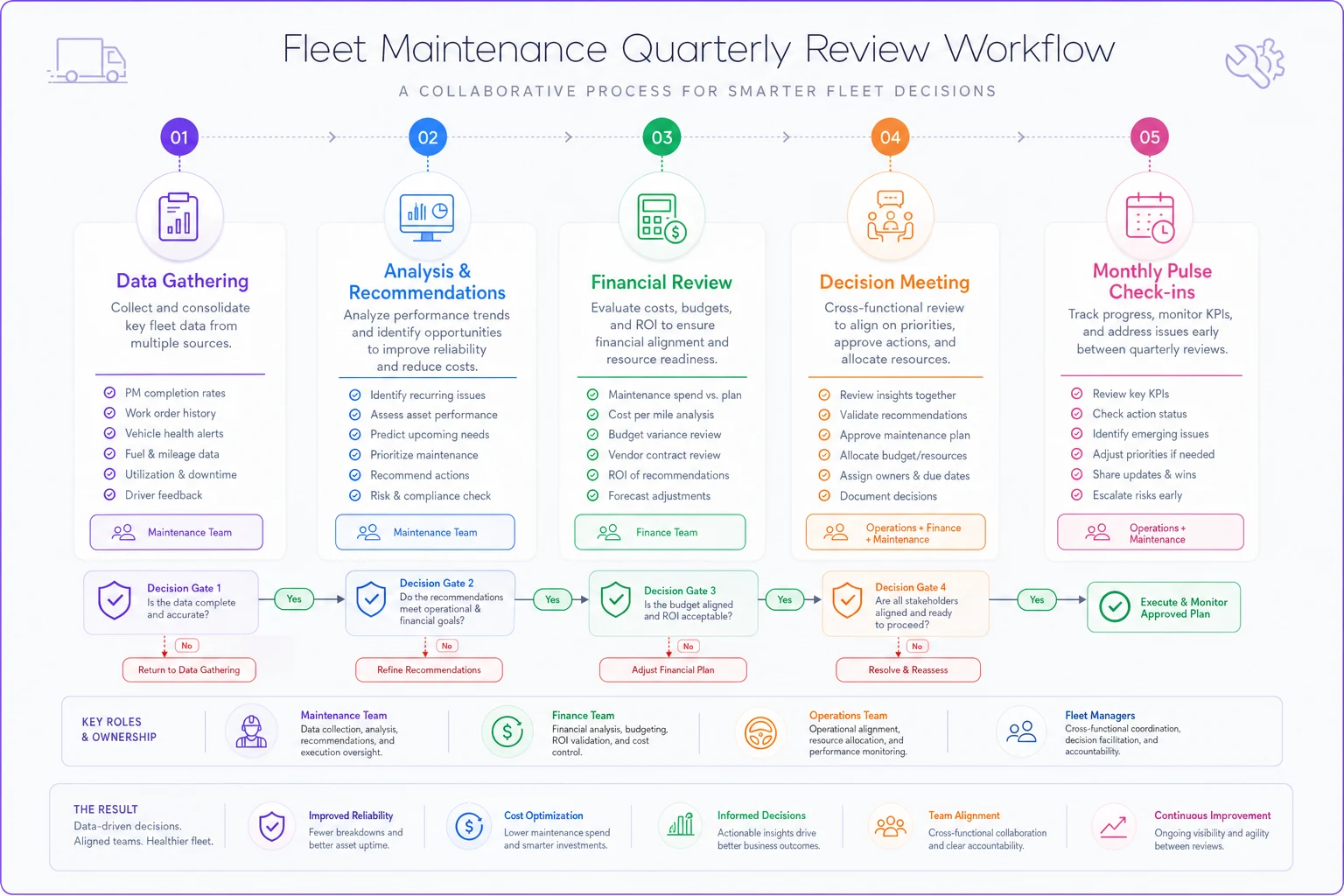
Between quarterly reviews, monthly check-ins track progress. Are we hitting cost targets? Any emerging patterns requiring intervention? These aren't full reviews — just 30-minute pulse checks.
CAPEX tradeoffs: the repair-versus-replace matrix
Every maintenance organization faces the same tension: fix what you have or buy something new. Without a clear framework, these decisions become emotional rather than analytical.
The basic math seems simple. Compare repair cost to replacement cost. But operational reality is messier. That $8,000 transmission rebuild might make sense on paper, but what about the four days of downtime? The risk of additional failures? The opportunity cost of not upgrading to a more fuel-efficient vehicle?
A construction company running 67 vehicles developed this decision matrix:
| Vehicle Age | Cumulative Repairs (12 months) | Reliability Rate | Action |
|---|---|---|---|
| <3 years | Any amount | Any rate | Repair |
| 3-5 years | <30% of value | >85% | Repair |
| 3-5 years | >30% of value | <85% | Evaluate replacement |
| 5-7 years | <20% of value | >80% | Repair |
| 5-7 years | >20% of value | <80% | Replace |
| 7+ years | >15% of value | Any rate | Replace |
The matrix is just the starting point though. Real decisions require additional context. Current vehicle market conditions (chip shortage made replacement impossible in 2021-2022). Financing availability and rates. Operational requirements (can you operate with one less vehicle during procurement?). Vendor relationships (some repairs cost 40% less with specific vendors).
The framework needs escape clauses too. Revenue-critical vehicles might justify repairs beyond normal thresholds. Seasonal businesses might defer replacements until slow periods. Expanding operations might accelerate replacement to standardize fleet.
Escalation triggers: when normal rules don't apply
Every maintenance framework needs circuit breakers — specific conditions that trigger immediate escalation regardless of normal approval levels.
Safety-critical failures Brake system failures, steering problems, structural damage — these bypass normal approval chains. Any technician can stop vehicle operation. Immediate notification to fleet manager and operations director required. Fix first, discuss cost later.
Cascade failure risk When multiple vehicles show similar problems, assume fleet-wide issue until proven otherwise. Three transmission failures in the same vehicle model within 60 days triggers executive review. Pattern recognition prevents fleet-wide breakdowns.
Vendor performance issues Same repair failing repeatedly, extended downtime for routine work, consistent overcharging — these trigger vendor review. Maintenance supervisor documents issues, fleet manager reviews quarterly, executive team can terminate contracts.
Budget breach conditions Monthly maintenance spend exceeding 115% of budget triggers immediate review. Quarterly spend over 110% requires reforecast. Annual trending toward 120% means something fundamental is broken.
One logistics company learned this lesson expensively. They had escalation triggers for individual repairs but not for patterns. Over six months, they spent $340,000 replacing EGR valves across their fleet — all from the same defective batch. Nobody noticed because each $3,800 repair fell under the supervisor approval limit.
Organizational clarity: roles that actually work
Most fleet maintenance org charts are fiction. The title says "Maintenance Supervisor" but they're actually approving purchases, scheduling drivers, and negotiating vendor contracts. Role confusion creates decision paralysis.
Effective maintenance organizations separate three distinct functions:
Technical operations Shop supervisors and lead technicians focus on repair quality, diagnostic accuracy, and shop efficiency. They recommend repairs but don't approve spending above defined limits. They own maintenance quality metrics.
Resource management Fleet managers balance vehicle availability against maintenance needs. They approve repair-versus-replace decisions, manage vendor relationships, own budget performance. They translate between technical needs and business requirements.
Financial oversight Finance partners (not necessarily full-time fleet finance) monitor spend patterns, model CAPEX scenarios, ensure compliance with approval frameworks. They don't make operational decisions but provide guardrails and analysis.
The interfaces between these roles matter more than the roles themselves. Technical operations needs to communicate repair urgency clearly. Resource management needs to explain operational impact of maintenance decisions. Financial oversight needs to provide real-time visibility into budget status.
Information architecture: making governance possible
Governance frameworks fail without accessible information. A brilliant decision matrix is worthless if supervisors can't quickly check vehicle history, cumulative repair costs, or budget status.
The minimum viable information system needs real-time maintenance cost tracking by vehicle, historical repair patterns accessible during approval decisions, budget versus actual visibility at vehicle level, vendor performance metrics updated monthly, and vehicle replacement pipeline visible to all stakeholders.
Surface cumulative vehicle spend and replacement schedule on the repair approval screen to speed and standardize decisions.
A transportation company with 234 vehicles tried governing maintenance through Excel sheets and email. Supervisors made decisions blind, finance discovered overages months later, patterns went unnoticed. They weren't lacking governance structure — they were lacking information flow.
Modern fleet operations need their governance framework embedded in their operational tools. When a supervisor reviews a $4,000 repair request, they should see that vehicle's cumulative maintenance spend, its replacement schedule, and current budget status in the same screen. AI-powered operational software increasingly handles this integration, surfacing relevant context at decision points and flagging when normal approval rules should be reconsidered.
The information system also needs to capture institutional knowledge. When a senior technician identifies a pattern — like specific vehicle models needing transmission service earlier than manufacturer recommendations — that insight needs to inform future decisions. Too many fleets lose this knowledge when experienced staff leave.
The quarterly review in practice
Here's what an actual quarterly review looks like for a 125-vehicle delivery fleet:
Preparation (Week 1-2) Maintenance team aggregates data from previous quarter. Total spend: $387,000. Cost per mile by vehicle class: box trucks at $0.42/mile, sprinter vans at $0.31/mile. Problem vehicles identified: three trucks consuming 11% of total maintenance budget.
Analysis (Week 2-3) Five vehicles flagged for replacement based on cumulative repair costs. Preventive maintenance compliance at 76% — below target due to vehicle availability constraints. Vendor analysis shows primary repair shop averaging 3.2 days for transmission work versus 2.1 days at alternative vendor.
Financial Planning (Week 3) Q2 maintenance budget set at $410,000 based on historical patterns plus 8% inflation adjustment. CAPEX approved for two replacement vehicles at $145,000 total. Finance models impact of deferring three additional replacements to Q3.
Decision Meeting (Week 4) 90-minute meeting with fleet manager, maintenance supervisor, operations director, and CFO.
Decisions documented:
-
Approve two immediate vehicle replacements
-
Shift transmission work to faster vendor despite 8% higher cost
-
Implement Saturday PM program to improve compliance
-
Defer three replacements pending Q2 performance
Communication All supervisors briefed on decisions within 48 hours. Vendor notified of shift in transmission work. Drivers informed of Saturday maintenance schedule. Finance updates forecasts.
This rhythm seems bureaucratic until you compare it to the alternative — reactive decision-making, budget surprises, and systematic underinvestment in preventive maintenance.
Warning signs your governance is broken
Governance failure doesn't announce itself. It appears as operational friction that seems unrelated to organizational structure.
Vendors calling random people for approval because they don't know who has authority. Maintenance getting deferred because nobody wants to make the decision. Simple repairs waiting three days for approval while vehicles sit idle. Emergency repairs consistently bypassing normal procedures because the standard process is too slow.
Financial symptoms are clearer. Maintenance costs varying wildly month-to-month with no operational explanation. Regular budget overruns followed by panic cost-cutting. CAPEX decisions made without maintenance input, resulting in premature vehicle replacements or expensive repairs on vehicles scheduled for disposal.
A distribution company discovered their governance problem through vendor complaints. Three different supervisors were approving work on the same vehicles. Vendors were getting conflicting instructions. One supervisor would approve a repair, another would cancel it, a third would approve it again. The company was paying for diagnostic work three times on some vehicles.
The fix wasn't complicated — they just needed clear roles and communication protocols. But first they had to recognize that their organizational chaos was a governance problem, not a people problem.
Building governance without bureaucracy
Small fleets resist governance frameworks because they seem like big company bureaucracy. "We're not Ford, we don't need all these processes." Then they grow to 75 vehicles and suddenly they're hemorrhaging money on maintenance.
Start with the minimum viable framework. Document who can approve what dollar amounts. Create a simple escalation path for problems. Schedule monthly spend reviews. Track patterns, not just individual repairs.
A regional HVAC company with 54 vehicles implemented just these four elements. Their maintenance costs dropped 18% in six months — not from spending less, but from spending smarter. They caught pattern failures earlier, stopped approving major repairs on vehicles near replacement, and identified a vendor systematically overcharging for parts.
As operations grow, add layers gradually. Quarterly reviews when you exceed 50 vehicles. Formal CAPEX planning at 100 vehicles. Dedicated fleet finance role at 200 vehicles. Each layer should solve a specific problem you're experiencing, not anticipate problems you might have.
Technology's role in governance execution
Manual governance frameworks collapse under their own weight. By the time someone compiles the data for a decision, the decision window has passed. Modern fleet operations need governance embedded in their daily tools.
When a technician identifies a $6,000 repair need, the system should automatically route it to the appropriate approver based on vehicle age, cumulative repairs, and criticality. The approver should see relevant context — repair history, budget status, replacement schedule — without hunting through multiple systems.
AI automation increasingly handles the routine elements of governance. It flags when vehicles exceed repair thresholds, identifies pattern failures across the fleet, and suggests when repair-versus-replace decisions need review. This isn't about replacing human judgment — it's about ensuring human judgment has complete information.
The best systems make governance invisible. Supervisors follow their normal workflow, but the system ensures proper approvals happen, patterns get noticed, and information flows to the right people. The framework operates in the background, preventing problems rather than creating additional work.
Making governance stick
The best framework fails if people don't follow it. Implementation requires more than documentation — it needs behavioral change.
Start with the pain points everyone recognizes. If emergency repairs are causing chaos, begin there. Create clear emergency approval processes, communicate them repeatedly, then gradually expand to routine maintenance decisions. People adopt frameworks that solve immediate problems.
Training matters, but not the way companies usually approach it. Skip the PowerPoint presentations about organizational theory. Instead, run scenarios. Here's a $7,000 repair quote on a five-year-old vehicle with 200,000 miles. Who approves it? What additional information do you need? What if it's revenue-critical? What if it's the third major repair this quarter?
Monitor compliance without becoming the governance police. Track metrics like approval response time, number of emergency overrides, and budget variance. When people bypass the framework, understand why. Usually it's because the framework doesn't match operational reality.
A fleet running 183 vehicles across multiple locations discovered their framework was failing because it required in-person approval signatures. Supervisors were approving repairs over the phone then backdating paperwork. They shifted to digital approvals with mobile access, and compliance jumped to 94% within a month.
The compound effect of good governance
Governance frameworks don't produce immediate, dramatic results. They create compound improvements over time. Better decisions today mean fewer emergency repairs tomorrow. Clear escalation paths reduce expensive delays. Connected planning prevents premature replacements and deferred maintenance spirals.
A concrete contractor tracked their metrics after implementing a governance framework. Year one saved 8% on maintenance costs. Year two saved another 12% as pattern recognition improved. Year three saw reliability increase by 15% as preventive maintenance became systematic rather than sporadic. By year four, they were operating 20% more vehicles with only a 5% increase in maintenance staff.
The real value isn't in the cost savings — it's in the predictability. Finance can actually budget for maintenance. Operations can rely on vehicle availability. Maintenance teams can focus on quality work rather than constant crisis management.
Good governance also improves vendor relationships. Clear approval processes mean faster payment. Consistent decision-making means vendors can staff appropriately. Pattern identification means vendors can stock relevant parts. One fleet's primary vendor reduced repair turnaround time by 30% after the fleet implemented consistent governance processes.
Whether people understand
Ready to maximize fleet uptime and reduce maintenance costs?
Join 2,000+ fleet managers using Fleetelyly to streamline maintenance workflows and improve vehicle reliability.