



A fleet maintenance shop in Denver showed me their scheduling board last spring. Monday mornings: 14 vehicles waiting. Friday afternoons: two techs standing around doing inventory. Their senior tech was pulling 12-hour days early in the week while junior techs clocked out early Thursday.
Getting arrival patterns wrong kills shop throughput before the day starts
The problem wasn't the techs. It was scheduling shifts against completely wrong assumptions about when vehicles actually show up. Most fleet shops still run static 7-3 or 8-4 shifts across the board, ignoring when work really arrives and what types of jobs come through.
Looking at scheduling data from dozens of operations, the pattern becomes obvious: arrival timing and job complexity drive everything. Get it wrong, you're fighting uphill all week. Get it right, that persistent backlog starts shrinking without adding people.
Why standard shift patterns fail fleet maintenance
Fleet maintenance isn't like regular auto repair. Commercial vehicles arrive based on route schedules, DOT requirements, operational windows. A delivery fleet pulls trucks Sunday night for Monday service. Municipal fleets cluster PM work around fiscal quarters. Construction equipment floods in before project deadlines.
Prevent costly breakdowns with proactive maintenance.
Fleetelyly helps you schedule, track, and manage every vehicle service efficiently.
- Automated maintenance reminders
- Real-time service tracking
- Parts inventory integration
No credit card required
Standard 8-hour shifts assume work arrives evenly. It doesn't.
Heavy arrivals concentrate around operational windows. Delivery fleets bring vehicles between 6 PM and 6 AM. Service companies need same-day turnaround between 10 AM and 2 PM. Municipal fleets dump everything at month-end.
Job complexity varies by time and day. Monday mornings bring weekend breakdowns plus deferred repairs. Mid-week sees scheduled PM services. Fridays get emergency repairs before weekend operations. Each needs different skills and time.
The usual response? Overtime and chaos. Senior techs burn out covering complex repairs during surge periods. Junior techs sit idle during slow afternoons. Work backs up because the right skills aren't available when specific job types arrive.
Building arrival-based scheduling heuristics that work
Forget optimization models. Real technician shift scheduling needs practical heuristics based on your actual patterns.
Map arrivals over 4 weeks. Track vehicle arrival time, job type, completion time. Don't use scheduled times – use when vehicles actually hit your gate. Most shops discover their real peak periods are 2-3 hours off from assumptions.
-
Quick turns (under 2 hours)
inspections, fluid services, tire rotations
-
Standard repairs (2-6 hours)
brake jobs, PM services, minor repairs
-
Complex work (6+ hours)
engine repairs, transmission work, major diagnostics
-
Specialized tasks
welding, hydraulics, electrical diagnostics
Overlay skill requirements. Which techs handle which complexity levels? Where are bottlenecks?
The scheduling pattern emerges from this data. A municipal shop discovered 60% of complex repairs arrived Monday-Tuesday mornings. Their fix: start two senior techs at 5 AM those days, regular schedule rest of week. Backlog dropped 40% in six weeks.
Here’s a quick visualization of the workflow for turning arrival data into shift decisions.
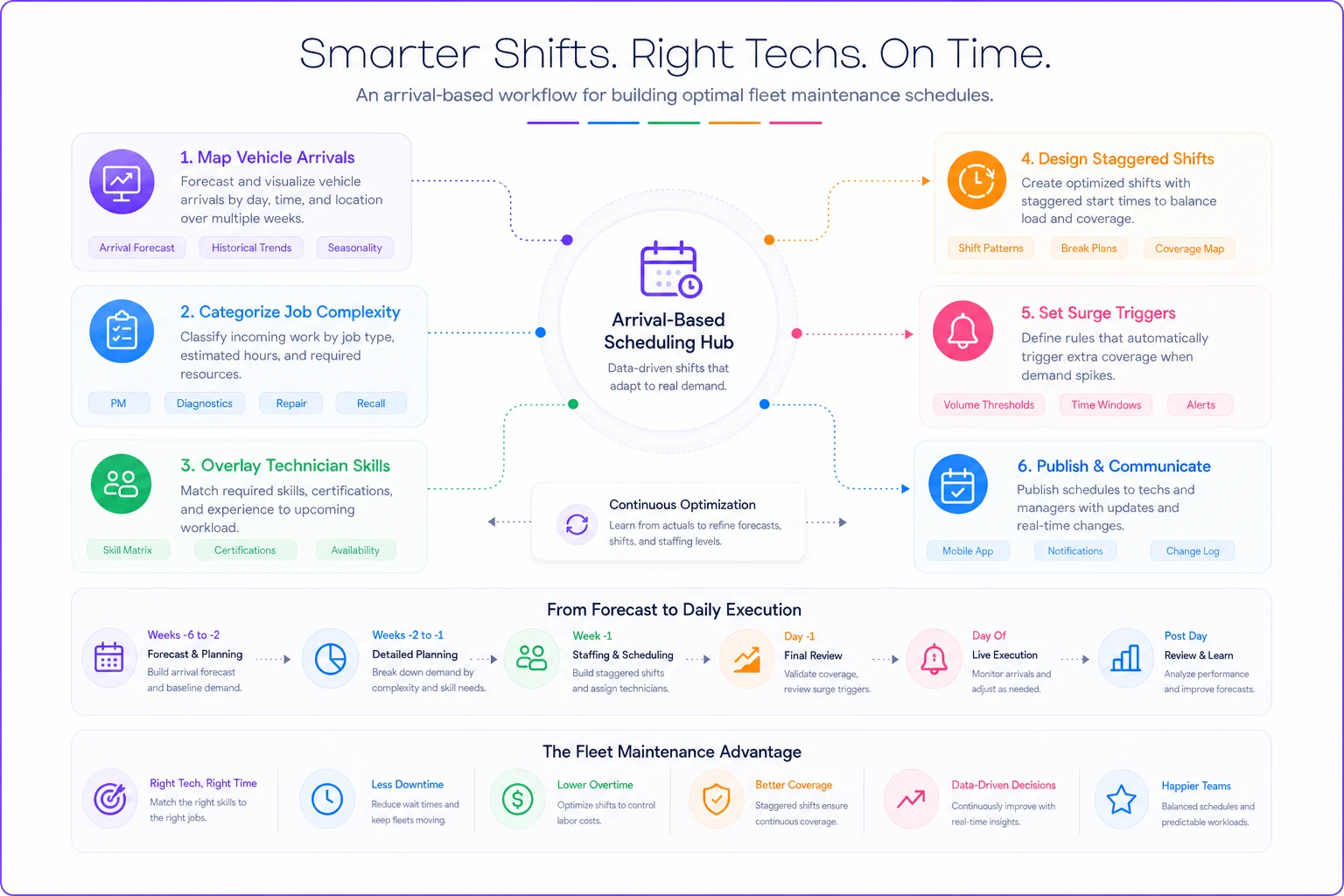
The graphic shows steps from data collection to shift rollout, highlighting decision points like peak windows and skill overlays.
Cross-skilling rules that prevent skill bottlenecks
Pure specialization creates bottlenecks. Pure generalization wastes expertise. Strategic cross-skilling based on arrival patterns works better.
Map skill gaps first. If electrical diagnostics only happens Tuesday-Thursday but your electrical specialist works Monday-Wednesday-Friday, you've created an artificial constraint. If brake work clusters on Mondays but only three techs are brake-certified, Monday becomes a permanent bottleneck.
-
70% primary specialty
-
20% secondary capability
-
10% learning/support
A Phoenix transportation company discovered hydraulic repairs clustered Wednesday-Thursday but their hydraulic tech worked Monday-Tuesday-Wednesday. Rather than reshuffling everything, they cross-trained two techs for basic hydraulic work. The specialist shifted to Tuesday-Wednesday-Thursday for complex issues while cross-trained techs covered simple maintenance other days.
Don't cross-skill everything. Some work needs dedicated expertise. But routine procedures that spike predictably? Perfect cross-skilling candidates.
Surge staffing without breaking budgets
Every fleet shop faces surge periods. School districts before semester start. Delivery fleets before peak season. Construction fleets before ground freeze. Static staffing means overstaffing year-round or understaffing during surges.
Dynamic surge planning starts with identifying triggers:
-
Seasonal patterns (weather, fiscal periods, operational cycles)
-
Regulatory deadlines (inspections, emissions, safety requirements)
-
Operational events (fleet additions, route changes, contract requirements)
Build surge capacity three ways:
Flex scheduling: 4-10s or 9-80s create coverage flexibility. One shop runs four techs on 4-10s with staggered days off. During surges, they overlap all four for two days, creating 60% more capacity without overtime.
Talent pooling: Partner with nearby shops for skilled overflow. A municipal fleet shares specialized techs with the school district during non-overlapping surge periods. Both get expert coverage without full-time overhead.
Graduated response triggers:
-
Stage 1 (backlog exceeds 3 days)
Activate flex scheduling
-
Stage 2 (backlog exceeds 5 days)
Bring in pool talent
-
Stage 3 (backlog exceeds 7 days)
Authorize overtime and outsourcing
Make surge response systematic, not reactive.
Metrics that actually control backlog
Complex dashboards impress nobody. For technician scheduling, four metrics matter:
Daily Completion vs Arrival Rate: If 12 vehicles arrive but you only complete 10, backlog grows by 2. Track daily, not weekly. A municipal fleet noticed Tuesdays consistently ran negative. They shifted one tech from Thursday to Tuesday. Fixed.
Skill-Weighted Backlog Hours: Ten hours of oil changes differs from ten hours of transmission rebuilds. Weight by skill requirement:
| Work Type | Multiplier |
|---|---|
| Basic work | 1.0x |
| Skilled work | 1.5x |
| Specialist work | 2.0x |
This reveals true capacity constraints. That 40-hour backlog might actually be 60 skill-weighted hours if it's mostly complex repairs.
First-Touch Resolution Rate: Percentage of vehicles completed without returning for same issue. Low rates indicate rushing during surges or wrong skill assignments. One shop discovered Monday first-touch was 15% below other days. Junior techs were handling complex weekend breakdowns. They adjusted skill deployment and jumped to 95%.
Tech Utilization by Skill Level: Are senior techs doing oil changes during slow periods? Are junior techs attempting diagnostics during surges? Track actual work performed versus capability. Mismatches reveal scheduling problems.
Making scheduling changes stick
Theory meets reality when you start changing schedules. Techs have lives, preferences, routines.
Start with volunteers. One shop had a tech who wanted long weekends for racing. Perfect 4-10 candidate. Another needed afternoons free for kids. Ideal early shift candidate. Build success with willing participants.
Phase changes gradually. Don't flip everyone overnight. Transition 25% of staff, measure results, adjust, then expand. A delivery fleet took four months to fully implement arrival-based scheduling, but the gradual rollout prevented disruption and built buy-in.
Share the wins. When backlog drops or overtime decreases, techs need to see the connection to scheduling changes. Post weekly backlog trends. Celebrate when everyone goes home on time.
When arrival-based scheduling becomes essential
Not every shop needs complex scheduling. A small fleet with steady maintenance might run fine on standard shifts. But certain conditions make arrival-based scheduling essential:
High variation operations: Mixed fleets with different schedules create natural arrival clustering. A shop servicing delivery trucks and service vans sees completely different patterns. Delivery trucks arrive overnight. Service vans need midday turnaround.
Regulatory compliance pressure: DOT inspections, emissions deadlines, safety requirements create artificial surges. Standard scheduling means massive overtime or missed deadlines.
Skill-constrained environments: When expertise is limited (diesel diagnostics, hydraulic specialists, certified welders), scheduling must optimize around skill availability, not body count.
Cost-sensitive operations: If overtime costs are killing margins or backlog delays are driving vehicles to outside shops, optimized scheduling often provides more impact than adding headcount.
Real implementation roadmap
A regional delivery fleet with 85 vehicles and 8 technicians faced chronic Monday-Tuesday backlog while techs stood idle Thursday-Friday.
-
Week 1-2
Data gathering
- Tracked every arrival, job type, completion. No changes yet, just observation. Discovered 65% of arrivals happened Sunday night through Tuesday morning. -
Week 3-4
Pattern analysis
- Categorized work complexity and mapped tech capabilities. Found electrical and diagnostic work clustered early-week while PM services spread throughout. -
Week 5-6
Schedule design
- Created staggered shifts: 2 senior techs Sunday-Thursday 6 AM start, 3 mid-level techs Monday-Friday 7 AM start, 3 junior techs Tuesday-Saturday 8 AM start. -
Week 7-8
Pilot launch
- Implemented with volunteers first. Measured daily completion rates and backlog hours. -
Week 9-12
Full rollout
- Expanded to all techs with adjustments based on pilot feedback.
Results after 90 days:
-
Monday backlog eliminated
-
Overtime hours down roughly 35%
-
First-touch resolution up from 87% to 94%
-
Better work-life balance
Better work-life balance
Common mistakes that create hidden bottlenecks
Over-optimizing for averages: Your "average" Tuesday shows 8 arrivals, but reality swings between 4 and 12. Scheduling for 8 fails half the time. Build buffers around variation.
Ignoring setup and transition time: A tech might handle 3 brake jobs daily, but not if each requires bay changes, parts gathering, equipment setup. Real capacity includes transition overhead.
Misaligning skills with complexity: Having bodies present doesn't equal having right skills available. One shop had perfect arrival-based coverage but kept backing up because junior techs were scheduled during complex repair windows.
Forcing unwanted schedules: That perfect 4 AM shift for early arrivals? Useless if nobody wants to work it. Better to adjust arrival expectations than force unsustainable schedules.
Building scheduling resilience
Static schedules break eventually. Arrival patterns shift. Job mix evolves. Building resilience means creating adaptive capacity:
Review patterns quarterly. What worked in summer might fail in winter. Municipal fleets see different patterns during budget seasons. Adjust proactively.
Cross-train continuously. Every tech should be building secondary skills. Strategic redundancy prevents single points of failure.
Document scheduling logic. When you find patterns that work, write them down. "Start extra diesel tech on Mondays during harvest season" becomes institutional knowledge.
Create flexibility buffers. Maybe you handle current patterns with 8 techs, but what happens when someone's sick? Build schedules assuming 85-90% attendance.
Moving from reactive to predictive scheduling
The best shops don't just react to arrival patterns – they shape them.
Incentivize off-peak arrivals. Offer faster turnaround or priority scheduling for vehicles arriving during slow periods. A concrete company gives 10% labor discount for Thursday-Friday PM service. They shifted 20% of volume from Monday-Tuesday.
Bundle similar work. Instead of spreading brake jobs across the week, designate Tuesday-Thursday as "brake days" with specialized setup and skilled tech concentration. Efficiency improves when techs stay in rhythm.
Communicate patterns to customers. Let fleet managers know when you're slammed versus available. They often have flexibility you don't realize. A delivery company happily shifted PM schedules once they understood shop capacity patterns.
Technician shift scheduling for fleet operations isn't about perfection. It's about matching capacity to reality instead of forcing reality to match rigid schedules. Get arrival patterns roughly right, build in cross-skilling buffers, and create surge mechanisms that activate before crisis hits.
Measure what matters. Not utilization percentages or theoretical efficiency. Measure whether vehicles get fixed when promised, whether techs go home on time, whether backlog stays manageable.
AI-powered operational software can track these patterns automatically, flagging when arrival patterns shift or skill bottlenecks emerge. But even basic tracking beats flying blind. The shop that maps arrivals for two weeks learns more than the shop guessing for two years.
Your techs want predictable schedules. Your customers want reliable service. Your operation needs sustainable throughput. Arrival-based scheduling delivers all three – if you build it on actual patterns, not theoretical models.
Ready to maximize fleet uptime and reduce maintenance costs?
Join 2,000+ fleet managers using Fleetelyly to streamline maintenance workflows and improve vehicle reliability.