

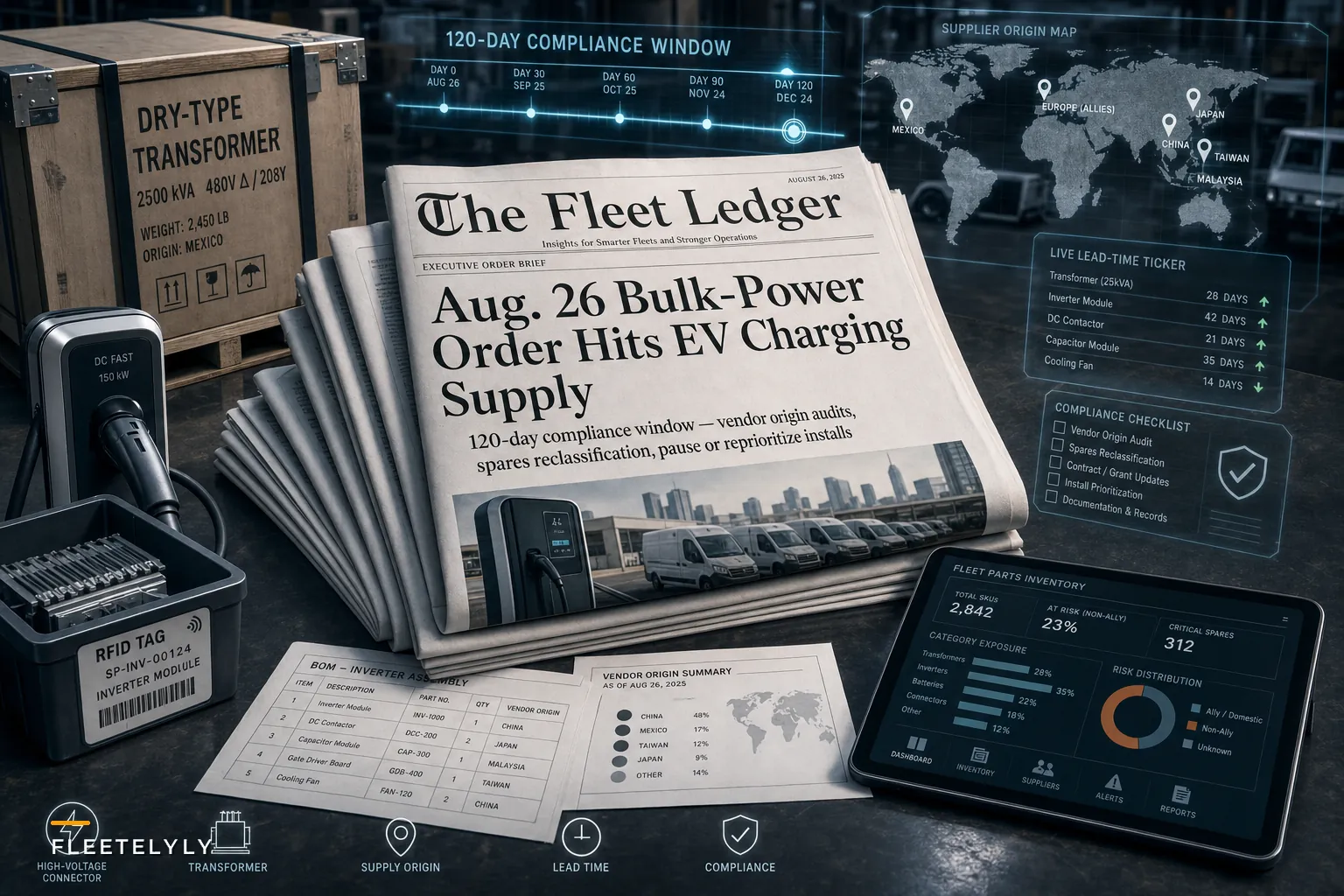

If you're mid‑way through electrifying part of your fleet, the ground just shifted under your procurement schedule. On Aug. 26, 2026, the White House issued Executive Order 14420, declaring a national emergency around the security of the U.S. bulk‑power system and directing restrictions on the acquisition, installation, and continued use of certain foreign‑produced bulk‑power equipment — transformers, inverters, batteries, and the software that runs them. The official order hands the Department of Energy roughly a 120‑day window to write the actual rules.
The part that matters for fleets: nobody knows exactly what "compliant" means yet. Utility Dive's reporting on the order flagged the immediate supply‑chain uncertainty for equipment buyers, and that uncertainty flows straight downhill into your charger installs, your service transformer orders, and the spare‑parts closet behind your maintenance bay.
This isn't a "wait and see" situation. The vendors supplying your medium‑voltage transformers and DC fast chargers are already re‑pricing and re‑quoting lead times right now, before the rules are even final. Below are seven operational moves that actually protect a rollout during a rulemaking window — not policy commentary, but the stuff you can act on this week.
First, understand why this hits fleets harder than most buyers
A lot of coverage frames this as a utility problem. It's not only a utility problem. Fleet electrification sits at an awkward intersection: you're not a utility, but you're buying utility‑grade equipment. A depot running a dozen 150kW+ chargers needs service transformers, switchgear, and sometimes battery buffers — precisely the categories in scope.
What makes it worse is the continued use language. Most disruptions only affect new purchases. This order references acquisition, installation, and continued use of certain foreign‑produced equipment. That opens a question no fleet manager wants during a grant‑funded project: could a component you already installed need retrofit or removal? Nobody can answer that yet, but the fact that it's an open question changes how you should be contracting today.
The underlying problem this exposes has been sitting in fleet electrification plans for years. Most rollouts were built on optimistic, single‑source lead‑time assumptions. When chargers were quoted at 14–20 weeks and transformers at 20–30 weeks, teams treated those numbers as facts. They were always fragile estimates. This order just yanked the fragility into daylight.
Step 1: Freeze and re‑inventory every in‑scope component in your rollout
Before anything else, get a real list. Not the CAD drawing, not the vendor proposal — the actual bill of materials for every site, with country of origin flagged on each line.
Prevent costly breakdowns with proactive maintenance.
Fleetelyly helps you schedule, track, and manage every vehicle service efficiently.
- Automated maintenance reminders
- Real-time service tracking
- Parts inventory integration
No credit card required
On most depot projects, this list doesn't exist in one place. The charger sits on the EVSE vendor's quote. The transformer lives on the utility interconnection paperwork. The switchgear is buried in the electrical contractor's submittal. Pull them into a single sheet and mark three things per component: category (is it in scope?), country of origin, and current lifecycle stage (ordered / in transit / installed / planned).
You're looking for components that are both in‑scope and not yet locked. Those are your exposure. Everything installed and energized is a separate, longer conversation with legal and the utility.
Step 2: Rework your lead‑time assumptions before your vendors do it for you
The mistake here is passive waiting. Fleets that sit still get re‑quoted on the vendor's timeline, which means you find out about an extra 12 weeks when it's already too late to react.
-
Which of the components you're supplying fall under the equipment categories named in the order?
-
What is your current country‑of‑origin breakdown for those components, and do you have a compliant alternative?
-
If a compliant alternative is needed, what does that do to price and lead time?
A typical example of what comes back: an EVSE supplier confirms the charger cabinet is fine but the power modules are sourced from a flagged region, and a compliant swap adds roughly 8–12 weeks plus a low‑double‑digit percentage price bump. That's the kind of concrete number you can replan against. Vague reassurance is useless here.
Step 3: Rebuild your critical‑spares math around the new reality
When lead times for a component class jump from predictable to volatile, your entire reorder logic has to change. Safety stock built on stable historical lead times is quietly wrong the moment those lead times become uncertain.
If your reorder policy still assumes fixed replenishment windows, now's the time to move it toward variable‑lead‑time logic. The core framework — min/max levels, safety stock sized to lead‑time variability, and criticality tiers — is exactly what this situation demands. It's worth revisiting the mechanics in our breakdown of a spare‑parts reorder policy for variable lead times. The short version: components with high lead‑time variance and high downtime impact need dramatically more safety stock than they did last month.
A practical way to reclassify high‑voltage and charging spares under the new conditions:
| Component | Old lead‑time assumption | Risk under the order | New criticality tier | Action |
|---|---|---|---|---|
| DC fast charger power modules | 10–14 wks | High (origin‑flagged) | Critical | Pre‑buy or secure allocation |
| Service transformer | 20–30 wks | High (in‑scope) | Critical | Lock order + backup vendor |
| Inverter / rectifier units | 12–16 wks | Medium‑High | Critical | Confirm origin, stock 1 spare |
| Charger comms/control boards | 6–8 wks | Medium (software in scope) | Important | Increase min level |
| Cabling, connectors, mounts | 2–4 wks | Low | Standard | No change |
Don't over‑stock the bottom rows to feel productive. The whole point is concentrating capital on the top rows where both variance and downtime cost are high.
Step 4: Add compliance and origin clauses to every open contract
The contracts you sign during a rulemaking window need to protect you from rules that don't exist yet. That sounds impossible, but it's really just about who carries the risk.
Push for language covering: country‑of‑origin certification, the vendor's obligation to supply a compliant alternative at no schedule penalty if their component becomes restricted, and a clean exit or repricing trigger if compliance forces a material change. Also nail down documentation — if your project is federal or state grant‑funded, you'll almost certainly need to prove sourcing compliance later, and reconstructing that paper trail after the fact is miserable.
A pattern that shows up on grant‑funded installs repeatedly: the money comes with strings that tighten after equipment is already ordered. Get the origin documentation from your vendor now, in writing, while they still want the sale.
Step 5: Sequence your rollout to protect the sites that must go live
Not every site is equal. If lead times stretch, you can't finish everything on the original schedule, so decide the priority order deliberately instead of letting the slowest vendor decide it for you.
Rank your planned sites by three factors:
-
Operational necessity — which routes actually depend on this charging capacity next quarter?
-
Grant deadlines — which sites have funding tied to a completion date you can't miss?
-
Exposure level — which sites use the most in‑scope, origin‑flagged equipment?
The thing most teams miss: your highest‑exposure site and your most time‑critical site are often not the same location. When they're different, protect the time‑critical one first and give the high‑exposure one more schedule slack to sort out compliant sourcing. When they're the same site, that's your top escalation — flag it to leadership this week, not next month.
Step 6: Line up a second source for anything Critical‑tier
Single‑source procurement was already risky. Under an active equipment restriction with unwritten rules, it becomes a liability. The goal isn't to dual‑source everything — that's expensive and slow. It's to have a qualified backup for the handful of Critical‑tier components where a supply gap stops a truck from charging.
A realistic scenario: a mid‑size regional fleet building out three depots discovers its sole transformer supplier can't confirm compliant delivery for two of the three sites. Because they'd pre‑qualified a second manufacturer months earlier for an unrelated reason, they shifted two orders over and lost roughly six weeks instead of an entire quarter. The teams that get burned are the ones who never bothered to qualify anyone else because the primary was "fine."
Backup sourcing takes time to set up — qualification, sample review, contract terms. Start it now while it's a precaution, not later when it's an emergency.
Step 7: Centralize the tracking so nothing falls through the cracks
The operational failure that quietly kills projects during a period like this: information lives in too many places. The origin data is in a vendor email. The lead‑time update is in someone's inbox. The grant deadline is in a spreadsheet. The revised spare‑stock levels are in the maintenance system. When those don't talk to each other, decisions get made on stale information.
You don't need anything fancy. You need one place where the state of every in‑scope component is visible: current status, origin, compliance documentation, revised lead time, assigned owner, and next action. This is where a workflow platform that ties procurement status to your parts and maintenance data earns its keep — not because it's clever, but because it stops the "I thought the other team was tracking that" failure that shows up constantly under supply pressure. AI‑assisted operational tools help here by flagging when a lead‑time change should trigger a safety‑stock recalculation or a rollout resequence, so the reaction is automatic rather than dependent on someone noticing at the right moment.
Here's a simple visual to show the workflow for centralizing tracking across procurement, maintenance, and project teams.
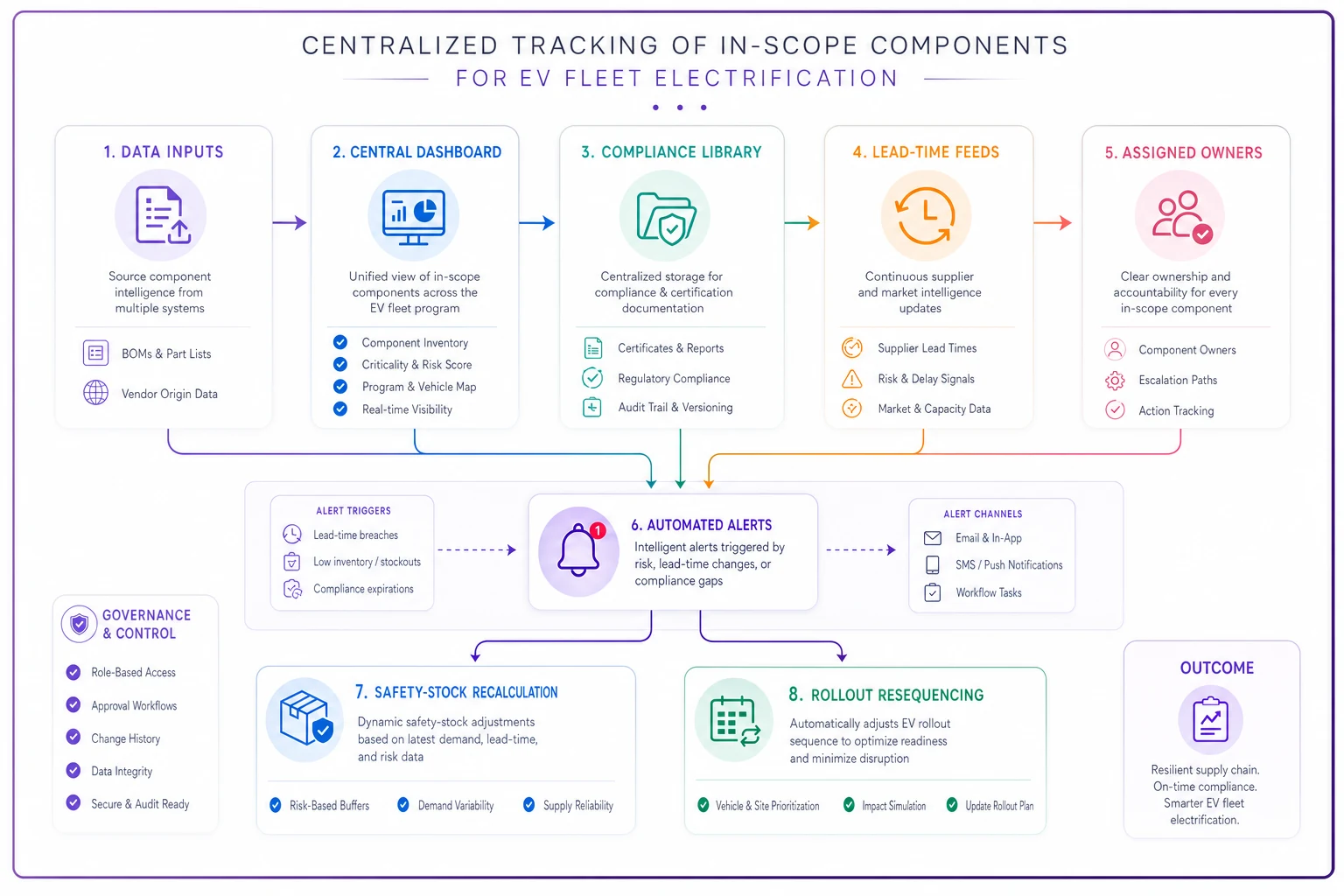
Automate lead‑time alerts to trigger safety‑stock recalculations so inventory adjustments don't wait on manual review.
A rulemaking window is exactly the kind of moving‑target situation where a shared, current picture beats a dozen individually‑correct but disconnected spreadsheets.
When aggressive pre‑buying makes sense — and when it doesn't
Pre‑buying Critical‑tier components to beat future restrictions is tempting, but it's not always the right call.
It makes sense when: the component is confirmed in‑scope, your project has a hard grant deadline, and you have storage and capital for the equipment. Locking a compliant transformer today at a known price beats gambling on an unknown price and timeline in four months.
It's a bad idea when: you're pre‑buying speculatively across every category just to feel safe. Buying non‑Critical components early ties up cash and warehouse space for parts that were never at real risk. It also risks buying something the rules later disfavor — pre‑buying to dodge one restriction can put you on the wrong side of another once DOE finalizes the details.
Who should avoid heavy pre‑buying entirely: small fleets with limited capital and no near‑term grant deadline. For those operations, the smarter move is securing vendor allocation and compliance clauses rather than sinking cash into inventory before the rules exist.
A short real scenario
A regional delivery fleet running around 40 vehicles was building out a single depot with eight DC fast chargers, partly funded through a state grant with a hard completion deadline. Their original plan assumed chargers at roughly 14 weeks and the service transformer at roughly 24 weeks.
After the order dropped, their EVSE vendor flagged the power modules as origin‑restricted. Compliant modules added about 10 weeks and a modest price increase. The transformer supplier couldn't guarantee compliant delivery inside the grant window at all.
What saved them was moving fast on the unglamorous steps: they'd already assembled a single BOM sheet with origin flags, so they knew their exposure within a day. They locked the compliant charger order immediately with an origin certification clause, activated a pre‑qualified backup transformer supplier, and resequenced — bringing four chargers live on time for the grant and phasing the other four a quarter later. Total slip on the critical portion was around three weeks instead of the two‑plus quarters they'd have lost by waiting for clarity.
Nothing about that outcome was luck. It was inventory logic, contract terms, and coordination — the same fundamentals that protect any fleet through any supply shock.
The equipment order isn't really the story here. The story is that it exposed how much of your electrification plan rested on stable lead times, single suppliers, and origin assumptions nobody had verified. Those weaknesses were always there. A 120‑day rulemaking window just made them expensive to ignore.
Work the seven steps in order: inventory your exposure, re‑quote lead times before your vendors force it, rebuild your spares math around variability, put compliance risk in your contracts, sequence sites by necessity and deadline, qualify backups for Critical parts, and centralize tracking so decisions run on current information. Do that, and a chaotic policy window becomes a manageable procurement problem — which is all it ever really was.
Ready to maximize fleet uptime and reduce maintenance costs?
Join 2,000+ fleet managers using Fleetelyly to streamline maintenance workflows and improve vehicle reliability.