

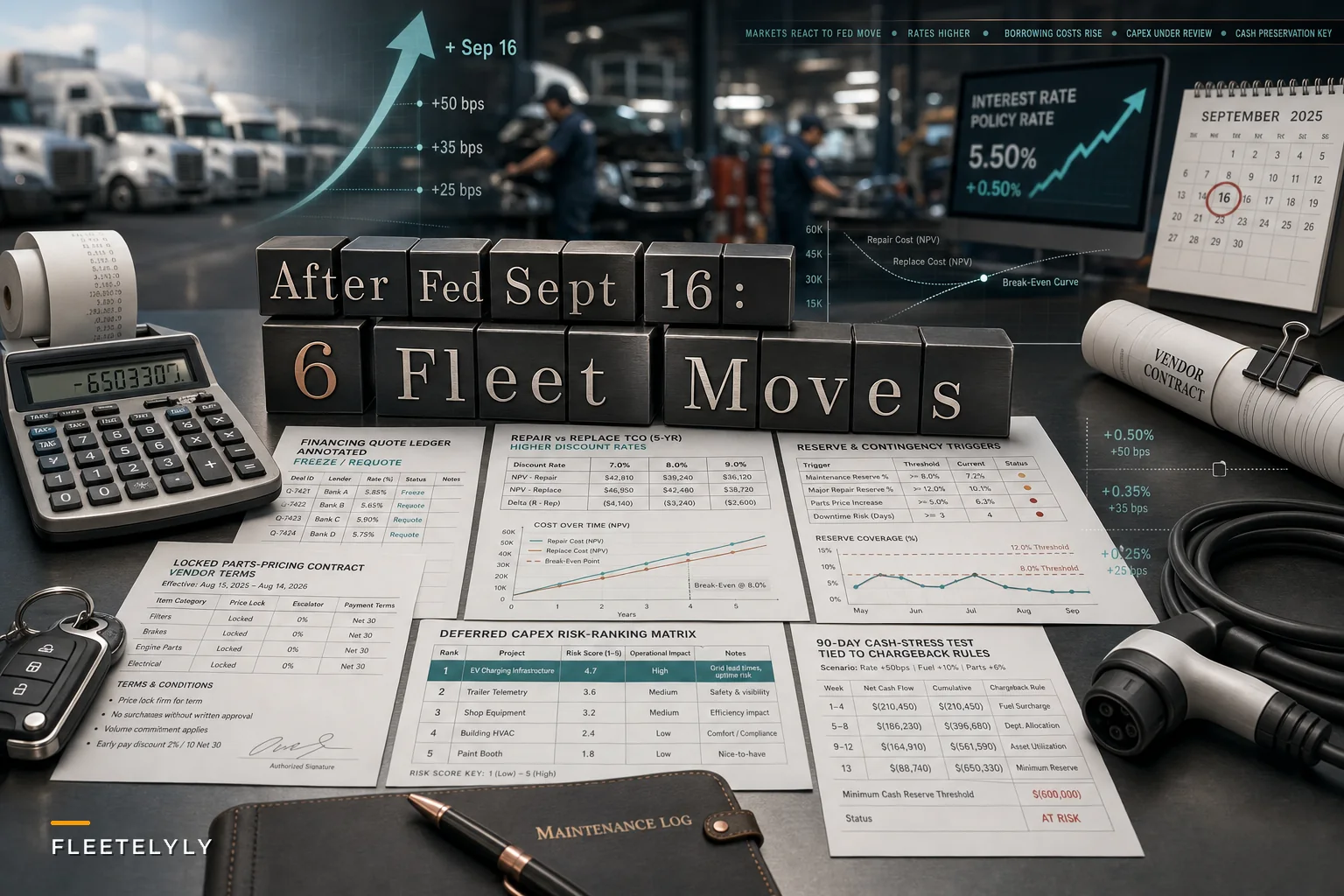

The Fed bumped rates another 25 basis points on September 16, pushing the target range to 3.75%–4.00%, and the messaging wasn't "we're done." Policymakers signaled more tightening could still be on the table. CNBC's coverage of the September decision framed it as a Fed willing to keep pressure on, and Reuters noted the move reflected a push for a timelier drop in inflation rather than a single adjustment and done.
For most people, that's a mortgage-rate headline. For a fleet maintenance team heading into Q4 planning, it's a direct hit to three things at once: the cost of financing new units, the economics of repair-vs-replace, and the capital you were counting on for parts stocking and depot projects. None of these show up on your maintenance dashboard. They show up two months later as a budget variance you have to explain.
This isn't a macroeconomics piece. It's a short list of operational moves worth making in the next few weeks, before Q4 locks and before suppliers start repricing.
Why a 25 bps hike actually touches your shop floor
The rate itself isn't the problem. A quarter point on a single truck loan is almost nothing. The problem is where fleet budgets sit in the capital stack and how many decisions quietly assumed cheap money.
Here's the chain that typically plays out over the 60–90 days after a hike like this:
-
Finance and leasing partners reprice new deals. If you were quoted on replacement units in August, refreshed October numbers will look different.
-
Suppliers whose own working capital got more expensive start pushing price increases, longer payment terms, or both. Parts and consumables move first because nobody fights hard over a 4% bump on filters and brake kits.
-
Internal CAPEX committees get more conservative. Projects that were "approved pending final numbers" — depot charging, bay expansions, diagnostic equipment — get pushed to next fiscal year.
-
Your reserve and chargeback math, calibrated in a different rate environment, starts quietly misfiring.
None of these are dramatic on their own. Together they compress the maintenance budget right when you need flexibility for year-end work.
The deeper issue is that most fleet budgeting processes treat the cost of capital as a fixed background assumption. It isn't. It moved on September 16, and if your forecasts, reserve triggers, and replacement thresholds don't move with it, you're running last quarter's math on this quarter's money.
The six moves, in priority order
Ordered by how fast each one decays in value — the first few are time-sensitive because they involve locking numbers before they drift further.
Prevent costly breakdowns with proactive maintenance.
Fleetelyly helps you schedule, track, and manage every vehicle service efficiently.
- Automated maintenance reminders
- Real-time service tracking
- Parts inventory integration
No credit card required
Use this workflow to run the six checks quickly.
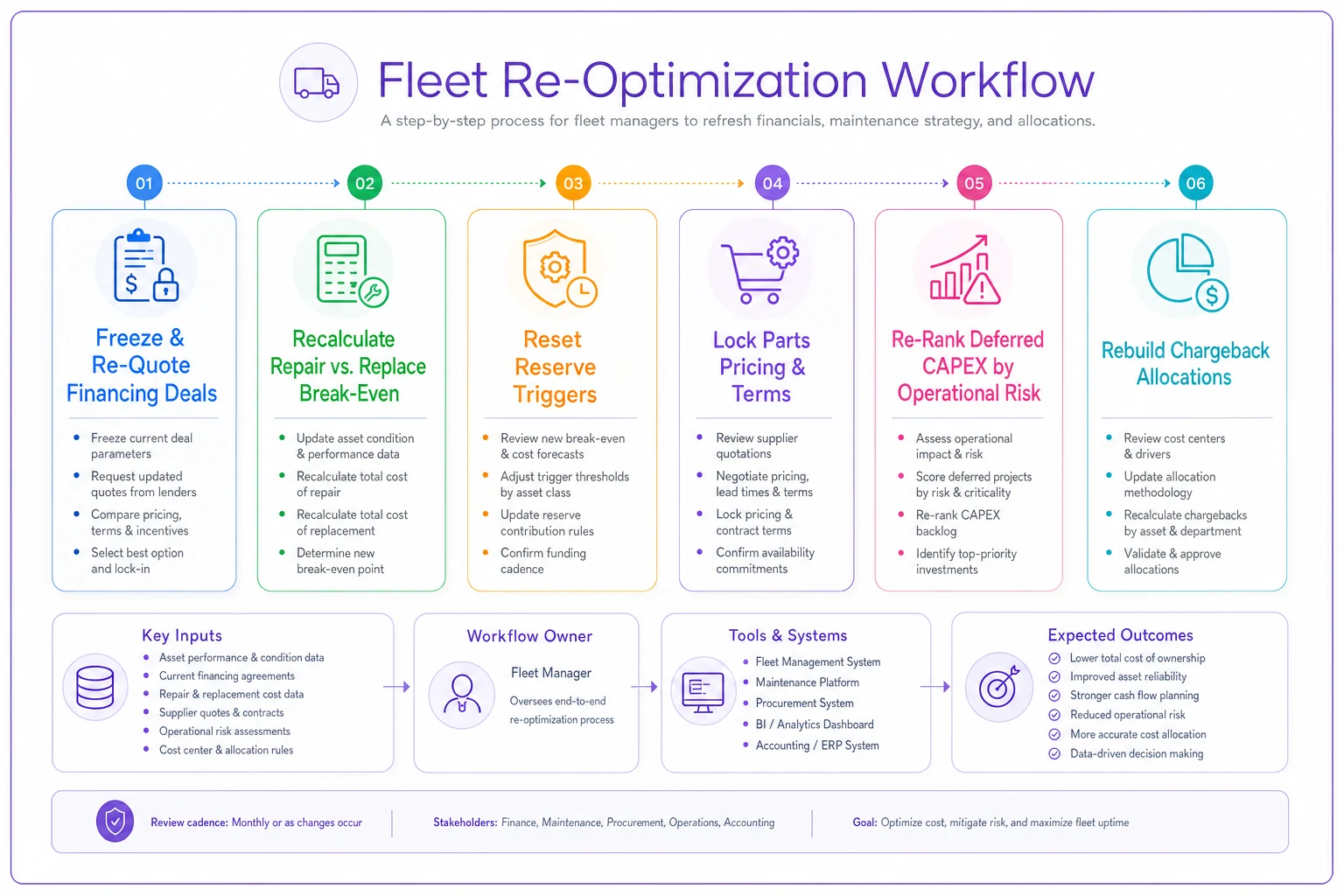
1. Freeze and re-quote any financing deals still in flight
If you have replacement units, lease renewals, or equipment purchases that were quoted but not signed, get refreshed numbers this week and compare them line by line against the original. Don't assume the delta is just the headline 25 bps — financing partners often widen their own margins when they expect further tightening, so the effective cost can move more than the Fed's move alone.
A realistic example: a mid-size fleet replacing eight medium-duty units on a five-year lease saw monthly payments drift up by roughly $90–$140 per unit between a late-August quote and an October re-quote. Not a disaster, but across eight units over five years that's an unbudgeted swing somewhere in the $45k–$65k range that nobody approved. Catching it before signing means you can renegotiate term length, adjust the spec, or at least walk into the budget meeting with the number already on the table.
When this matters most: any deal touching four or more units, or anything on a lease over 48 months, where small rate changes compound.
2. Recalculate your repair-vs-replace break-even
This is the one most teams skip, and it has the biggest downstream effect. Repair-vs-replace decisions are a comparison between known repair costs and the carrying cost of a new asset. When financing gets more expensive, the new-asset side of that equation gets heavier — the break-even shifts, and some units you were about to retire now make more sense to run a bit longer.
| Factor | Before the hike | After the hike | Effect on decision |
|---|---|---|---|
| Monthly cost of a replacement unit | Lower | Higher | Pushes toward repair |
| Acceptable repair ceiling per unit | Tighter | Higher | Allows more repair spend |
| Payback period on replacement | Shorter | Longer | Delays replacement trigger |
| Reserve draw to fund replacement | Smaller | Larger | Favors deferral |
Across mixed fleets, a rate increase quietly moves somewhere around 10–20% of your "replace soon" candidates back into the "repair and monitor" bucket — purely on economics, independent of vehicle condition. If your replacement triggers are hard-coded to an age or mileage threshold instead of a live cost comparison, you'll keep replacing units that are now cheaper to maintain.
3. Reset reserve triggers for the new cost of capital
Reserve triggers — the thresholds that tell you when to pull from your maintenance reserve — are usually set once and forgotten. A reserve calibrated for one borrowing environment either over-reserves (locking up cash you could deploy) or under-reserves (leaving you short when a major repair lands and emergency financing costs more than it used to).
If you're running rolling forecasts and reserve rules — and if you're not, this is a good moment to start — revisit the trigger levels against the new rate environment. Our earlier breakdown on rolling forecasts, reserve triggers and repair-vs-replace rules walks through the mechanics. The adjustment here is simple: treat the cost of capital as an input that gets updated every rate cycle, not a constant baked in two years ago.
A reasonable rule of thumb: if a surprise repair would push you into short-term financing to cover it, the cost of that financing just went up — which argues for a slightly deeper reserve on your most failure-prone asset classes.
4. Lock parts pricing and terms before suppliers reprice
Suppliers feel the same rate pressure you do. The ones carrying inventory on credit have real incentive to pass higher financing costs down the chain, and parts and consumables tend to move first because the increases are small enough to slip through without much resistance.
Over the next few weeks, worth doing:
-
Pull your top 20–30 SKUs by annual spend and check current pricing against your last PO.
-
Ask key suppliers to hold current pricing on blanket orders through Q1, in writing.
-
Watch for quiet term changes — net-45 turning into net-30 is a working-capital hit even if the unit price stays flat.
-
Flag consumables where you buy at volume; a 3–5% creep on high-velocity parts adds up faster than a bigger bump on something you order twice a year.
Get price-hold commitments from suppliers in writing and tie them to specific POs or blanket orders.
A fleet spending around $400k annually on parts that absorbs a blended 4% increase without noticing is eating roughly $16k it never budgeted. That shows up as a slow leak across dozens of invoices — which is exactly why it's hard to catch manually.
5. Re-rank deferred CAPEX projects by what actually breaks if you wait
Higher capital costs mean something on your CAPEX list is going to slip. The mistake is letting that happen by default — whatever's least politically defended gets cut — rather than by operational logic.
Run your pending projects through one question: what's the uptime or compliance cost of waiting another two quarters? A depot charging expansion might be deferrable. A diagnostic tool that's the only thing keeping a high-failure asset class diagnosable probably isn't. A lift that's one inspection away from being red-tagged definitely isn't.
-
List every pending CAPEX item with its cost and intended quarter.
-
For each, write the concrete consequence of a six-month delay — downtime hours, compliance exposure, overtime, outsourced repair spend.
-
Convert that consequence into a rough dollar cost where you can.
-
Compare the delay cost against the project cost.
-
Protect anything where delaying costs more than proceeding; defer the rest deliberately.
"Deferrable" and "low priority" aren't the same thing. Some cheap projects prevent expensive problems, and those should jump the line even when capital is tight.
6. Rebuild chargeback allocations so the rate impact lands where it belongs
If you cross-charge maintenance costs back to departments or cost centers, higher financing and parts costs will flow into those chargebacks. If your allocation model is stale, the increases land unevenly and you spend December arguing about whose budget absorbed what.
Update the allocation basis now so the added cost of capital is distributed on defensible logic — usage, asset value, failure rate — rather than whatever split you configured three years ago. The goal isn't to hide the increase. It's to make it explainable, so when a department head asks why their chargeback went up, you have the math ready instead of a shrug.
A real scenario: the regional delivery fleet that caught it early
A regional last-mile delivery operation running about 120 mixed vehicles went into Q4 with six replacement units quoted in August and a depot charging project penciled in for Q1.
The problem was the usual one: replacement triggers were age-based, the reserve was set two years prior, and parts pricing was tracked on spreadsheets nobody reconciled against actual POs more than quarterly. When rates moved, none of their systems flagged anything — because none of them were watching for it.
They worked through the checklist above over roughly two weeks. Re-quoting the six units surfaced a payment increase of around $110 per unit per month, so they shortened the term on two units and deferred two others back into repair after rerunning the break-even. They locked top-SKU pricing with two suppliers before a quietly circulated 4% increase took effect. They pushed the charging project one quarter after scoring it on operational risk and finding nothing critical broke by waiting.
The net effect wasn't headline-worthy — it was avoiding somewhere around $30k–$40k in unbudgeted drift across financing, parts, and premature replacements, plus walking into the Q4 budget review with every number already explained. That last part mattered more than the dollars. Finance stopped treating maintenance as the department that always runs over.
Where the manual process breaks down
Most fleets don't eat this kind of drift because they don't know the moves. They eat it because the inputs live in different places. Financing terms in one system, parts pricing in another, reserve rules in a spreadsheet, replacement triggers in someone's head, chargeback logic in a finance file nobody opens until year-end. When a rate change hits, there's no single place where all of those recalculate together.
That's the quiet case for pulling budgeting, reserve triggers, parts pricing, and repair-vs-replace logic into one operational platform rather than five disconnected tools. When cost of capital is a shared input feeding every downstream calculation, a 25 bps move becomes a recalculation you run in an afternoon rather than a variance you discover in December. AI-assisted monitoring helps most on the slow-leak stuff — flagging SKU prices that crept up, chargeback splits that drifted, replacement candidates whose break-even just flipped — things that are individually too small to catch by hand but add up meaningfully across a fleet.
The point isn't the tooling, though. Rate changes are an operational event for fleets, not just a finance headline, and the teams that treat them that way protect their budgets before the quarter gets away from them.
Bottom line
A quarter-point hike with a hawkish tone behind it won't bankrupt anyone. But it quietly reshapes the math underneath your financing, reserves, parts pricing, and replacement decisions — without sending you a single alert. The fleets that come out ahead are the ones that treat the September move as a trigger to re-run their numbers now, while deals are still re-quotable and suppliers haven't finished repricing. Work through the six moves above over the next couple of weeks, and Q4 planning gets considerably less stressful than explaining the variance later.
Ready to maximize fleet uptime and reduce maintenance costs?
Join 2,000+ fleet managers using Fleetelyly to streamline maintenance workflows and improve vehicle reliability.