



Most parts rooms don't have a purchasing problem. They have a proliferation problem. Over five, six, seven years of buying whatever the OEM catalog spat out for each new chassis, you end up with three brake pad part numbers that are functionally identical, two coolant filters that fit the same engine family, and a shelf full of "unique" fasteners that a single supplier convinced you were special.
Parts rationalization is the discipline of proving which of those SKUs are actually the same, retiring the duplicates, and negotiating from a consolidated position. Done right, it shrinks carrying cost, cuts dead stock, and gives you leverage you didn't know you had. Done wrong, it retires the wrong part number and takes a unit out of service during a peak week.
This is the playbook for doing it right — the audit rhythm, the interchangeability matrix, the substitution rules, and a phased retirement plan that won't blow up in your face.
Start with why the SKU count balloons in the first place
You can't fix the sprawl until you understand how it grows, because those same mechanics will refill the shelves after you clean them.
-
Per-chassis cataloging. Every time you add a new model year, the OEM parts catalog assigns fresh part numbers even when the physical component hasn't changed. A filter that's been the same casting for six years gets three part numbers because three model years reference it differently.
-
Emergency cross-shipping. A tech needs a part now, the usual SKU is out, so someone orders the "equivalent" from a different vendor under a different number. Nobody ever reconciles the two afterward. Now you carry both.
-
Vendor lock-in by design. Suppliers love proprietary part numbers because they make comparison shopping harder. A "special" hydraulic fitting that's actually a standard SAE size gets a vendor-specific SKU, and you pay a premium forever.
-
Well-meaning safety stock. Someone stocks a slightly different bracket "just in case" and it becomes permanent inventory that turns over once every four years.
The part most teams miss: SKU proliferation isn't a one-time cleanup problem. It's a leak. If your only fix is a big rationalization project every few years, you're mopping the floor with the tap still running. The audit cadence matters as much as the audit itself.
Set the audit cadence before you touch a single part number
The mistake is treating rationalization as a project instead of a recurring review. A one-off audit gets you a clean shelf that's dirty again within eighteen months.
Prevent costly breakdowns with proactive maintenance.
Fleetelyly helps you schedule, track, and manage every vehicle service efficiently.
- Automated maintenance reminders
- Real-time service tracking
- Parts inventory integration
No credit card required
-
Monthly (light) New-SKU review. Any part number added in the last 30 days gets a quick check — is this genuinely new, or a duplicate of something already stocked under a different number? This is where you stop the leak. It takes maybe an hour if the data's clean.
-
Quarterly (medium) Movement and dead-stock review. Pull anything that hasn't moved in 12+ months, anything with fewer than two turns a year, and any SKU pair flagged by the interchangeability matrix as potential duplicates.
-
Annual (deep) Full cross-fleet rationalization pass, including supplier renegotiation on consolidated volumes and formal SKU retirements.
The monthly review is the one everyone skips, and it's the one that actually keeps the SKU count flat. When you catch a duplicate the week it's created, retiring it is trivial — nothing depends on it yet. Catch it three years later and you've got open POs, min/max settings, and a tech's muscle memory all wired to the redundant number.
Pro-tip: Make the monthly new-SKU check part of the receiving workflow so it happens as soon as a new part is entered.
When you catch a duplicate early, retiring it is trivial — nothing depends on it yet.
Build the interchangeability matrix (this is the real work)
The core artifact of parts rationalization is an interchangeability matrix — a structured record of which part numbers are functionally substitutable, under what conditions, and with what confidence level.
Don't overbuild this. A workable matrix has a handful of columns:
| Field | What it captures | Example |
|---|---|---|
| Canonical SKU | The part number you intend to keep | BRK-PAD-4412 |
| Alternate SKU | The duplicate/equivalent under review | BRK-PAD-9981, VND-BP-7734 |
| Interchange type | Full / One-way / Conditional | One-way |
| Fitment scope | Which chassis/engine families it covers | Class 6, engine family X |
| Confidence | Verified / Catalog-claimed / Suspected | Verified |
| Constraint notes | Torque spec, warranty, emissions, etc. | Warranty void on unit under 24mo coverage |
A few things the matrix has to get right or it becomes dangerous.
Interchange direction is not always symmetric. Part A may substitute for Part B, but not the reverse. A heavier-duty pad can cover a lighter application, but you don't want to drop a light-duty pad into a severe-service unit. Record direction explicitly. "Interchangeable" without a direction is how you end up with an under-spec'd component on a unit that beats it to death.
Confidence level is a real column, not decoration. "Catalog says they're equivalent" and "our tech physically swapped it on three units and confirmed fitment" are different levels of trust. Never retire a SKU based on catalog-claimed interchange alone. Verify the ones you're actually consolidating.
Constraints kill more consolidations than fitment does. Two parts can be physically identical and still not interchangeable in practice — because one is under an OEM warranty program, one carries an emissions certification the other doesn't, or the service procedure differs enough that your techs need retraining. A physically-fits part that voids a powertrain warranty is not a substitute. It's a liability.
Substitution rules: what techs are allowed to do under pressure
The matrix is useless if it lives in a spreadsheet nobody opens during a 7 a.m. breakdown. You need substitution rules — clear, pre-approved logic a tech or parts clerk can follow without calling a manager.
Structure the rules in tiers:
-
Auto-approved substitutions. Verified full-interchange pairs with no warranty or emissions constraints. The tech grabs whichever is on the shelf, logs the actual SKU used, done.
-
Conditional substitutions. One-way or constraint-bound pairs. Allowed only when a condition is met — e.g., "OK to substitute the heavier pad onto any unit; never the reverse" or "OK only on units past warranty."
-
Manager-approval substitutions. Suspected-but-unverified equivalents, or anything touching a safety-critical system. Requires a sign-off and becomes a data point for future matrix verification.
Worth noting: log the actual part used, every time, even for auto-approved swaps. That log feeds your matrix verification. Every real-world substitution that holds up in service upgrades a "catalog-claimed" pair to "verified." Over a year, your fleet's own repair history becomes the most trustworthy interchangeability source you have — better than any catalog.
The phased SKU retirement plan (with the risk controls that keep a truck moving)
This is where rationalization projects go wrong. Someone gets excited, zeroes out fifteen "duplicate" SKUs in the system, and two weeks later a unit's down because the min/max on the surviving part didn't account for the combined demand — or worse, the surviving part wasn't actually a full substitute.
Retire in phases. Never delete; deprecate first.
Below is a simple flow diagram of the phased retirement.
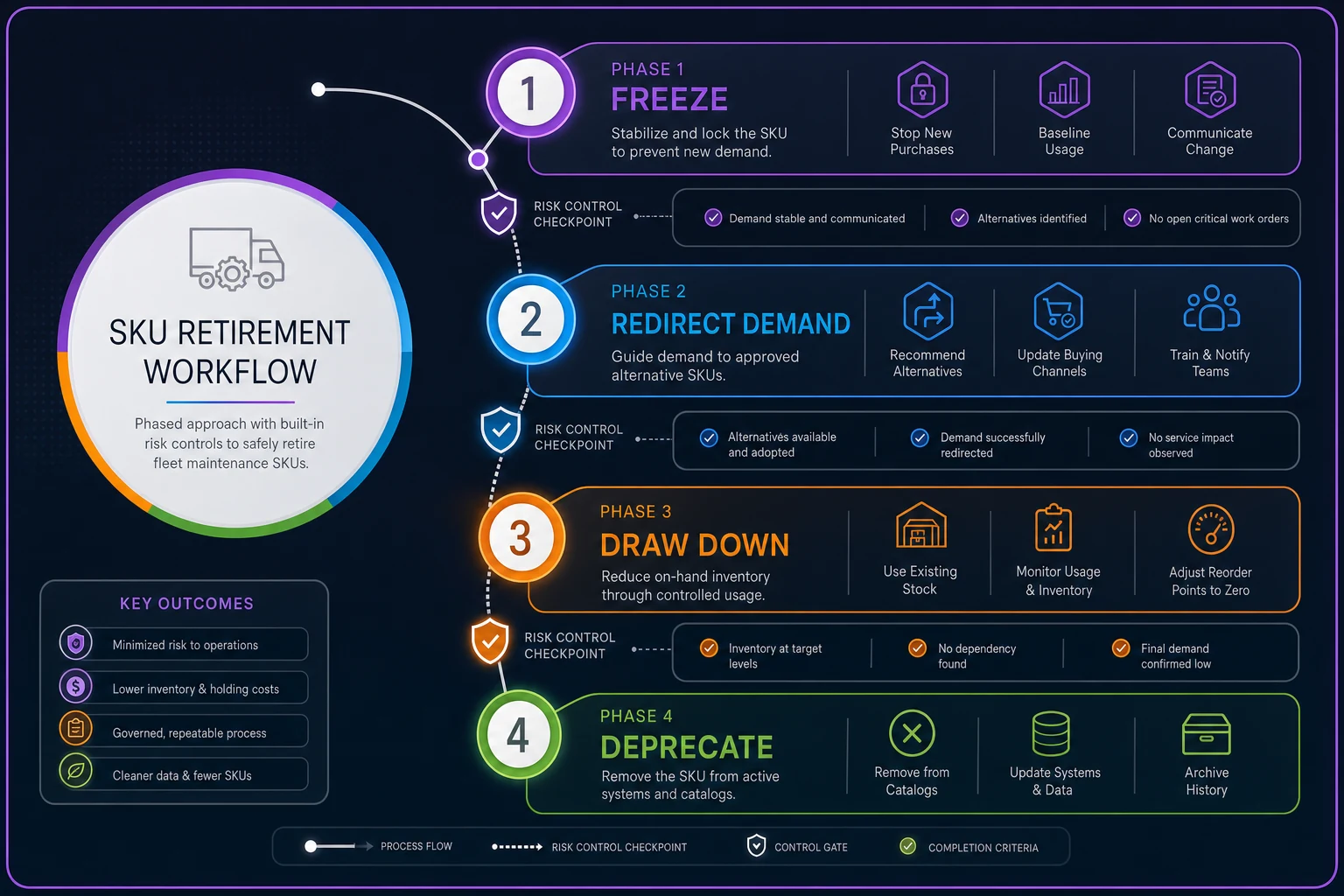
Phase 1 — Freeze (weeks 1–2). Flag the target SKU as "no reorder." Existing stock stays usable, but no new POs get cut against it. This stops money going toward duplicates while you validate everything else. Nothing gets stranded because nothing changes operationally yet.
Phase 2 — Redirect demand (weeks 2–6). Reroute the retiring SKU's consumption to the canonical part. This is the step people botch: the surviving SKU's reorder point has to absorb the combined demand of both part numbers. If Part A moved 8/month and Part B moved 5/month, the canonical SKU now needs safety stock sized for roughly 13/month, not 8. If you don't reset min/max here, you'll stock out during Phase 3. Getting these reorder levels right for variable lead times is its own discipline — worth reviewing your min/max, safety stock and criticality tier logic before you consolidate, because a retirement plan built on stale reorder points fails quietly.
Phase 3 — Draw down (weeks 6–12). Let existing stock of the retiring SKU deplete naturally through the substitution rules. Watch two signals: the retiring SKU dropping toward zero, and the canonical SKU holding its target stock without a stockout. If the canonical part gets shaky, back off and re-tune before going further.
Phase 4 — Deprecate (after clean draw-down). Mark the old SKU inactive but keep the historical record and the interchangeability mapping. You want to know, two years from now, that BRK-PAD-9981 was rolled into BRK-PAD-4412 — for warranty lookups, cost history, and the next audit.
Risk controls that ride alongside every phase
-
Criticality gate. Safety-critical and single-source-of-uptime parts get a slower, more conservative retirement. A wiper linkage can move fast. A brake component moves at half speed with extra verification.
-
Seasonality check. Don't run a draw-down phase into your peak operating season. Retire cooling-system SKUs in fall, not the week before summer.
-
Rollback trigger. Define, in advance, the condition that pauses a retirement — e.g., "any stockout on the canonical SKU" or "any tech-reported fitment issue." A retirement plan without a defined rollback is just optimism.
-
Single-supplier alarm. If consolidating onto the canonical SKU means depending on one vendor with no alternate, flag it. You may be trading SKU sprawl for supply-chain fragility, which is a worse trade during a shortage.
Every retirement should clear a criticality gate before it moves to the next phase. That gate is what separates a well-run rationalization from a regrettable one.
Supplier negotiation: use the consolidated volume as leverage
Once you've consolidated three SKUs into one, you're buying more of one part number from one supplier. That's a negotiating position — but only if you use it before the supplier realizes you've locked yourself in.
-
Consolidate first, negotiate second. Walk into the conversation already knowing your true combined annual volume on the canonical SKU. Vague "we buy a lot" gets you nothing. "We're now committing roughly 1,900 units a year of this part number, up from the 1,100 you saw last year" starts a real conversation.
-
Trade volume for price and terms. Don't just chase unit price. Consolidated volume is worth pushing on lead time guarantees, stocking commitments, and return rights on the deprecated SKUs still sitting on your shelf.
-
Never single-source without a price cap. If you're consolidating onto one supplier, get a documented ceiling. Consolidation gives them leverage too, and a proprietary part number with no cap is how a good deal becomes a slow squeeze.
> "We've rationalized our brake pad program from three part numbers down to yours. That takes your annual volume from roughly 1,100 to about 1,900 units. We're prepared to commit to that consolidated volume for the year. In return we need a tiered price on the combined quantity, a firm lead-time SLA, and buy-back or credit on the two SKUs we're retiring that we sourced through you. If those work, you become our single source on this line."
Notice what that does: it hands them growth, but ties it to terms, and quietly reminds them the consolidation could go a different direction if the terms don't land.
A real scenario: mid-size municipal fleet, brake and filtration lines
A regional fleet running roughly 140 mixed units — refuse trucks, light service vehicles, a handful of Class 6 chassis — had accumulated somewhere north of 4,000 active SKUs. Nobody set out to build it that way; it just grew.
A focused rationalization on two categories, brake components and filtration, surfaced around 60 SKUs that were duplicates or near-duplicates. After verification, roughly 40 got consolidated down to about 15 canonical part numbers.
The results over the following year weren't dramatic in a headline sense, but they were real: dead-stock write-offs on those two categories dropped noticeably, carrying cost came down by a few thousand dollars a month once the deprecated stock cleared, and — the part the parts manager cared about most — the number of "we're out, order the equivalent" emergency scrambles fell off significantly, because the shelf finally matched the substitution rules.
The consolidated brake volume also unlocked a tiered price and a lead-time commitment from the surviving supplier that the fragmented buying never would have. No unit got stranded during the retirement because the draw-down phases were sequenced around the fleet's peak weeks and the reorder points were reset before demand got redirected.
When this makes sense — and when to leave the shelf alone
When rationalization pays off:
-
Your active SKU count has grown faster than your fleet size.
-
You're carrying dead stock you can't quite explain.
-
Emergency "order the equivalent" substitutions happen weekly and never get reconciled.
-
You buy the same functional part from multiple vendors under different numbers.
When to slow down or skip it:
-
On safety-critical parts where the verification effort outweighs the carrying-cost savings — the risk math doesn't favor aggressive consolidation.
-
Right before or during peak season. Retire in the trough, not the peak.
-
When "duplicates" are actually protecting you from a single-supplier risk. Sometimes carrying two numbers is deliberate resilience, not sprawl.
-
When your parts data is too messy to trust. If you can't reliably tell what moved and what didn't, fix the data first. Retiring SKUs on bad data is how you retire the wrong one.
Who should not run this on gut feel: any shop without a clean movement history and a verified interchangeability record. Rationalization is a data exercise before it's a purchasing one. If the underlying part records are unreliable — inconsistent naming, missing fitment data, no substitution logs — you'll consolidate the wrong pairs and find out on a hoist.
The quiet advantage: your own repair history is the best catalog
The real leverage in fleet parts rationalization isn't the OEM catalog or the supplier's cross-reference sheet. It's your own service data. Every substitution your techs log, every part that held up in service, every fitment that failed — that's a proprietary interchangeability record no vendor can sell you, and it's specific to how your units actually get used and abused.
That's why the less exciting parts of this playbook — logging the actual SKU used on every job, keeping deprecated mappings instead of deleting them, running the monthly new-SKU check — matter more than the big annual cleanup. Fleets that keep that data clean, whether in a purpose-built maintenance platform or a disciplined system of record, get to rationalize confidently every year. Fleets that don't end up doing a painful cleanup every three years and refilling the shelves in between.
Get the cadence right, verify before you retire, sequence the draw-down around your season, and negotiate from the consolidated volume before you're locked in. That's the whole game.
Ready to maximize fleet uptime and reduce maintenance costs?
Join 2,000+ fleet managers using Fleetelyly to streamline maintenance workflows and improve vehicle reliability.