

Most fleet maintenance analytics don't fail because the models are bad. They fail because the data feeding those models shifts quietly underneath everyone, and nobody owns the moment it breaks. A telematics vendor changes how it reports engine hours. A shop starts logging oil changes under a new labor code. A VIN field that used to be 17 characters starts showing up with trailing spaces. None of these are dramatic. All of them poison a predictive maintenance model or a cost-per-mile report within a few weeks.
That's the real governance problem in fleet maintenance — not a lack of dashboards, but a lack of agreements about what the data is supposed to mean and who's responsible when it stops meaning that. This post is about building governance light enough that technicians, analysts, and vendors actually follow it, but structured enough that your predictive maintenance and maintenance analytics don't quietly rot.
Why maintenance data governance breaks differently than other data governance
Corporate data governance frameworks were written for finance and customer data — places where records are entered by a handful of trained people into controlled systems. Fleet maintenance data is the opposite. It comes from everywhere at once: telematics units bolted to trucks, tablets in a loud shop, third-party repair invoices, a parts system that barely talks to the work-order system, and a warranty portal that expects a completely different format.
Each of those sources has a different "owner" who doesn't think of themselves as a data producer at all. The technician closing a work order is trying to get the truck back on the road, not thinking about whether the fault code field is populated correctly for someone's model six weeks later. The telematics admin is thinking about device connectivity, not schema stability. So when something changes, there's no handoff, no notice, and nobody feels accountable.
The result is a slow drift. A maintenance analytics team ends up spending a huge chunk of its time — realistically somewhere between 40 and 60 percent in a lot of shops — just cleaning and reconciling data instead of producing decisions. Governance, done right, is about shrinking that number. Not with a 50-page policy document, but with a handful of agreements that actually hold.
The core idea: treat every dataset like it has a supplier and a customer
The single most useful mental shift is to stop thinking about "the data" as one shared pool and start thinking about producers and consumers with a contract between them. The telematics feed is a product. The work-order export is a product. The parts-usage table is a product. Each has someone upstream who produces it and someone downstream who depends on it to make a decision.
Prevent costly breakdowns with proactive maintenance.
Fleetelyly helps you schedule, track, and manage every vehicle service efficiently.
- Automated maintenance reminders
- Real-time service tracking
- Parts inventory integration
No credit card required
Once you frame it that way, governance becomes a set of simple SLAs — service-level agreements between the producer and the consumer. Not legal documents. One-page definitions of what the consumer can count on and what happens when something breaks.
A workable producer/consumer SLA for a maintenance dataset covers maybe five things:
-
Freshness — how current the data is (e.g., work orders land in the analytics layer within 24 hours of closing, telematics within 15 minutes)
-
Completeness — which fields are guaranteed populated, and acceptable null rates for the rest
-
Schema stability — producer commits to notifying consumers before changing field names, types, or codes
-
Accuracy expectations — known tolerances (odometer readings within a reasonable range, no future-dated repairs)
-
Break protocol — who gets notified, how fast, and who owns the fix when the SLA is violated
That last one matters more than people expect. Most governance programs define quality rules and then have no answer for what happens when a rule fails at 2 a.m. The SLA isn't real until someone's name is attached to the broken-pipe response.
A sample SLA breakdown for common fleet datasets
| Dataset | Producer | Primary consumer | Freshness target | Most common break |
|---|---|---|---|---|
| Telematics fault codes | Telematics vendor / admin | PdM models, alert triage | ~15 min | Code mapping changes after firmware update |
| Work-order closeouts | Shop techs / service writers | Cost analytics, MTTR, RCA | ~24 hrs | Labor/complaint codes used inconsistently |
| Parts usage | Parts/inventory system | Cost-per-mile, reorder logic | ~24 hrs | SKU renames, superseded part numbers |
| Repair invoices (external) | Outside vendors | Chargeback, warranty recovery | 3–5 days | Format drift, mismatched VIN formats |
| PM completions | Scheduling system | Compliance, PM effectiveness | ~24 hrs | Backdated or bulk-closed PMs |
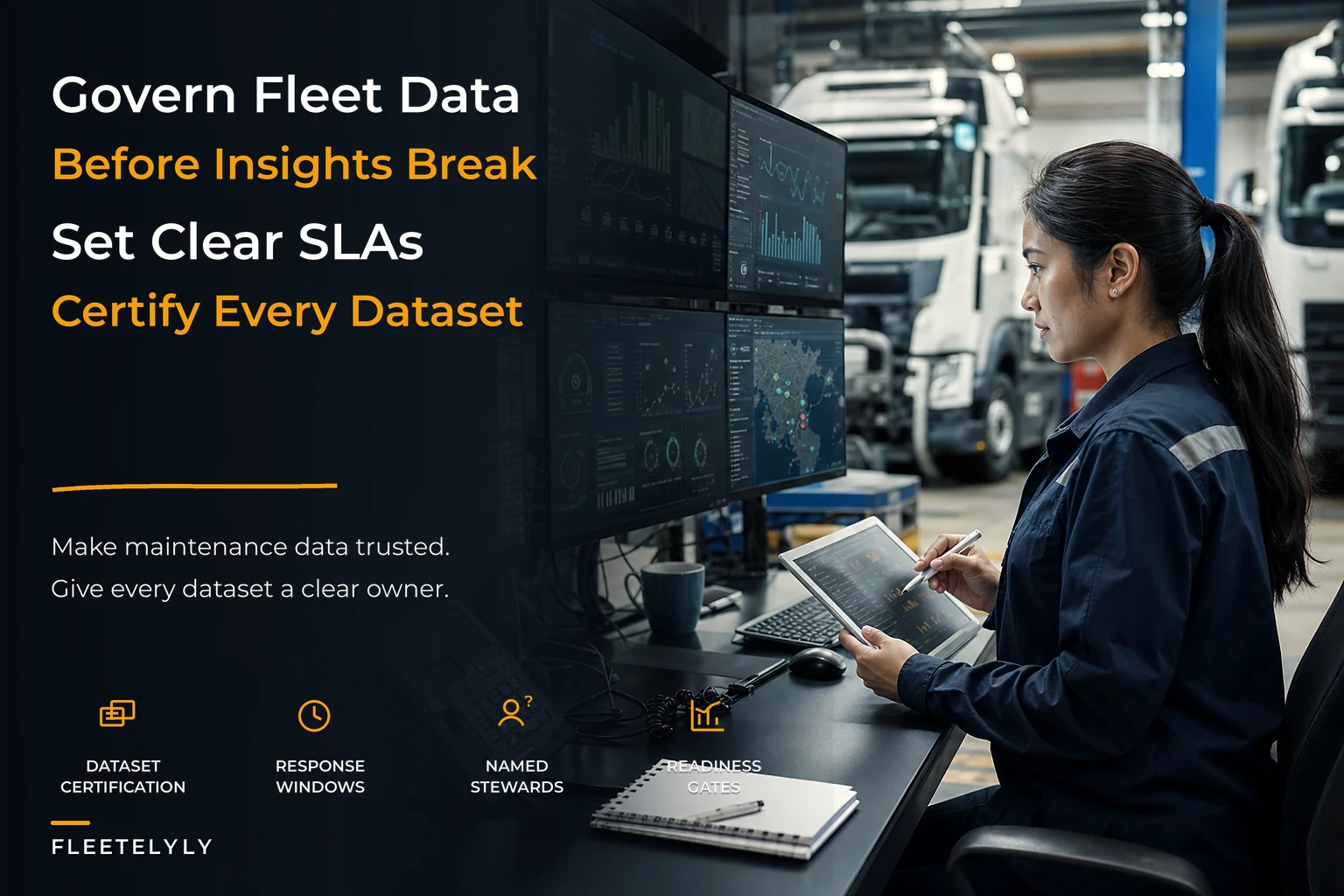
The diagram shows the producer-consumer flow and the certification gates.
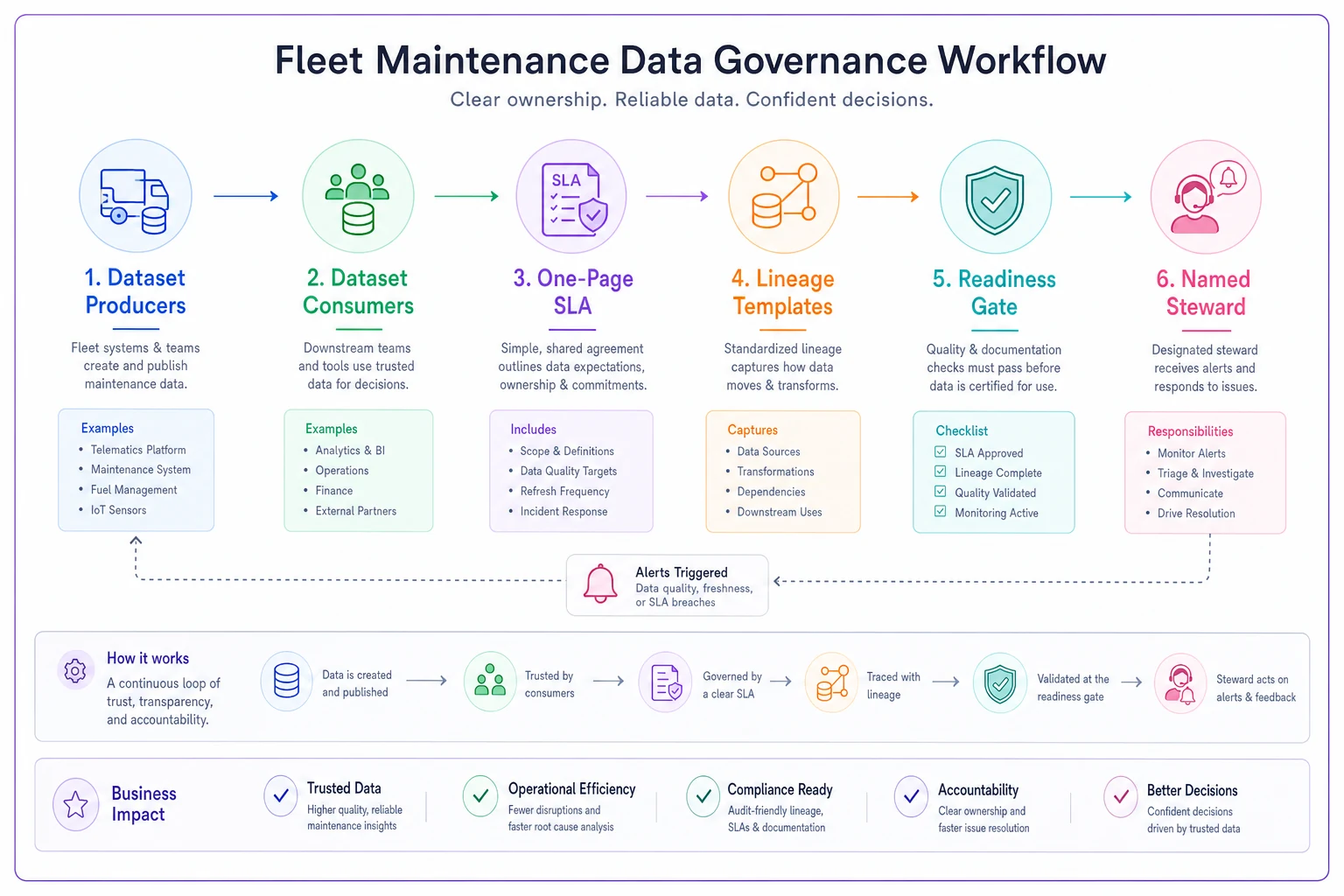
Notice how different the freshness targets are. A mistake that shows up constantly is treating all data as if it needs to be real-time, which makes governance feel impossibly heavy. Most maintenance decisions run on daily or weekly cadences. Reserve the strict SLAs for the feeds that actually drive automated action.
Lineage you can actually maintain
Everyone nods along about data lineage and then abandons it because full column-level lineage across a messy fleet stack is a project that never ends. The practical version is lighter: a lineage template that captures just enough to answer three questions when something breaks.
-
Where did this number come from?
-
What transformations happened between the source and the report?
-
Who do I call if it's wrong?
A one-page lineage template per critical dataset usually does the job. It lists the source system, the key fields, the transformation steps in plain language (not code), the downstream reports and models that depend on it, and the steward. When your cost-per-mile number looks off, you don't launch an investigation — you pull the lineage sheet and work backward in ten minutes.
This connects directly to how you've structured your underlying platform. If you've already done the work of defining a clean master-data layer and event taxonomy — the kind laid out in a minimal master-data and event-taxonomy blueprint for a fleet maintenance data platform — your lineage templates get dramatically simpler because the source definitions are already stable. Governance is much easier to bolt onto a platform with a deliberate taxonomy than onto a pile of spreadsheets and exports.
Worth internalizing: lineage isn't documentation for its own sake. It's the thing that turns a half-day firefight into a ten-minute lookup. If your lineage template doesn't actually shorten break investigations, it's too detailed and nobody will keep it current.
Dataset readiness gates: certify before anyone trusts it
A readiness gate is a checklist a dataset has to pass before it's allowed to feed a decision or a model. Think of it like the inspection a vehicle passes before it leaves the bay — you don't skip it because the truck "looks fine."
Readiness gates stop the most expensive failure mode in maintenance analytics: building a predictive model or a budget forecast on data that was never validated. Teams spend months tuning a PdM model only to discover the training data included a period where a whole depot's fault codes were miscategorized. The model learned garbage, confidently.
A reasonable readiness gate for a maintenance dataset before certification:
-
Schema matches the agreed contract (field names, types, code lists)
-
Null rates on guaranteed fields are within tolerance
-
Key identifiers (VIN, asset ID, part number) resolve against master data with a high match rate — somewhere above 97–98 percent
-
No impossible values (negative odometer deltas, future repair dates, labor hours over a realistic ceiling)
-
Volume is within expected range (a sudden drop usually means a broken pipe, not a quiet week)
-
Lineage template exists and names a steward
-
The dataset has been stable through at least two refresh cycles
Only when a dataset clears the gate does it get the "certified" label that analysts and model owners are allowed to trust. Everything else is explicitly marked as provisional. That single distinction — certified vs. provisional — prevents an enormous amount of downstream confusion, because people stop building critical decisions on data that was never meant to carry that weight.
Automate identifier-match and null-rate checks so datasets fail fast before certification.
This pairs naturally with how you move from numbers to action. A certified dataset is the foundation of a reliable analytics-to-decision framework for fleet maintenance — skip the certification step and every decision downstream inherits the uncertainty, and eventually people stop trusting the whole analytics program.
Stewardship runbooks: what to do when it breaks
A steward isn't a full-time data job in most fleets. It's a named person who owns a dataset's health as part of their existing role — often a senior analyst or a maintenance systems lead. The point of the runbook is that when something breaks, the response doesn't depend on that person's memory or their availability at that particular moment.
A stewardship runbook for a maintenance dataset is short and operational. For each common failure, it answers: how you detect it, what you check first, how you contain it, and who you escalate to. A typical entry looks like this:
Failure: telematics fault-code distribution shifts suddenly
-
Detect
daily check flags codes appearing/disappearing outside normal range
-
First check
recent firmware or vendor mapping change
-
Contain
mark affected date range as provisional; hold PdM retraining
-
Escalate
telematics admin within 4 hours; notify model owner same day
The whole thing fits on a page or two per dataset. What makes it work isn't completeness — it's that it removes the "who do I even call?" paralysis that turns a small break into a two-week data quality incident.
The fleets that recover fastest from data breaks aren't the ones with the most sophisticated monitoring. They're the ones where the runbook made containment the first move. Marking data provisional and holding downstream use for a day is almost always cheaper than letting a corrupted feed flow into a budget forecast or an auto-generated work order.
Where automation genuinely helps — and where it doesn't
A lot of this — freshness checks, null-rate monitoring, schema-drift detection, identifier match rates — is tedious to do by hand and nearly impossible to sustain manually as the fleet grows. This is where operational software with AI-assisted monitoring earns its place: automated checks that run every refresh, flag anomalies against the readiness gate, and route the alert straight to the named steward with the relevant lineage attached. The automation handles detection and routing; people still own the judgment calls and the fixes.
What automation should not do is replace the SLA negotiation or the stewardship decisions. Teams try to buy their way out of governance by installing a data-quality tool and expecting it to define quality for them. It can't. The tool can tell you a null rate jumped; it can't tell you whether that matters for your particular PdM use-case. The thinking stays human. The watching and the nagging can be automated — and honestly should be, because that's the part people reliably stop doing when things get busy.
When this level of governance makes sense — and when it's overkill
When it's worth it:
-
You're running predictive maintenance models that drive real spending or scheduling
-
You operate a mixed fleet with multiple data sources that don't naturally reconcile
-
More than one team depends on the same datasets for different decisions
-
You've been burned by a silent data break that produced a wrong decision
When it's overkill:
-
A small single-depot fleet where one person touches all the data and knows every quirk
-
Early experimentation where you're still figuring out which data even matters
-
Datasets that feed curiosity dashboards nobody acts on
Don't certify everything. Pick the five or six datasets that drive actual decisions and money, and govern those properly. Trying to apply SLAs and readiness gates to every table in the warehouse is how governance programs collapse under their own weight in the first quarter.
A short real scenario
A regional mixed fleet — roughly 400 vehicles across three depots — had stood up a predictive maintenance program and a cost-per-mile dashboard. Both looked great for a few months, then started disagreeing with reality. PdM alerts dropped off, and maintenance cost numbers swung without obvious cause.
The root issue was undramatic. One depot had migrated to a new tablet app for work orders and started using slightly different complaint and labor codes. Nobody upstream flagged it, because nobody upstream thought of themselves as owning a dataset. The analytics team eventually traced it, but it took the better part of two weeks and a stretch of decisions made on bad numbers.
After putting in lightweight governance — producer/consumer SLAs on the five decision-driving datasets, one-page lineage sheets, a readiness gate before any PdM retraining, and stewardship runbooks with named owners — the next similar break was caught at the daily check. The affected data was marked provisional the same morning, the depot was contacted, and the fix landed in about a day and a half instead of two weeks. The analysts also got a chunk of their week back, because they weren't constantly re-verifying numbers they couldn't trust.
Nothing about that fix was exotic. It was agreements, a few templates, and named accountability.
Pulling it together
Governance in fleet maintenance analytics isn't a compliance exercise and it isn't a tooling purchase. It's the set of small, enforced agreements that keep your data meaning what everyone assumes it means. Producer/consumer SLAs assign ownership. Lineage templates make breaks traceable. Readiness gates stop bad data from reaching decisions. Stewardship runbooks make the response fast and repeatable.
Keep it light. Govern the datasets that drive money and scheduling, leave the rest provisional, and let automation handle the tedious watching so your people can handle the judgment. The fleets that get this right aren't the ones with the heaviest frameworks — they're the ones whose analytics teams have stopped quietly distrusting their own numbers.
Governance in fleet maintenance analytics isn't a compliance exercise and it isn't a tooling purchase. It's the set of small, enforced agreements that keep your data meaning what everyone assumes it means. Producer/consumer SLAs assign ownership. Lineage templates make breaks traceable. Readiness gates stop bad data from reaching decisions. Stewardship runbooks make the response fast and repeatable.
Keep it light. Govern the datasets that drive money and scheduling, leave the rest provisional, and let automation handle the tedious watching so your people can handle the judgment. The fleets that get this right aren't the ones with the heaviest frameworks — they're the ones whose analytics teams have stopped quietly distrusting their own numbers.
Ready to maximize fleet uptime and reduce maintenance costs?
Join 2,000+ fleet managers using Fleetelyly to streamline maintenance workflows and improve vehicle reliability.