


Most fleets already have the data. Telematics streams pouring in, work-order histories going back years, supplier scorecards, warranty logs, PM schedules. The problem almost never is "we don't have enough signals." The problem is that when a signal fires, nobody agrees on who owns the next move, how fast they need to move, or what budget it comes out of.
That gap — between a dashboard lighting up and an actual decision getting made — is where fleets bleed money and uptime. A derate code sits in someone's inbox for three days because it wasn't clear whether it was a shop problem, a supplier problem, or a "monitor it" problem. A supplier late-delivery signal never triggers a schedule adjustment because the person watching the supplier dashboard isn't the same person building the PM calendar. Everyone has the information. Nobody has the decision rights mapped to it.
This is a systems article. Not a list of KPIs to watch, not another triage tree. The goal is to lay out how you build a repeatable path from signal → owner → decision → SLA → escalation → feedback, so that when something fires at 6am on a Tuesday, the routing already exists and the analytics get smarter every time you use it.
Why the signal-to-decision gap exists in almost every fleet
Most fleet analytics were built to report, not to decide. Someone stood up a telematics platform, someone else built a maintenance dashboard, procurement runs its own supplier tracking, and finance owns the budget view. Four systems, four owners, four different refresh cadences. Each one produces signals. None of them agree on what happens next.
Across a lot of fleet operations, decisions get made informally — by whoever happens to notice the problem first and feels enough ownership to act. That works fine when you're running 40 vehicles and the maintenance manager sees everything. It falls apart somewhere around 150 to 300 assets, when no single person can hold the whole picture in their head anymore.
The pattern that repeats: a signal fires, three people all assume someone else is handling it, and the vehicle either sits or gets over-serviced. Both are expensive. The over-servicing is sneakier because it feels like diligence. A fault code that should've been a "monitor for 500 miles" turns into a bay slot, a diagnostic, and a technician's afternoon — because nobody had authority to say "wait."
The second reason the gap exists is that signals arrive with wildly different urgency and cost consequences, but they get treated with the same flat process. A brake-system warning and a low-priority telematics nuisance code both become "a thing to look at." Without a taxonomy that classifies signals by severity and decision-owner, you're forcing your best judgment onto every single alert, every single day. That doesn't scale, and it burns out the exact people you can't afford to lose.
Building a signal taxonomy first
Before you assign owners or SLAs, you have to name and rank the signals. This is the part most fleets skip, and it's why their escalation processes feel chaotic — you can't route what you haven't classified.
Prevent costly breakdowns with proactive maintenance.
Fleetelyly helps you schedule, track, and manage every vehicle service efficiently.
- Automated maintenance reminders
- Real-time service tracking
- Parts inventory integration
No credit card required
A workable taxonomy has three axes: source, severity, and decision type. Source is where the signal originates. Severity is how bad the consequence is if you're wrong. Decision type is the shape of the response — act now, schedule it, monitor it, or escalate it up a level.
| Signal source | Example signal | Severity tier | Default decision type |
|---|---|---|---|
| Telematics (real-time) | Brake pressure fault, engine derate | Critical | Act now — pull from service |
| Telematics (trend) | Rising coolant temp over 2 weeks | Elevated | Schedule diagnostic |
| Telematics (nuisance) | Recurring low-severity fault code | Low | Monitor / tune threshold |
| Work-order (recurrence) | Same component failing 3rd time | Elevated | Escalate to RCA |
| Work-order (cost overrun) | Repair exceeds estimate by >30% | Elevated | Budget-owner review |
| Supplier | Late delivery on critical part | Elevated | Schedule + inventory adjust |
| Supplier | Quality defect rate spike | Critical | Escalate to procurement lead |
| Warranty | Failure inside coverage window | Elevated | Route to warranty owner |
The point of the taxonomy isn't to be exhaustive on day one — it's to force agreement on what "critical" actually means before a critical event happens. A signal that lands in "critical" needs to trigger a fundamentally different path than one in "low." If your team can't distinguish those cleanly, no downstream process will save you.
One thing worth flagging: nuisance codes deserve their own category on purpose. If you dump false or low-value alerts into the same bucket as real ones, your response windows get poisoned by noise and people start ignoring the dashboard entirely. Getting that noise under control is its own discipline — there's a full audit-and-tuning playbook for false telematics alerts that pairs directly with building this taxonomy, because a taxonomy built on untuned signals just automates the chaos faster.
The who-decides-when matrix (decision-owner RACI)
Once signals are classified, you assign decision rights. The mistake here is thinking a RACI is a formality — a box you fill in for the compliance binder. In practice, the RACI is the thing that determines whether a signal moves or stalls.
For fleet maintenance decisions, keep the RACI tight. Every signal type needs exactly one Accountable owner — the person who owns the outcome — and clarity on who's Responsible for the actual work, who must be Consulted, and who's just Informed. When two people are both "accountable" for the same signal, that's not redundancy, that's a stall waiting to happen.
-
Maintenance supervisor — Accountable for critical and elevated telematics signals that affect vehicle availability. Decides act-now vs. schedule.
-
Shop lead / foreman — Responsible for executing the diagnostic or repair once routed.
-
Reliability / RCA owner — Accountable when a signal is a recurrence, not a one-off. This is a different decision than "fix the truck."
-
Parts / procurement lead — Accountable for supplier and inventory signals. Owns the schedule impact of a late or defective part.
-
Budget owner (finance or ops manager) — Consulted on any repair crossing a defined cost threshold; Accountable for repair-vs-replace calls above the CAPEX line.
-
Fleet manager — Informed on most, Accountable only on escalations that cross budget or safety thresholds.
The single most useful move here is separating the fix-it decision from the why-did-it-happen decision. When the same person owns both, the "why" always loses — because the truck needs to go back in service today and root cause can wait until never. Assigning recurrences to a distinct reliability owner is how you break that cycle. If you're formalizing this, the fleet RCA process with evidence templates and escalation triggers covers exactly what that owner should be doing when a signal gets routed to them.
SLAs and response windows: attaching time to every decision
A decision owner with no clock is just a suggestion. The taxonomy tells you what it is, the RACI tells you who owns it, and the SLA tells you by when they have to move. Without the third piece, elevated signals quietly drift into low-priority territory because nothing forces action.
-
Acknowledge — Owner confirms they've seen the signal and it's theirs.
-
Decide — Owner classifies the response (act/schedule/monitor/escalate).
-
Resolve — The work is done or the escalation is closed.
A reasonable starting framework:
-
Critical signals Acknowledge within 15–30 minutes, decide within the hour, vehicle pulled or safed same shift.
-
Elevated signals Acknowledge same day, decide within 24 hours, resolution scheduled within the week.
-
Low / monitor signals Reviewed in a weekly batch, no individual clock, but tracked for trend.
-
Supplier signals Acknowledge within 24 hours, but the decision window depends on lead-time exposure — a late part on a critical SKU with two weeks of buffer is different from one with two days.
The insight most people miss is that the decide window is where the real value lives, not the resolve window. Resolution depends on parts, bays, and technicians — things partly outside your control. But acknowledging and deciding are fully within your control, and that's where signals die. Measure decision latency separately and you'll expose the stalls that a resolution-only SLA hides.
Worked escalation examples
Example one — recurring derate on a delivery unit. A medium-duty box truck throws an engine derate code. It's the third time in about six weeks. First derate: routed as critical, maintenance supervisor pulls it, shop clears the code, back in service — normal path. But the taxonomy has a rule: third occurrence of the same code within 90 days auto-reclassifies as a recurrence. So instead of just clearing it again, the signal now routes to the reliability owner, not the shop lead. That owner opens an RCA, pulls the work-order history, and finds two different technicians treated symptoms without checking the same sensor harness. Root cause was a chafed wire, not the component that kept getting replaced. Cost of the three symptom-fixes was somewhere around $2,400 combined; the actual fix was under $300. The escalation rule paid for itself on one truck.
Example two — supplier late-delivery cascade. Procurement's supplier dashboard flags that a critical brake component supplier has slipped from 3-day to 9-day lead times. Under a flat process, this sits on the procurement lead's screen and nothing changes until a truck needs the part and it's not there. Under a routed system, the supplier signal at "elevated" severity has a defined consult path: procurement lead plus maintenance planner, within 24 hours. Together they check which PM jobs in the next two weeks need that SKU, pull safety stock forward, and re-sequence two brake jobs to before the buffer runs dry. No downtime, no expedite fees. The signal didn't just get seen — it triggered a coordinated schedule move because the routing defined who gets pulled in.
The difference in both cases isn't smarter people. It's that the path from signal to decision was pre-built, so nobody had to invent it under pressure.
Escalation templates worth standardizing
The reason escalations fail isn't lack of urgency — it's that each one gets rebuilt from scratch, missing context, and lands on someone's desk without enough to act on. Templates fix that. Keep them short and structured so the receiving owner can decide fast.
-
Signal ID and source — what fired and where it came from
-
Classification — severity tier and current decision type
-
Trigger reason — why it's escalating (threshold crossed, recurrence, cost overrun)
-
What's been tried — prior work-orders or actions, with dates
-
Decision requested — the specific call the owner needs to make
-
Budget exposure — estimated cost and which budget line it hits
-
Clock — when the SLA window closes
That "decision requested" line is the one people leave off, and it's the most important. An escalation that says "please review" invites delay. One that says "approve repair-vs-replace on unit 214, estimate $6,800, exceeds threshold by $1,300, decision needed by Thursday" gets answered. The template forces the sender to have already framed the decision, which is half the work.
Case-routing and feedback loops: where the system compounds
Everything above is static until you close the loop. The real leverage in an analytics-to-decision framework for fleet maintenance is that every routed case becomes training data for the next one. If a signal gets classified as "critical," acted on, and then turns out to have been a nuisance — that outcome should feed back and tune the threshold. If a supplier signal repeatedly leads to schedule disruption, that pattern should raise the supplier's risk weighting automatically.
A signal-to-decision feedback loop typically moves through the following stages: a signal fires and gets classified against the taxonomy, the routing layer assigns it to the accountable owner with the SLA clock started, the owner decides and the work executes, and the closed outcome posts back against the original classification — adjusting thresholds and owner assignments as the data accumulates. Each completed cycle sharpens the next one.
A visual of the routing and feedback workflow:
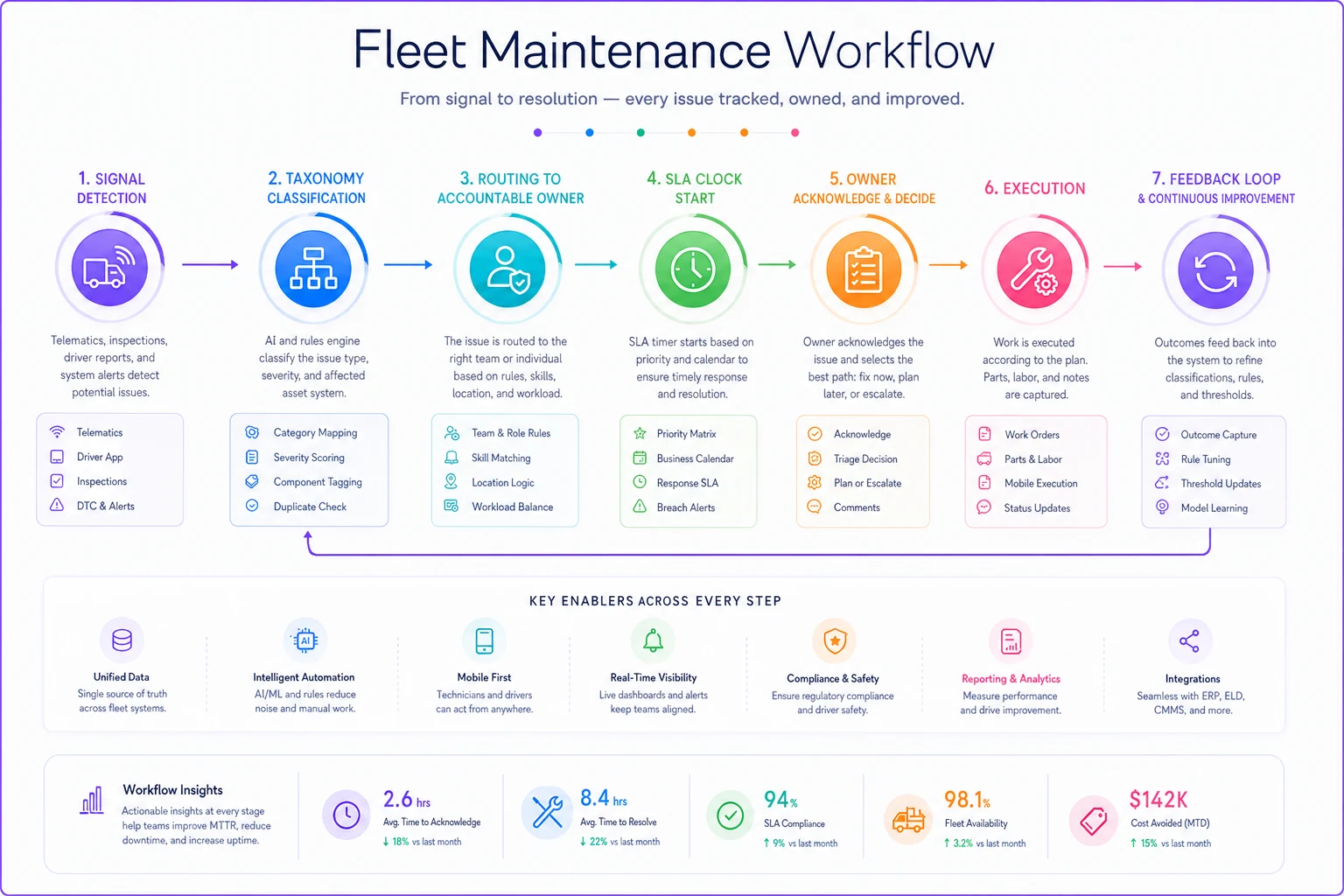
This is where operational software earns its place — not as a dashboard, but as the connective tissue. A workflow platform enhanced with AI automation can watch incoming signals, apply the taxonomy rules, route each case to the accountable owner with the escalation template pre-filled, start the SLA clock, and log the eventual outcome back against the original classification. The value isn't the alerting — you already have alerts. The value is that routing, timing, and feedback stop depending on whoever happens to be paying attention that morning.
-
Consistency — the same signal type always routes the same way, regardless of who's on shift.
-
Decision latency — the acknowledge-and-decide clock is enforced automatically, so stalls surface instead of hiding.
-
Model feedback — closed cases feed outcome data back into your predictive and threshold models, so classifications get sharper over time instead of drifting.
-
Cross-team coordination — supplier, maintenance, and finance signals land in one routing layer instead of four disconnected tools.
The feedback loop is what separates a framework that improves from one that just runs. Every case that closes should answer: was the classification right? Was the SLA realistic? Did the right owner get it? Feed those answers back, and six months later your taxonomy reflects your actual fleet — not the assumptions you started with.
When this framework makes sense — and when it doesn't
When it makes sense: You're running enough assets — usually north of 100 to 150 — that no single person can hold every open signal in their head. You have multiple owners across maintenance, parts, and finance. And you're already generating more signals than you're acting on cleanly. If your dashboards are full but your decisions feel reactive and inconsistent, this framework addresses that directly.
When it's overkill: A small fleet with one maintenance manager who genuinely sees everything doesn't need a formal RACI and routing layer — it'd add overhead without solving a real problem. Build the taxonomy anyway (it's cheap and it future-proofs you), but skip the heavy routing until you feel the coordination strain.
Who should not do this yet: If your underlying signals are noisy and untuned, don't automate routing on top of them. You'll just deliver garbage faster to more people. Clean the signal quality first, then build the decision layer on top of data you trust.
Bringing it together with governance
A signal-to-decision framework isn't a one-time build. Classifications drift, suppliers change, new fault patterns emerge, and SLA windows that made sense last year strangle you this year. That's why this framework needs to sit inside a review cadence — quarterly, at minimum — where you audit whether the taxonomy still matches reality and whether decision owners are actually meeting their windows.
The routing framework handles the day-to-day; the governance layer keeps it honest over time. The maintenance governance framework for mixed fleets covers how to structure those decision gates and quarterly reviews so this doesn't quietly rot.
The fleets that get real leverage out of their analytics aren't the ones with the fanciest dashboards. They're the ones where a signal firing means something specific happens next — a known owner, a known clock, a known path — and where every closed case makes the next decision a little sharper. Get that loop running, and your data finally starts doing what you bought it to do: drive decisions, not just describe problems.
Ready to maximize fleet uptime and reduce maintenance costs?
Join 2,000+ fleet managers using Fleetelyly to streamline maintenance workflows and improve vehicle reliability.