


Most VMI pitches sound great in the conference room. The supplier owns the stocking, you stop writing POs for every brake pad, and your parts room magically stays full. Then six months in, your lead tech is standing in front of an empty bin for a filter that used to always be there, and nobody can explain why the fill rate looks "fine" on the supplier's dashboard.
That gap — between the dashboard everyone agreed on and the shelf reality your mechanics live with — is where most fleet VMI programs quietly fail. Not in a dramatic blowup. Just a slow erosion of trust until someone starts hoarding a side stash of critical SKUs again, which defeats the entire point.
This playbook is about running a VMI pilot the way you'd run any other operational change: tight scope, real prerequisites, SLAs with teeth, and a kill switch. We're focusing only on critical MRO SKUs for fleets, because that's where VMI either earns its keep or sinks your availability.
Why fleet VMI fails differently than warehouse VMI
Vendor-managed inventory came out of retail and manufacturing, where consumption is relatively smooth and predictable. A distribution center burns through corrugated boxes at a steady clip. The supplier can forecast replenishment with a spreadsheet and a calendar.
Fleet maintenance doesn't work that way. Your consumption is lumpy and event-driven. You might not touch a particular water pump for five months, then pull four in a week because a batch of vehicles hit the same mileage band or a telematics fault code started cascading across a sub-fleet. A VMI model tuned for smooth demand will chronically under-stock the exact parts that spike.
The second difference: in retail VMI, a stockout means a lost sale. Annoying, recoverable. In a fleet, a stockout on a critical SKU means a truck sits. That downtime has a dollar figure attached that's usually far higher than the part itself — and it's your downtime, not the supplier's. The incentives are misaligned from day one unless your SLA forces them to align.
VMI suppliers optimize for inventory turns and their own carrying cost. You optimize for availability. Those two goals only overlap if your contract makes them.
Prerequisites: don't start a pilot until these exist
A significant share of failed pilots failed before they started, because the fleet didn't have the data foundation to hold a supplier accountable. If you can't measure consumption cleanly, you can't tell whether VMI is helping or hurting — you're just trusting a vendor's report.
Prevent costly breakdowns with proactive maintenance.
Fleetelyly helps you schedule, track, and manage every vehicle service efficiently.
- Automated maintenance reminders
- Real-time service tracking
- Parts inventory integration
No credit card required
-
Clean consumption history for the candidate SKUs. At minimum 12 months, ideally 18–24, so seasonal and mileage-driven spikes show up. If your part usage isn't tied to work orders reliably, fix that first.
-
A defined criticality tier for every SKU in scope. Not every part belongs in a VMI program. You want the fast-moving, uptime-critical items where a stockout is expensive. If you haven't set tiers yet, the logic in this spare-parts reorder policy for variable lead times is a good starting point for separating the SKUs that matter from the ones that don't.
-
Current baseline metrics. Your existing fill rate, average lead time, stockout frequency, and carrying cost on the candidate SKUs. Without a baseline, you can't prove the pilot worked or failed.
-
A single system of record for inventory transactions. If parts get consumed in three different places — shop floor, mobile techs, satellite depot — and reconciled manually, VMI will amplify the chaos, not fix it.
-
Bin-level location accuracy. The supplier needs to know where the stock physically lives and how it's counted. Vague "we keep some in the back" arrangements wreck telemetry-based replenishment.
If two or more of these are missing, your pilot isn't ready. Spend a quarter fixing the data instead of launching a program you can't evaluate.
Which SKUs belong in a fleet VMI pilot (and which don't)
This is where fleets get greedy and try to hand over the whole parts room. Resist that.
| SKU type | Good VMI candidate? | Why |
|---|---|---|
| High-velocity consumables (filters, wiper blades, common bulbs, fluids) | Yes | Predictable-ish demand, cheap to overstock slightly, painful to stock out |
| Mid-tier wear parts (brake pads, belts, common sensors) | Usually | Good if consumption data is clean and the SKU is standardized across the fleet |
| Critical slow-movers (specific ECUs, transmission components) | Rarely | Demand too lumpy; better handled by consignment or a strict reorder policy |
| One-off / vehicle-specific parts | No | No consumption pattern for the supplier to manage |
| Obsolescence-risk parts | No | You want direct control over last-time-buy decisions |
The sweet spot for a first pilot is high-velocity and mid-tier wear parts — somewhere around 30 to 60 SKUs. That's enough volume to generate meaningful replenishment signals and enough concentration that a stockout actually teaches you something. Trying to pilot 400 SKUs at once means you can't isolate what's working.
The SLA is the whole game
A VMI agreement without a hard SLA is just you giving a supplier a key to your parts room and hoping for the best. The SLA is where you encode "your incentives must match my uptime."
Two numbers matter most: fill rate and replenishment lead time. Define both precisely, because suppliers love to measure fill rate in ways that flatter themselves.
Fill rate — define it at the bin, not the order
The trap: a supplier reports "98% fill rate" measured as lines shipped against lines they chose to replenish. That's meaningless. You want fill rate measured as parts available at the bin when a tech reached for them.
Sample SLA language in plain terms:
-
Target bin availability
97–98%
for Tier-1 critical SKUs, measured per SKU per month. -
A "miss" = any instance where a tech needs a Tier-1 SKU and the bin is below the agreed minimum.
-
Misses are logged automatically at consumption time, not self-reported by the supplier.
Lead time — measure trigger-to-shelf
Replenishment lead time should be measured from the moment the min threshold is breached to the moment stock is physically back on the shelf and counted. Not "time from when we cut the replenishment order." That second definition lets a supplier sit on a signal for three days and still look compliant. Reasonable targets for a regional supplier on common SKUs: 24–48 hours for Tier-1, 3–5 business days for Tier-2.
Put consequences in writing
| Metric | Target | Measurement | Breach consequence |
|---|---|---|---|
| Tier-1 bin availability | ≥97% monthly | Logged at consumption | Credit + root-cause report |
| Tier-1 replenishment | ≤48 hrs trigger-to-shelf | System timestamps | Escalation after 2 breaches/month |
| Tier-2 bin availability | ≥95% monthly | Logged at consumption | Credit |
| Data accuracy (count vs physical) | ≥99% | Monthly cycle count | Joint audit if below |
The credit amount matters less than the root-cause requirement. A supplier who has to explain why the bin was empty, in writing, every time, fixes their process faster than one who just eats a small credit.
Integration checklist: ERP and telemetry
VMI lives or dies on data flow. If the supplier can't see real-time consumption, they're forecasting blind and you're back to manual counts. This is the least glamorous part of the pilot and the part that sinks the most programs.
-
Consumption event capture. Every part pulled must generate a transaction at the moment of use — ideally scanned off the work order, not entered later. Batch end-of-day entry introduces lag the supplier's replenishment logic can't absorb.
-
ERP ↔ supplier data exchange. Decide the mechanism
API, scheduled file drop, or a shared portal. Define the refresh cadence. Daily is usually the floor; near-real-time is better for Tier-1.
-
Min/max ownership. Agree who sets thresholds and how often they're reviewed. A common failure: the supplier sets min/max at launch and never updates them as consumption shifts. Lock in a quarterly review.
-
Telemetry-driven demand signals. If your telematics can flag emerging fault patterns — a sensor failing across a sub-fleet, a batch nearing a PM interval — those signals should feed demand planning. Almost nobody wires this up, and it's exactly where lumpy fleet demand becomes predictable.
-
Reconciliation and cycle counting. Define how physical counts get compared to system counts, who does them, and what happens when they diverge.
-
Alerting and exception routing. When a replenishment signal fails or a count is off, someone on your side needs to know — not just the supplier.
Prioritize near-real-time feeds or API cadence for Tier-1 SKUs so replenishment reacts to demand spikes.
On point four specifically: the fleets that make VMI work for lumpy demand are the ones that stop treating replenishment as purely consumption-reactive. When your maintenance platform can tie telematics fault trends and upcoming PM intervals to parts demand, the supplier gets a forward-looking signal instead of only reacting to an empty bin. A platform that centralizes work orders, consumption, and telemetry in one place makes this feed possible without someone manually emailing a spreadsheet of "parts we think we'll need soon." Done well, the demand signal becomes a shared, trustworthy source instead of two parties arguing over whose number is right.
The phased pilot plan
Don't flip the whole thing on at once. Phase it so each stage has a decision gate.
Phase 0 — Baseline (2–3 weeks). Lock in current fill rate, lead time, stockout frequency, and carrying cost on the candidate SKUs. This is your control group. Skip this and you'll never prove ROI.
Phase 1 — Shadow mode (4–6 weeks). The supplier manages replenishment recommendations, but you still execute. You compare their suggested replenishment against what you'd have done. This catches bad min/max settings before they cause real stockouts. Cheapest insurance in the whole pilot.
Phase 2 — Limited live (6–8 weeks). Hand over execution on the Tier-1 SKUs only. Keep Tier-2 manual. Watch the SLA metrics weekly, not monthly, during this phase — weekly cadence catches drift early.
Phase 3 — Full pilot scope (8–12 weeks). Add Tier-2 SKUs. Now you're measuring against the full SLA. This is the real test.
Decision gate. At the end of Phase 3, you either expand, renegotiate the SLA, or exit. Decide the exit criteria before Phase 1 so nobody's negotiating emotionally later.
Here's a simple visual of the phased pilot workflow.
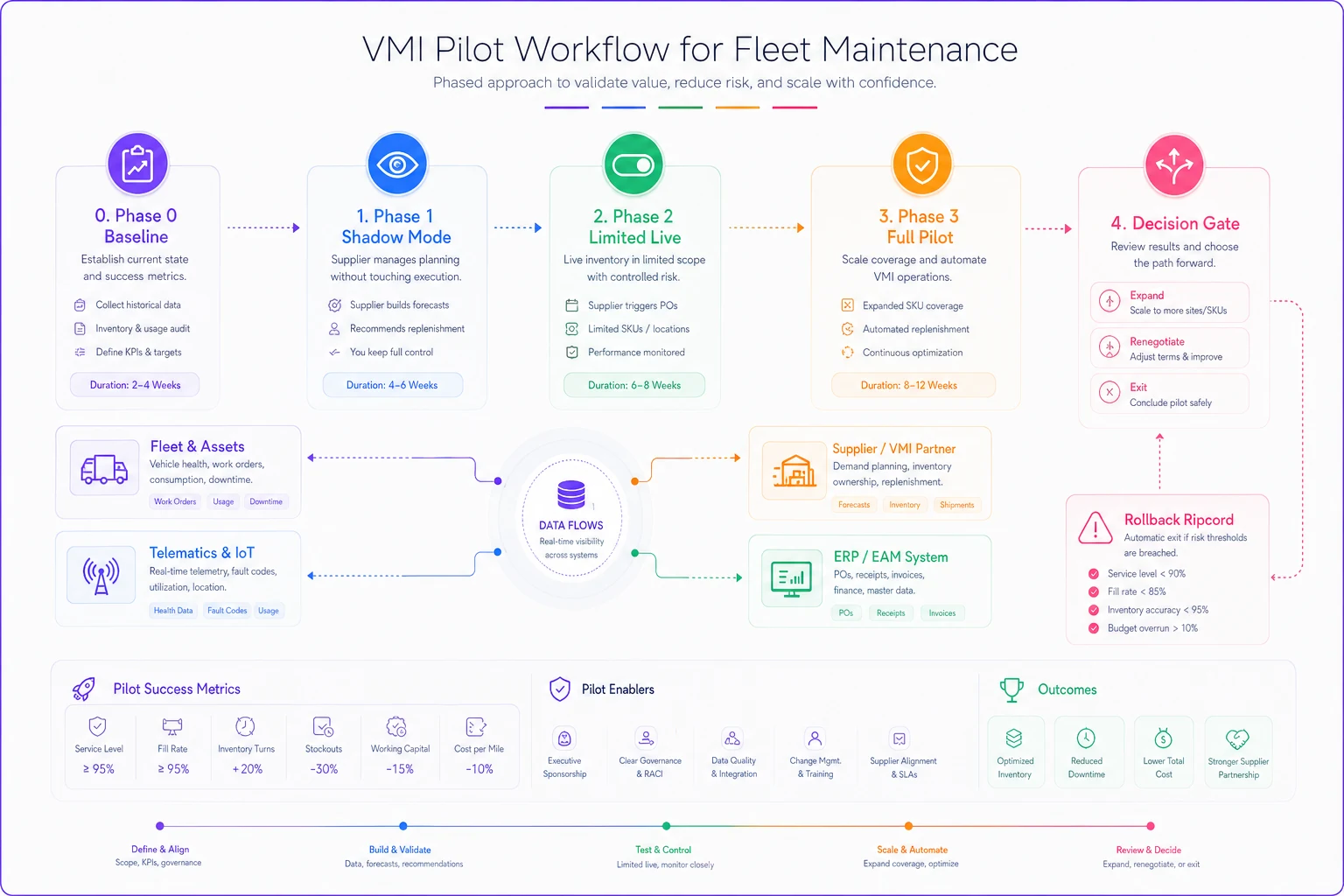
Keep a documented rollback plan the whole time: if bin availability on Tier-1 drops below 94% for two consecutive weeks, you revert to manual on those SKUs immediately. The ability to pull the ripcord is what makes a pilot safe to run.
Success metrics: what you're actually measuring
Fill rate and lead time are the SLA metrics, but they're not the whole story.
Track these together so no single number can be gamed:
-
Bin availability on critical SKUs (the uptime number).
-
Stockout-driven downtime hours — the metric that actually hits your P&L.
-
Carrying cost / on-hand value — to make sure availability isn't being bought with bloated inventory.
-
Inventory accuracy — count vs physical, because VMI programs quietly drift here.
-
Emergency / expedite orders — these should drop sharply if VMI is working. If they don't, the program isn't preventing the fires it was supposed to.
-
Tech side-stash incidence. Soft metric, but telling. If mechanics are still squirreling away personal stashes of a VMI SKU, they don't trust the program — and they're usually right.
A supplier can hit fill rate by drowning your bins in stock, which just moves carrying cost around.
A realistic pilot scenario
A regional last-mile fleet running around 130 vehicles piloted VMI on 44 SKUs — mostly filters, brake components, common sensors, and fluids. Their baseline was rough: somewhere in the range of 7–8 unplanned stockouts a month on critical consumables, and techs had quietly built personal stashes that threw off counts by a noticeable margin.
They ran shadow mode for five weeks and immediately found the supplier's proposed min/max for two fast-moving filters was set too low — it would've caused stockouts right out of the gate. They corrected before going live. By the end of the roughly three-month live phase, Tier-1 bin availability sat around 97%, expedite orders on the piloted SKUs dropped to one or two a month, and stockout-driven downtime on those parts fell to near zero. Carrying cost did creep up slightly — a few percent — which they accepted as the cost of availability. The honest caveat: on two lumpy mid-tier sensors, demand spiked faster than replenishment could keep pace, and they pulled those back to a manual reorder policy. VMI worked for the predictable SKUs and didn't for the erratic ones, which is exactly what you'd expect.
When fleet VMI makes sense — and when it doesn't
It makes sense when: you have clean consumption data, a concentrated set of high-velocity standardized SKUs, a supplier close enough to hit tight replenishment windows, and the internal discipline to hold an SLA accountable.
It's a bad idea when: your part usage is dominated by one-offs and vehicle-specific components, your inventory data is unreliable, or you're using VMI as a way to avoid fixing a broken parts process. VMI doesn't fix chaos — it inherits it.
Who should not run this yet: fleets without a single system of record for parts consumption. If three people enter parts three different ways, hand a supplier that data stream and you'll spend the whole pilot arguing about whose count is correct instead of measuring availability.
The fleets that get real value out of vendor managed inventory treat it as a controlled experiment with a defined exit, not a permanent handoff of responsibility. You're not outsourcing the problem of parts availability — you're sharing it, and the SLA is what keeps both sides honest. Scope it tight, measure it against a real baseline, keep the rollback ready, and expand only once the numbers prove it works for the SKUs you chose.
Ready to maximize fleet uptime and reduce maintenance costs?
Join 2,000+ fleet managers using Fleetelyly to streamline maintenance workflows and improve vehicle reliability.