


Most fleet budgets are built on a comfortable lie: that a brake caliper costs roughly the same today as it did last quarter, give or take a supplier increase you saw coming. That assumption held up reasonably well when pricing was slow-moving and mostly negotiated in bulk contracts. It's starting to crack.
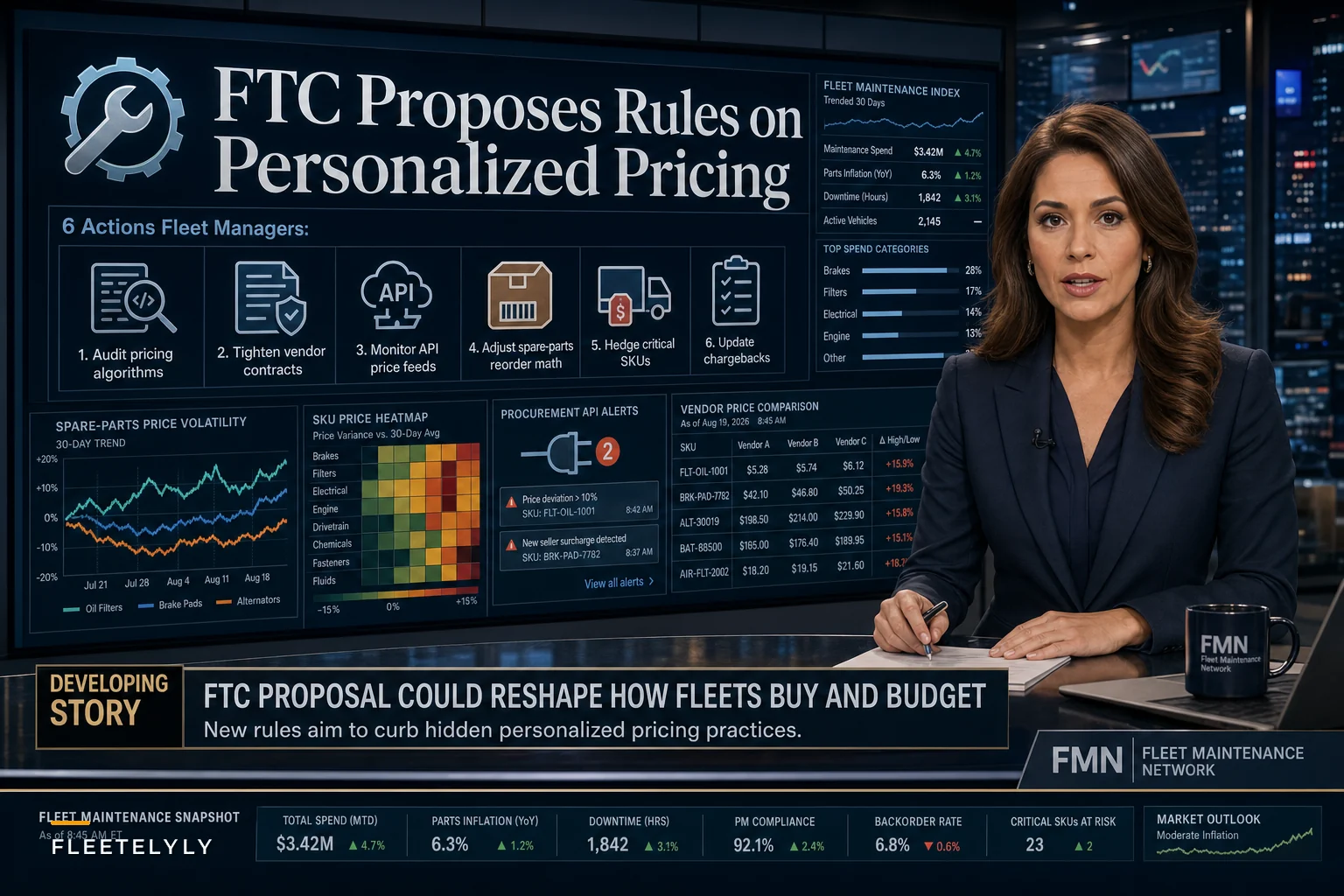
On August 19, 2026, the FTC published a proposed enforcement policy statement and opened it for public comment. The gist: businesses may soon have to disclose when they use personalized or algorithmic pricing tied to a specific customer. A Reuters report on the proposal framed it around consumer-facing pricing, and the FTC's own comment request makes clear this is early-stage — nothing is final. But the direction matters more than the timeline.
The part that doesn't make headlines: if regulators are formally acknowledging that algorithmic pricing tied to individual buyers is widespread enough to need disclosure rules, that's confirmation your parts vendors and service shops are probably already doing some version of it to you. The proposal isn't creating personalized pricing. It's dragging something that already exists into the open. For anyone responsible for parts spend and chargebacks, that visibility is either a gift or a headache depending on how prepared you are.
What personalized pricing actually looks like in parts and service
Forget the consumer framing for a second. In fleet procurement, personalized pricing rarely shows up as a dramatic surprise invoice. It shows up as drift.
You order the same alternator you've ordered for two years. The list price hasn't "changed." But the price you get quoted moves based on your order velocity, your payment terms, how much you've bought this quarter, whether the vendor's pricing engine flagged you as low-churn-risk, and sometimes just what day of the week the API call landed on. Two of your regional shops order the identical part on the same afternoon and get quoted a 6–9% difference. Neither manager notices because neither is comparing.
A few patterns worth naming, because most teams only recognize them in hindsight:
-
Loyalty penalty pricing. The vendors you've been most consistent with sometimes get the worst algorithmic pricing, because the model has learned you won't shop around. New or lapsed accounts get the discounts.
-
Time-and-urgency premiums. Emergency or same-day parts requests get priced against your desperation. The engine knows a downed unit costs you more per hour than the part markup.
-
Bundle-masked increases. The headline SKU stays flat, but freight, handling, or "core" charges float. Your PO total moves while the line item you're watching sits still.
None of this is new. What's new is that regulators are signaling disclosure expectations, which gives procurement teams a legitimate reason to start asking — and a reason to expect vendors to eventually answer.
The real problem this exposes: your budget model assumes stable inputs
Most maintenance budgets — even sophisticated ones — treat unit part cost as a slowly-changing variable. You build a rolling forecast, set reserve triggers, write repair-vs-replace rules around a cost baseline. That whole framework depends on the baseline being roughly true across your locations and across the quarter.
Prevent costly breakdowns with proactive maintenance.
Fleetelyly helps you schedule, track, and manage every vehicle service efficiently.
- Automated maintenance reminders
- Real-time service tracking
- Parts inventory integration
No credit card required
Personalized and dynamic pricing quietly violates that assumption. When the same part carries different effective costs across shops, depots, and even across the same week, three things happen:
-
Your chargeback math gets fuzzy. If you're charging maintenance costs back to departments or business units, you're now charging back a number that partly reflects which shop ordered it and when, not the true cost of the work.
-
Your variance reports lie to you. A line comes in 8% over forecast and you assume it's a volume issue or a bad estimate. It's actually pricing drift you never had visibility into.
-
Your reserve triggers fire late. If reserves are pegged to expected spend and expected spend was calculated on stale, averaged pricing, you under-reserve on exactly the parts most exposed to volatility.
This is the deeper issue. The FTC proposal is a symptom-level event. The underlying condition is that fleet finance has been forecasting against prices it never fully saw. Disclosure rules, if they land, just make the invisible visible — and if your systems can't ingest that visibility, you gain transparency and lose sleep.
If your budgeting and chargeback logic still leans on flat quarterly assumptions, this is a good moment to revisit how rolling forecasts and reserve triggers should behave under volatile inputs — something worth reading alongside the fundamentals in our breakdown of fleet maintenance budgeting and chargebacks.
Six actions worth taking now
You don't need to wait for a final rule. Everything below improves your operation regardless of what the FTC ultimately does. The regulatory movement is just the nudge.
1. Start capturing price at the SKU level, not the PO level
This is the unglamorous foundation and most teams skip it. If your records store the total PO amount but not clean, per-SKU, per-order pricing with a timestamp and the ordering location, you literally cannot detect personalized pricing even if a vendor discloses it.
Start logging, for every parts line:
-
SKU / part number
-
Effective unit price (net of discounts)
-
Ordering location or account
-
Timestamp of quote and of order
-
Any freight/core/handling adders as separate fields
A typical example: a mid-size regional fleet found that once they broke out core charges and freight into their own columns, the "flat" price on a common turbo actuator had actually risen close to 14% over ten months — all of it hidden in adders while the headline SKU price hadn't moved.
Here's a simple workflow to implement SKU-level price capture and cross-location comparison.
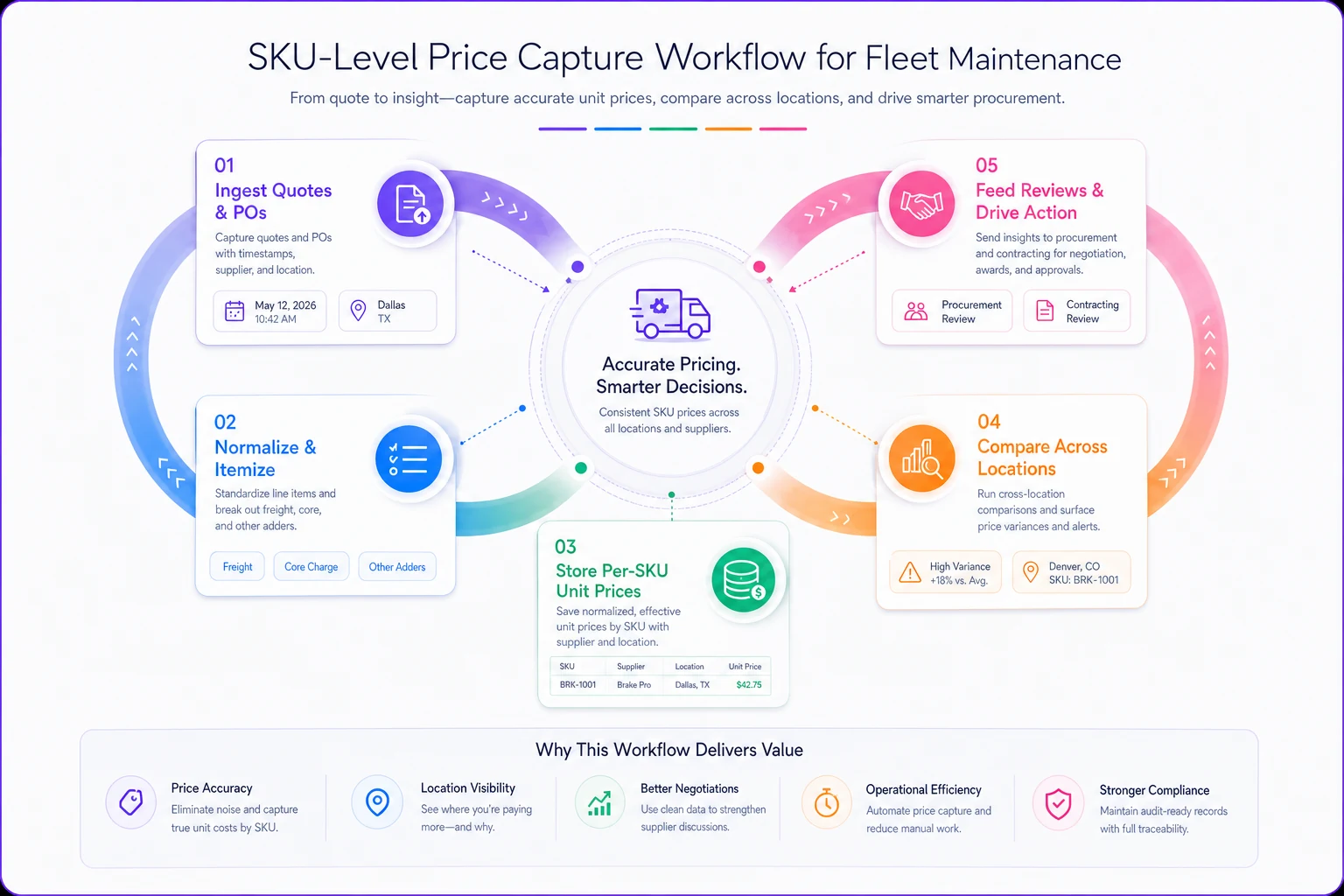
Use the flow to prioritize capture, comparison, and alerting so you can surface negotiation levers quickly.
Prioritize logging SKU-level prices for your highest-spend parts first to uncover material drift quickly.
2. Build a same-part, cross-location price comparison
Once you're capturing SKU-level data, run a simple monthly comparison: for every part ordered by more than one location, what's the spread between the cheapest and most expensive effective price?
This is the single highest-value report you can build right now. It surfaces personalized pricing without needing any disclosure from the vendor at all. When you see the same filter costing $41 at one depot and $47 at another in the same week, you have a negotiation lever today.
The table below maps the signals you'll start seeing once that comparison is running, what's likely causing them, and where to start.
| Signal you'll see | Likely cause | First move |
|---|---|---|
| Same SKU, wide cross-location spread | Account-level personalized pricing | Consolidate ordering, demand best-account pricing across all locations |
| Headline price flat, PO total rising | Adder/freight drift | Contractually cap or itemize adders |
| Urgent orders priced far above routine | Urgency-based dynamic pricing | Pre-negotiate emergency pricing bands |
| Prices creep quarter-over-quarter with no notice | Slow algorithmic drift | Add price-change notice clauses |
Most teams that run this report for the first time are surprised by the spread. Not shocked — surprised. It tends to be consistent enough to be systematic, not random enough to be noise.
3. Add disclosure and notice language to vendor contracts
This is where the FTC movement gives you real leverage. Even before any rule is final, you can amend contracts and RFPs to require:
-
Disclosure of whether pricing is dynamic, personalized, or algorithmically determined.
-
Advance notice (say, 15–30 days) before effective price changes on contracted SKUs.
-
Price-lock windows for your highest-volume or most safety-critical parts.
-
Audit rights to review how your account's pricing was calculated.
Vendors won't love all of these, and you won't win all of them. But asking is now normal. The regulatory context makes "how is this price determined?" a reasonable procurement question instead of an awkward one.
4. Set price-delta alerts on your critical parts
You don't monitor everything — you monitor what hurts. Take your criticality tiers and put automated alerts on unexpected price movement for the parts that most affect uptime and budget.
A workable threshold logic:
-
For tier-1 critical parts, alert on any effective-price change above 3–5% vs the trailing 90-day average.
-
For high-volume routine parts, alert on cross-location spread above a set percentage.
-
For anything urgent-ordered, flag the premium paid vs the routine price so you can quantify what emergencies actually cost you.
The point isn't to react to every wiggle. It's to catch the drift before it shows up in a quarterly variance report you can't explain to finance.
5. Rework chargeback rules to isolate price volatility
If you charge maintenance back to units or departments, decide deliberately how you'll handle pricing variability. Two common approaches:
-
Standard-cost chargebacks charge back a stable planned cost, and absorb the actual-vs-standard difference into a central variance pool. Departments get predictability; volatility becomes a managed line you monitor centrally.
-
Actual-cost with transparency charge actual cost but attach a variance explanation, so a department seeing an 8% jump knows whether it's their behavior or the market.
The mistake to avoid is charging back raw actuals with no explanation. That's how you end up in monthly arguments with department heads who think maintenance is gouging them, when the real story is upstream vendor pricing. Neither approach is universally better — it depends on how much budget ownership you want departments to carry versus how much you want to absorb centrally.
6. Consolidate ordering to strip away the personalization
This one's counterintuitive. Personalized pricing works against fragmentation. When five locations each order independently, the vendor's engine prices each account on its own thin signal. Consolidate that volume — even just centralizing the quoting while keeping local receiving — and you become a single, larger, harder-to-segment account.
A fleet that pulled quoting for its top 40 SKUs into one central process, while letting depots still receive locally, saw its cross-location price spread on those parts compress from roughly 5–11% down to low single digits within two quarters. Same volume. Same vendors. Just a harder target for the pricing algorithm.
When to act aggressively — and when not to bother
This is worth serious effort if:
-
You operate across multiple locations that order independently.
-
Parts and service are a large, variable share of your maintenance spend.
-
You do formal chargebacks and get pushback on variance.
-
You rely heavily on API-connected vendor catalogs where prices update dynamically.
You can move slower if:
-
You're single-location with a couple of long-standing negotiated contracts.
-
Your spend is dominated by a few flat-priced, master-agreement SKUs.
-
Your vendors already provide itemized, notice-based pricing.
Small fleets with tight vendor relationships and stable pricing shouldn't over-engineer this. Building SKU-level alerting and cross-location comparison for a shop that buys from two suppliers on fixed terms is effort spent solving a problem you don't have. Capture clean data anyway — but skip the heavy monitoring apparatus.
A short real scenario
A regional service fleet running about 180 units across four depots had a persistent, low-grade budget problem: parts spend ran 6–10% over forecast most quarters, and no single line ever looked wrong enough to investigate. Finance assumed it was estimating error.
When they finally broke ordering data down to SKU-and-location level, the picture changed. Two depots were consistently paying more for identical parts — not dramatically, just a few percent each — and urgent orders were carrying premiums nobody had ever tallied. Freight and core adders had been quietly climbing on a handful of high-volume parts while the base prices held flat, which is exactly why nobody caught it.
They didn't do anything exotic. They centralized quoting on their top parts, added notice-and-disclosure language at the next contract renewal, and set price-delta alerts on their tier-1 SKUs. Over the following two quarters, the chronic overrun shrank to low single digits, and — maybe more valuable — the variance they did see finally had explanations attached. The arguments with department heads mostly stopped, because everyone could see what was market-driven and what wasn't.
The takeaway that actually matters
The FTC proposal will do what it does — comment periods run long and rules change shape. Betting your operation on the regulatory outcome is a mistake.
The durable move is to build procurement and budgeting that don't care whether pricing is personalized, because you can see it either way. Clean SKU-level data, cross-location comparison, contract language that assumes prices move, alerting on the parts that actually hurt — none of that depends on a final rule. It just makes you a fleet that isn't surprised by its own invoices. Whether regulators ever force disclosure or not, the operators who come out ahead are the ones who stopped forecasting against prices they couldn't see.
The FTC proposal will do what it does — comment periods run long and rules change shape. Betting your operation on the regulatory outcome is a mistake.
The durable move is to build procurement and budgeting that don't care whether pricing is personalized, because you can see it either way. Clean SKU-level data, cross-location comparison, contract language that assumes prices move, alerting on the parts that actually hurt — none of that depends on a final rule. It just makes you a fleet that isn't surprised by its own invoices. Whether regulators ever force disclosure or not, the operators who come out ahead are the ones who stopped forecasting against prices they couldn't see.
Ready to maximize fleet uptime and reduce maintenance costs?
Join 2,000+ fleet managers using Fleetelyly to streamline maintenance workflows and improve vehicle reliability.