

Most pipeline breakages don't happen because the code is wrong. They happen because the code met a version of reality nobody tested against. A truck sends a fault code the ingest layer has never seen. A device reboots mid-transmission and sends half a payload. A duplicate event arrives 40 seconds after the first one, and now there are two open work orders for the same wheel-end.
The problem with telematics to work order integration testing is that everyone tests the happy path. Device sends fault → system creates work order → dispatcher assigns it. That path works fine in the demo. It's the other 200 paths that page you at 2 a.m.
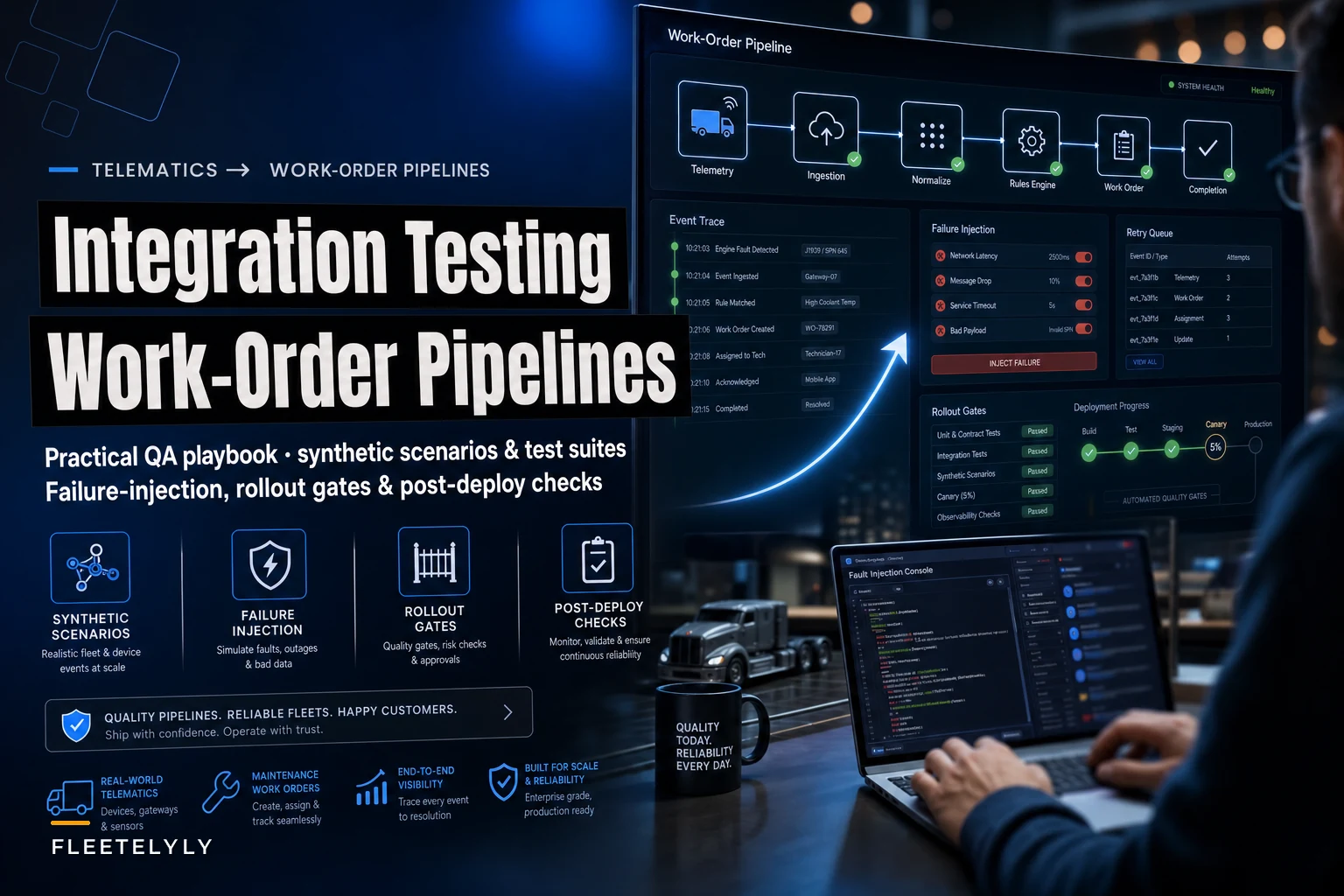
This piece is about building a test suite that actually exercises the ugly paths — synthetic data that looks like your real fleet's mess, failure-injection cases that mimic how devices and networks actually fail, and rollout gates that stop a bad deploy before it floods your shop with garbage work orders.
Why the happy-path test suite lies to you
A team wires up a new telematics provider or a new work-order rule, tests it against a handful of clean sample payloads pulled from the vendor's docs, and everything passes. They ship it. Within a week, the shop is dealing with work orders that make no sense — duplicates, orders for vehicles that were sold three months ago, priority-1 emergencies for a fault code that's actually just a loose gas cap sensor.
Vendor sample payloads are clean because vendors clean them. Real device traffic is not. In a mixed fleet you've got devices from three generations of firmware, aftermarket dongles, OEM-embedded units, and one truck where somebody unplugged the harness and plugged it back in wrong. Each of those sends slightly different shapes of data.
The core mistake: teams treat integration testing as "does my code parse the sample file" instead of "does my pipeline survive the actual distribution of events my fleet produces." Those are completely different questions. The first one you can answer in an afternoon. The second one requires synthetic data that reflects your fleet's real weirdness — and deliberately breaking things to see what happens.
If your integration keeps failing at the contract layer specifically — schema mismatches, field renames, timestamp formats — that's a slightly different problem, and there's a full breakdown of that in the data-contract playbook for CDC, APIs and event-driven flows. This article assumes your contracts are mostly stable and focuses on behavior under load, duplication, and failure.
Building synthetic scenarios that match your fleet's actual mess
Generic synthetic data — random valid payloads — is nearly useless. It tests that your parser works, nothing more. The synthetic scenarios that catch real bugs are the ones modeled on the specific failure shapes your fleet actually produces.
Prevent costly breakdowns with proactive maintenance.
Fleetelyly helps you schedule, track, and manage every vehicle service efficiently.
- Automated maintenance reminders
- Real-time service tracking
- Parts inventory integration
No credit card required
Start by mining a few weeks of real production events and cataloging the weird ones. Not to replay them exactly (privacy, PII, VIN handling), but to understand the shapes you need to synthesize. In practice, the categories that cause the most damage almost always include:
Start by mining a few weeks of real production events and cataloging the weird ones.
-
Duplicate events — same fault, same vehicle, arriving 2–90 seconds apart because a device retried on a flaky cell connection
-
Out-of-order events — a "fault cleared" arriving before the "fault active" it's supposed to close, because of buffering on the device
-
Stale events — a device that was offline in a yard for six hours dumps a backlog of events all timestamped from the morning
-
Partial payloads — truncated JSON, missing the odometer field, null where a fault severity should be
-
Ghost vehicles — events for VINs that were decommissioned or transferred but the device wasn't deprovisioned
-
Fault storms — one electrical fault triggering 40 related codes in a 10-second window
Each of these becomes a synthetic scenario generator, not a single test file. You want to produce hundreds of duplicate-event cases with different timing gaps, not one hand-crafted example.
A useful way to organize the synthetic suite:
| Scenario class | What it simulates | What it should prove |
|---|---|---|
| Duplicate storm | Same fault code, 3–5 copies, staggered arrival | Exactly one work order created, not five |
| Out-of-order clear | "Cleared" arrives before "active" | No orphaned open order; no work order for an already-resolved fault |
| Stale backlog | 6 hours of buffered events dumped at once | Events are aged out or flagged, not treated as fresh emergencies |
| Partial payload | Missing odometer / null severity | Graceful rejection or defaulting, no crash, logged to a dead-letter queue |
| Ghost VIN | Fault for a decommissioned unit | Routed to a quarantine queue, no work order in an active shop |
| Fault cascade | 40 correlated codes in 10 seconds | Deduped/grouped into one investigable work order, not 40 |
The point of this table isn't the categories themselves — it's that each row has a specific, checkable assertion. "It should prove exactly one work order is created" is testable. "It should handle duplicates" is not.
Worth being blunt about: the fault-cascade row is where most systems fall down. A single alternator or CAN-bus issue can throw dozens of correlated codes, and if your dedup logic keys only on exact code match, you'll create dozens of work orders. The synthetic generator for this scenario should produce realistic correlated-code bundles based on your actual fleet's fault taxonomy, not random codes.
Failure-injection: break it on purpose before it breaks on its own
Synthetic data tests what your pipeline does with bad inputs. Failure-injection tests what your pipeline does when its own infrastructure misbehaves. These are separate things and both matter.
The failures worth injecting are the ones that actually happen in fleet telematics stacks:
-
The work-order system is down or slow. Your ingest receives a fault, tries to create a work order, and the maintenance platform's API times out. What happens to that event? Does it retry? Does it get dropped silently? Does it get stuck in a queue that grows until it falls over? Inject a 30-second API delay and a hard 503 and watch.
-
The message broker drops or redelivers. Most event-driven pipelines run on a queue that promises "at-least-once" delivery, which is a polite way of saying "sometimes twice." Inject redelivery of already-processed events and confirm your idempotency actually holds.
-
Partial network partition. The telematics side keeps sending, the work-order side is unreachable for four minutes, then it comes back. Does your pipeline catch up cleanly or does it double-process the backlog it accumulated?
-
Downstream backpressure. Dispatch queue is full, technicians are all assigned, and 200 new fault events land in five minutes. Does the system degrade gracefully or does latency cascade until real-time alerts arrive 20 minutes late?
-
Clock skew. A device with a wrong clock sends events timestamped in the future or from last year. Confirm your aging and dedup logic doesn't get fooled.
A realistic example of why this matters: a mid-size fleet running around 600 vehicles pushed a new integration that created work orders synchronously — each fault event blocked on the work-order API returning success. It passed every test. Then their maintenance vendor had a slow morning, API responses crept from 200ms to 8 seconds, the ingest queue backed up, and by lunch they had roughly a 40-minute lag on genuine safety-critical alerts. Nobody had injected latency, so nobody knew the synchronous design was a landmine. The fix — moving to async write with a retry-and-dead-letter pattern — took two days. The failure-injection test that would have caught it took an afternoon to write.
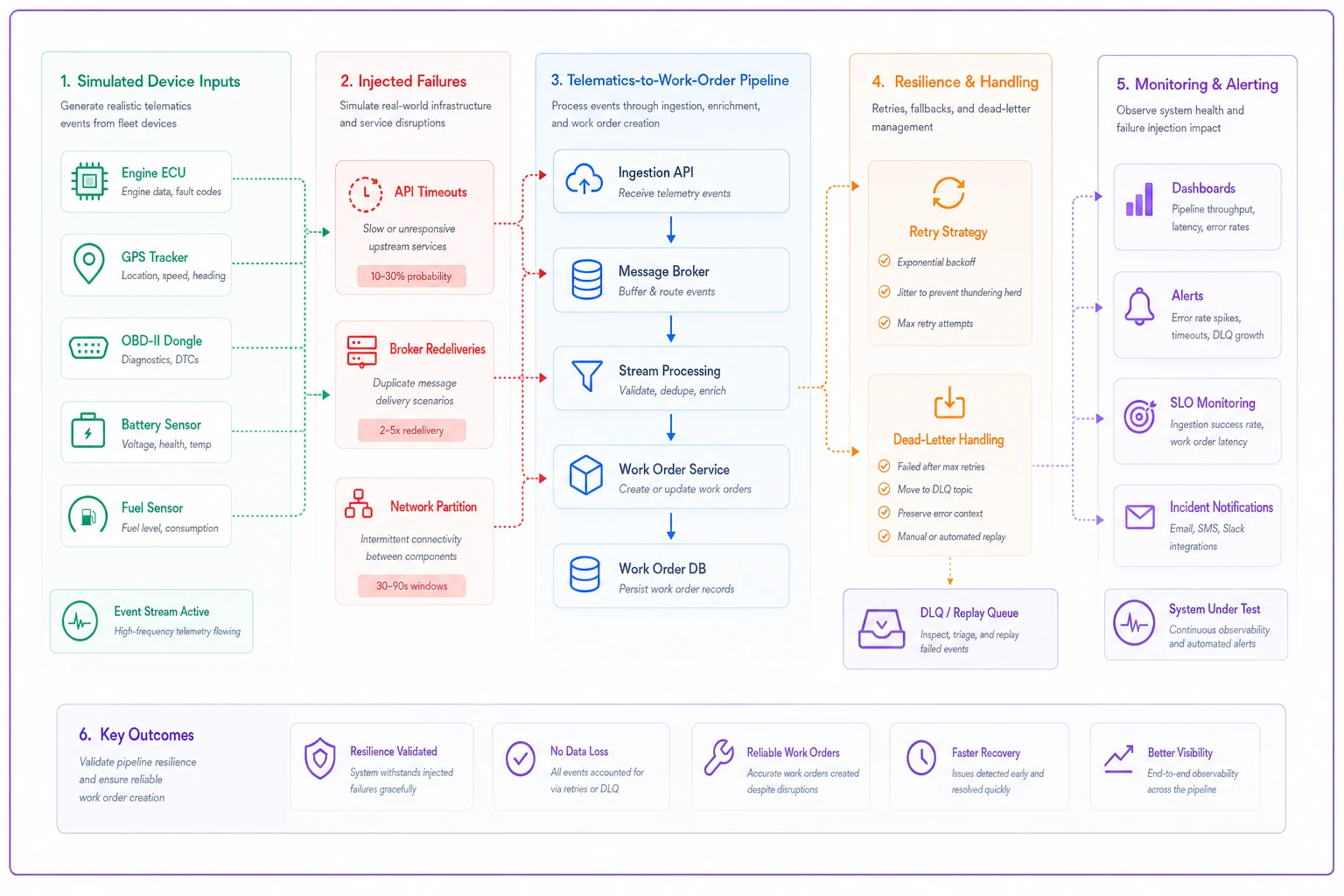
This diagram shows the failure-injection workflow in brief.
The bug wasn't in the code. It was in an assumption about timing that was never tested. Failure-injection exists specifically to surface those assumptions.
Rollout gates: don't let a passing test suite give you false confidence
A green test suite means your code works against your synthetic scenarios. It does not mean it works against tomorrow's real traffic. Rollout gates are the checkpoints between "tests pass" and "100% of the fleet is on the new pipeline."
The mistake is going from staging straight to full production because the tests were green. A graduated rollout with explicit gates that can auto-halt is what you actually want.
-
Gate 1 — Shadow mode. Run the new pipeline in parallel, consuming real events, but don't create real work orders. Log what it would have created and diff against what the old pipeline actually did. Run this for a few days across real event volume. A big divergence — new pipeline wants to create 30% more work orders — is a red flag you catch before it touches the shop.
-
Gate 2 — Canary fleet. Route a small, representative slice — say 5–10% of vehicles, ideally spanning your device generations — to the live new pipeline. Watch work-order creation rate, dedup rate, and dead-letter volume. Set thresholds that auto-rollback.
-
Gate 3 — Segment expansion. Move to 50%, holding back the fleet segments most likely to expose edge cases (oldest devices, aftermarket units) until last, on purpose, so they get the most soak time on the earlier gates.
-
Gate 4 — Full rollout with monitoring hold. 100% live, but the deploy isn't marked "done" until it's cleared a defined post-deploy validation window.
The thresholds that trigger a gate to halt should be defined before the rollout, not argued about during an incident. Reasonable auto-halt triggers:
-
Work-order creation rate deviates more than ~20% from the baseline for the same period
-
Dead-letter queue depth grows beyond a set ceiling
-
Duplicate-work-order rate rises above baseline
-
Any increase in orders created for quarantined/ghost VINs
Shadow mode is worth the effort because it's the only gate that tests the new pipeline against real traffic with zero production risk. It catches the gap between your synthetic data and the real-world event shapes you didn't think to model — which is exactly the gap that tends to hurt you.
Post-deploy validation templates
Deploying isn't the finish line. It's the start of the window where things go wrong quietly. The failures that survive your gates tend to be slow drips: a 3% duplicate rate that nobody notices until the shop complains about phantom work orders two weeks later.
A post-deploy validation template is just a fixed checklist you run at defined intervals after go-live — 1 hour, 24 hours, 7 days. Keep it boring and consistent:
-
Work-order creation volume is within the expected band vs. the prior period
-
Dedup rate is holding — no sudden spike in duplicates reaching the shop
-
Dead-letter queue is being drained, not just growing
-
No work orders created for decommissioned or quarantined VINs
-
Fault-cascade events are still grouping into single investigable orders
-
End-to-end latency (fault event → work order visible to dispatch) is within target
-
Sample audit
pull 15–20 real work orders created post-deploy and manually confirm each maps to a legitimate fault
That last one catches things no metric will. Automated checks confirm the numbers look right. A human reading 20 actual work orders confirms they mean the right thing. In real operations this is where you find the order that says "brake fault" but the underlying event was a wiring fault mislabeled by a code-mapping bug. Numbers can look fine while the data is quietly wrong.
Where a management platform actually helps here
Most of this — synthetic generation, failure-injection, gated rollout — lives in your engineering tooling. But the validation and monitoring side gets easier when your work orders, telematics events, and vehicle master data are in one place rather than scattered across a telematics portal, a maintenance system, and a spreadsheet.
When the pipeline runs through a workflow platform that centralizes event ingestion and work-order creation, the post-deploy checks are simpler because the data you need is already unified — creation rates, dedup outcomes, dead-letter events, and the VIN status that tells you whether an order should even exist. AI-assisted anomaly detection on that flow can also flag slow drips early: a quiet climb in duplicate orders or a shift in the fault-code-to-order mapping distribution that a threshold alert might miss until it's already a real problem. The value isn't the automation itself — it's validating against one clean source instead of reconciling three systems mid-incident.
When heavy failure-injection is overkill
Not every fleet needs a full failure-injection harness. If you're running a small operation with one homogeneous device type, a stable single telematics vendor, and a handful of work orders a day, building shadow-mode infrastructure is more effort than the risk justifies. A solid synthetic suite covering duplicates and partial payloads, plus a manual canary on a few trucks, is probably enough.
Where the full approach earns its keep:
-
Mixed fleets with multiple device generations or vendors
-
High event volume where a bad deploy floods the shop fast
-
Safety-critical fault handling where a missed or delayed work order has real consequences
-
Any pipeline where work-order creation is automated end-to-end with no human in the loop
If a human reviews every auto-generated work order before it hits the shop floor, your blast radius is smaller and you can lean lighter on gates. The moment you remove that human check to scale up, the gates and post-deploy validation stop being optional.
Real scenario: catching the duplicate storm before it hit the shop
A regional delivery fleet of roughly 400 vehicles was replacing its work-order creation logic to handle a new telematics provider. Their old system averaged somewhere around 60–80 work orders a day from telematics faults. During shadow mode, the new pipeline logged that it would have created closer to 130 a day — nearly double.
The diff investigation found it: the new provider sent a "fault confirmed" event a few seconds after the initial "fault detected" event for the same issue, and the new dedup logic keyed on event ID rather than fault-plus-vehicle-plus-time-window. Every fault was creating two work orders. On the old pipeline this had never been an issue because the old provider didn't send the confirmation event at all.
Because this surfaced in shadow mode — real traffic, zero shop impact — they fixed the dedup key and re-ran the shadow diff before any technician ever saw a phantom order. Had they skipped straight to production on green tests, the shop would have absorbed roughly 60 extra bogus work orders a day until someone noticed and traced it back. The cleanup and lost trust would have cost far more than the day it took to build the shadow-mode diff.
The uncomfortable takeaway
The pipelines that break in production almost never break because of the inputs someone thought to test. They break on the shape of traffic nobody imagined, at the moment infrastructure misbehaves, right after a deploy that looked clean. Good telematics to work order integration testing is really just a discipline of assuming your happy-path tests are lying to you, then building the synthetic scenarios, injected failures, and staged gates that force the pipeline to prove otherwise before it touches a real work order.
Start with the three or four ugliest event shapes your fleet actually produces, add shadow mode before your next rollout, and write down your auto-halt thresholds now — while nobody's paging you — instead of during the incident when everyone's guessing.
Start with the three or four ugliest event shapes your fleet actually produces, add shadow mode before your next rollout, and write down your auto-halt thresholds now — while nobody's paging you — instead of during the incident when everyone's guessing.
Ready to maximize fleet uptime and reduce maintenance costs?
Join 2,000+ fleet managers using Fleetelyly to streamline maintenance workflows and improve vehicle reliability.