


Most 5S rollouts in maintenance bays die within a month. The tape lines on the floor fade, the shadow boards fill up with the wrong tools, and by the second oil-change rush nobody's putting anything back where it belongs. The problem isn't that 5S doesn't work for fleets — it's that shops copy a factory version built for a stationary assembly line and try to force it onto an environment where a 40,000-lb truck rolls into a different bay every hour and the "workpiece" leaks, weighs a ton, and sometimes catches fire.
A maintenance bay 5S fleet program has to survive chaos. It has to work when three techs are sharing a torque wrench, when a road-call pulls someone off a brake job halfway through, and when a delivery of the wrong parts blows up the whole afternoon. What follows is a walkthrough of a 90-day pilot built for that reality — audits kept dead simple, safety baked directly into the checkpoints instead of bolted on afterward.
Why the factory version of 5S fails in a bay
Standard 5S assumes the work comes to a fixed station. In a fleet shop, the opposite is true — the tech and the tools travel to the vehicle. That single difference breaks half the assumptions in a typical 5S manual.
A few patterns come up repeatedly in shops that tried and abandoned it:
-
Tools get "sorted" into a central crib that's a 90-second walk from the bay. Techs stop returning them because the trip costs more time than just keeping the wrench in a pocket. Within weeks the crib is half-empty and every bay has a private stash.
-
Consumables run on vibes. Rags, brake cleaner, gloves, zip ties — nobody set a min/max, so a bay either drowns in them or runs dry mid-job.
-
The audit is a 40-line checklist nobody finishes. If a supervisor needs ten minutes to score one bay, it happens once and never again.
-
Safety lives in a separate binder. Lockout/tagout, jack-stand checks, and spill kits get treated as a compliance thing for the annual inspection, not part of daily bay setup.
The fix isn't more discipline. It's designing the system so the organized path is also the fastest path. When putting the impact gun back on the shadow board is quicker than hunting for it next time, techs comply without being nagged.
What "good" looks like in a fleet bay
Before the pilot starts, it helps to have a clear picture of the target. Here's a straightforward contrast between how the five S's usually get taught versus how they need to translate for a bay handling mixed vehicles.
Prevent costly breakdowns with proactive maintenance.
Fleetelyly helps you schedule, track, and manage every vehicle service efficiently.
- Automated maintenance reminders
- Real-time service tracking
- Parts inventory integration
No credit card required
| Step | Factory version | Fleet-bay version |
|---|---|---|
| Sort | Remove unused tools from a fixed station | Remove duplicate/broken tools per bay; standardize a common set every bay carries |
| Set in order | Shadow boards at the workstation | Mobile tool carts staged per job type (brake kit, PM kit, electrical kit) |
| Shine | Clean the machine and area | Clean bay + inspect for leaks/slip hazards as part of shine, not separately |
| Standardize | One layout for all stations | Same cart layout across all bays so any tech works any bay |
| Sustain | Weekly supervisor audit | 2-minute daily self-check + weekly 5-line supervisor audit |
The biggest translation is under "Set in order." Fleet bays run faster on job-type carts than on fixed shadow boards. A brake cart, a PM cart, an electrical/diagnostic cart — each pre-staged with the tools and consumables that job actually needs. This connects directly to how you sequence work overall. If you haven't mapped where the real delays are coming from, the cart design is essentially guessing. Working through takt time and bottleneck mapping for your bays first tells you which job types deserve a dedicated cart and which don't.
The audit has to be small enough to actually run
The most common reason sustain fails: the audit is too long. If it takes more than a couple minutes, it stops happening the first week someone's slammed.
-
Tools back on the cart, none missing (spot-check against the shadow outline)
-
Floor clear of cords, tools, and spills
-
Consumables at or above the min line — rags, cleaner, gloves
-
Jack stands and lifts returned to home position, nothing left under load
-
Waste sorted correctly; no oil rags in the general trash
That's it. Yes or no on five lines. The point isn't a perfect score — it's catching the one thing that's quietly drifting before it becomes the new normal.
The weekly supervisor audit runs a bit deeper but stays short — five lines that roll up across bays:
-
Are all bays running the same cart layout, or has one started drifting?
-
Any tools broken or missing that need replacing this week?
-
Any repeat safety flag from the daily checks — same bay, same issue?
-
Consumable stock-outs in the last seven days?
-
One improvement suggestion from a tech, logged.
That last line matters more than it looks. Techs know exactly where the friction is. If the audit never captures their input, they treat 5S as something done to them, and sustain quietly dies.
Safety checkpoints, built into the flow
Running a separate safety program on top of 5S doubles the paperwork and usually gets ignored. Fold the checkpoints into the same daily and weekly rhythm.
Three checkpoints cover most of the real risk in a bay:
Before lift/jack work — quick verbal or physical confirm that stands are rated for the load and placed on solid points. This is the one that prevents the worst outcomes, and it costs about ten seconds.
Before energized or fuel-system work — lockout/tagout applied, fuel lines relieved, hot-work permit if there's a torch near a tank. For bays handling a lot of electrical work, this belongs on the cart itself as a laminated tag.
End-of-shift — spill check, fire extinguisher and eyewash access clear, no smoldering rags. This overlaps with the daily 5S check, which is the whole point. One walk-through covers both.
Worth watching: shops that log near-misses during these checkpoints — not just injuries — catch the drift early. A jack stand that almost slipped is free data. One that actually slips is a claim, a downed tech, and a week of lost throughput.
The 90-day pilot
Run this on one bay bank — two or three bays — not the whole shop. Trying to convert every bay at once guarantees a sloppy rollout and leaves you with no clean before/after to point at.
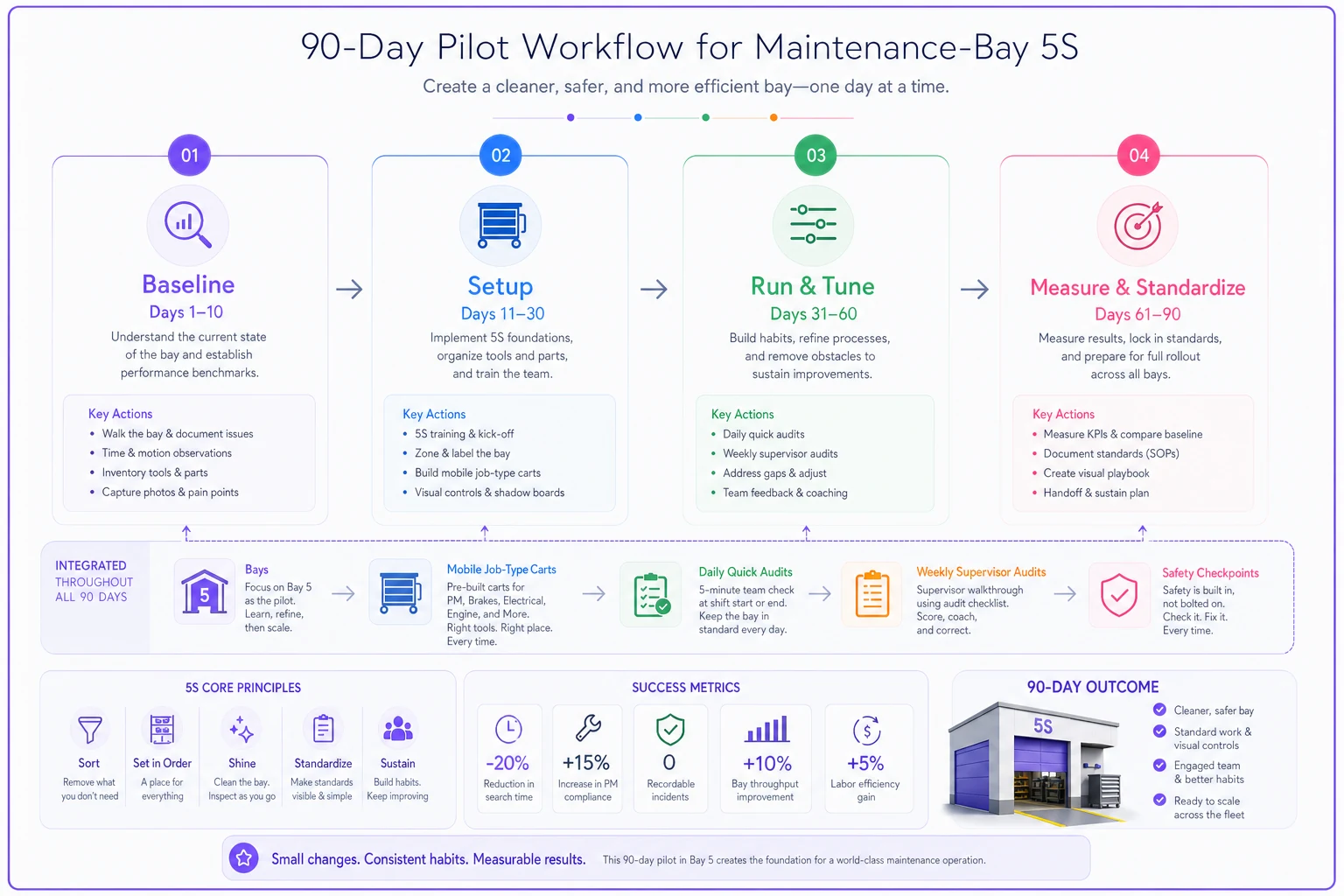
Days 1–10: Baseline. Before you change anything, measure. Track a few numbers on the pilot bays as they run today:
-
Average time to locate a tool per job (spot-timed, a dozen samples)
-
Rework/comeback rate on completed jobs
-
Recorded safety incidents and near-misses
-
Consumable stock-outs per week
Don't skip this. Most of the time the reason a 5S pilot can't prove its value is that nobody recorded the "before."
Days 11–30: Sort and set up carts. Purge duplicate and broken tools. Build the job-type carts. Set min/max on consumables. Mark home positions for stands and lifts. Get tech input while you're doing it — they'll tell you the cart layout is wrong before you find out the hard way.
Days 31–60: Run and tune. Daily self-checks start. Weekly audits start. Expect the first couple weeks to be rough — carts get restocked wrong, someone hoards a tool. Fix the layout, don't blame the tech. Most friction at this stage is a design problem you can actually solve.
Days 61–90: Measure again and standardize. Re-run the same measurements from the baseline window. Lock in the cart layouts that worked. Write the one-page standard so a new hire can be dropped into any pilot bay and know exactly where everything lives.
Start the pilot on bays that handle the most common job types so cart designs get broader reuse.
Here's a simple visual of the pilot phases and checkpoints.
Then, and only then, plan the rollout to the rest of the shop.
A realistic before/after
A regional delivery fleet ran this on three bays handling mostly PM and brake work. Their baseline was unremarkable in the ordinary way — not dramatic, just steady friction.
Before, techs were spending a real chunk of each job hunting for tools and walking to the crib. Comebacks — jobs that came back for the same issue within a week — sat around 9%. There'd been two minor jack-related near-misses in the prior quarter that nobody formally logged.
After 90 days, tool-hunting time on the pilot bays dropped noticeably once the job-type carts were dialed in. Enough that they were turning roughly one extra PM per bay per day without adding staff. Comebacks fell to around 5–6%, mostly because standardized carts meant torque wrenches and the right consumables were actually present instead of substituted. And the near-miss logging, unglamorous as it is, surfaced two more jack-placement habits that got corrected before anyone got hurt.
Nothing here was a miracle. It was the compounding effect of small friction removed, day after day, across three bays.
Where this tends to break down
Tracking it on a clipboard. The daily checks are manageable; keeping the history is where it falls apart. A stack of paper audit sheets in a drawer tells you nothing about whether Bay 2 has flagged the same jack-stand issue four weeks in a row. This is where operational software actually earns its keep — not for the checklist itself, but for surfacing the pattern across weeks and bays that no one person remembers. When repeat safety flags and consumable stock-outs are logged in one place, the weekly review takes five minutes and catches the drift instead of hiding it. AI-assisted flagging on that data is genuinely useful here: it catches the "same bay, same problem, third time" signal that's easy to miss when you're reading paper one sheet at a time.
Treating the pilot bays as special. If they get extra attention that the rest of the shop won't receive during rollout, the results won't transfer. Run the pilot with normal staffing and normal chaos.
Skipping the tech-suggestion line. Programs that sustain past six months are almost always the ones where techs feel like the layout is theirs. The ones that die are run top-down.
When a full 5S pilot isn't worth it
If your shop is a single bay with one or two techs, formal 5S is overkill — the coordination problem it solves barely exists. A clean cart and a habit of putting things back covers it.
It's also the wrong first move if your real bottleneck is upstream — parts that never arrive on time, or scheduling that leaves bays idle and then suddenly slammed. A spotless, perfectly organized bay with no parts in it is still a stopped bay. Fix the flow problem first.
Where this pays off is the mid-size shop: several bays, mixed vehicle types, multiple techs sharing tools, enough volume that a few minutes of lost time per job adds up to real hours across a week. That's the environment where a maintenance bay 5S fleet program stops being a poster on the wall and starts showing up in throughput and safety numbers you can actually defend.
The reason most bay 5S efforts fail isn't discipline — it's that they were designed for a factory floor and asked to survive a fleet shop. Build it around mobile job-type carts, keep the audit to five lines, fold safety checkpoints into the same daily walk, and run a real 90-day pilot with measured before/after.
Do that on a few bays first, prove it, then scale. The version that sustains is always the one where the organized way is also the fast way, and where the people doing the work had a hand in setting it up.
Ready to maximize fleet uptime and reduce maintenance costs?
Join 2,000+ fleet managers using Fleetelyly to streamline maintenance workflows and improve vehicle reliability.