


Most shops running mixed fleets have a skills map that lives entirely in the lead mechanic's head. He knows Diego is the only one who can properly diagnose the DEF system on the newer Freightliners, that two of the guys still won't touch anything hybrid, and that the night shift can't do warranty-facing electrical work without a callback. None of this is written down. It works fine until Diego takes two weeks off and MTTR on emissions-related work orders quietly doubles.
That's the actual problem a mechanic upskilling program is supposed to solve, and it's rarely framed that way. People treat upskilling as a training budget line — send someone to a class, get a certificate, move on. But the real value is operational: knowing exactly which tech can close which job type at what speed, and having a repeatable way to move people up the ladder without gambling on whether the training stuck.
This post is about building that. A competency matrix by job family, short certification modules you can actually finish between work orders, a way to measure whether skill genuinely improved, and a phased rollout tied to the KPIs you already track.
Start with job families, not job titles
The first mistake is building the matrix around titles like "Technician II" or "Senior Mechanic." Those grades don't tell you anything about capability on a specific vehicle system. A Tech II who's brilliant on hydraulics might be useless on CAN-bus diagnostics, and the pay grade hides that completely.
Instead, break the work into job families — clusters of related tasks that share diagnostic logic and tooling. For a mixed fleet, a reasonable starting set looks like:
-
Brakes & foundation (air, hydraulic, ABS)
-
Powertrain diagnostics (engine, transmission, driveline)
-
Emissions & aftertreatment (DPF, DEF, SCR, EGR)
-
Electrical & multiplexing (CAN, body controllers, telematics harness)
-
HVAC & thermal (including battery thermal on hybrids/EVs)
-
Chassis & suspension
-
EV/hybrid high-voltage (if you're running any)
-
PM & inspection (DOT, structured PMs, warranty documentation)
The part most shops miss: the families should map to how work orders actually cluster in your system, not to a generic ASE breakdown. If half your callbacks come from emissions work, that family needs finer granularity than just "emissions." Pull six months of work orders, tag them by system, and let the pain distribution tell you where to add detail.
Build the competency matrix with levels that mean something
For each job family, define four capability levels. The trick is writing them so an observer could actually rate someone — not vague adjectives, but observable outcomes.
Prevent costly breakdowns with proactive maintenance.
Fleetelyly helps you schedule, track, and manage every vehicle service efficiently.
- Automated maintenance reminders
- Real-time service tracking
- Parts inventory integration
No credit card required
| Level | What it actually means | How you verify it |
|---|---|---|
| 0 – None | Cannot start this work unsupervised | N/A |
| 1 – Assisted | Can complete routine tasks with a checklist and someone to escalate to | Watched completion of 3 routine jobs, no rework |
| 2 – Independent | Closes standard and moderate jobs solo, within expected labor time | Comeback rate under threshold across roughly 10 jobs |
| 3 – Diagnostic/Mentor | Handles ambiguous faults, trains others, signs off warranty work | Peer sign-off plus track record on hard diagnostics |
Notice levels 2 and 3 are tied to comeback rate and labor time variance, not to whether someone attended a course. That's the whole point. A guy can pass a written test on aftertreatment and still generate a comeback on every third DPF job because he skips the regen verification step. The matrix has to measure the shop-floor outcome, not the classroom one.
A typical filled-in row for one technician might read: Brakes L3, Powertrain L2, Emissions L1, Electrical L1, PM L3. That single line tells a scheduler more than his job title ever will — and it feeds directly into how you build shifts. If you're working through cross-skilling and coverage gaps, this matrix is the missing input for technician shift scheduling that reduces backlog, because now you can staff each bay against actual capability instead of guessing.
Design micro-certs that fit inside a real work week
Most training initiatives die because of scope. Someone buys a 40-hour course, nobody has 40 hours, and it rots on a shelf somewhere. Micro-certification works because each module is small enough to finish in the gaps — 45 to 90 minutes of structured content plus a hands-on verification.
A single micro-cert should target one capability jump within one family. Example: "Emissions L1 → L2: DPF regen diagnosis and forced regen procedure." Not "everything about emissions." Just the specific competency you're trying to move.
Each module has three parts:
-
Reference content — the actual procedure, common failure modes, and the two or three mistakes that cause comebacks. Keep it to what's non-obvious. Nobody needs a paragraph explaining what a DPF is.
-
Guided task — the tech performs the procedure on a real or bench unit while a level-3 observes against a checklist.
-
Verification — a short sign-off with a hard gate
did they hit the steps that actually matter? For DPF that's confirming the regen completed and soot load dropped, not just "ran the tool."
What tends to work is maintaining a library of somewhere around 30–50 of these micro-certs, each ownable and updatable when a procedure changes. When the fleet adds a new engine platform, you write two or three new modules instead of overhauling a monolithic curriculum.
Measuring skill uplift so you're not fooling yourself
Attendance is not uplift. Test scores are barely uplift. The measurement that matters is whether the work output changed after certification.
Track three things per technician per family, before and after a micro-cert:
-
Comeback / rework rate on that job type
-
Labor time variance against the standard (are they slow, on-target, or padding?)
-
Escalation rate — how often they still hand the job off to someone senior
A clean uplift looks like: comeback rate on DPF jobs drops from roughly 1-in-4 to under 1-in-10 over the following month, escalations on that job type basically stop, and labor time settles into the standard range. If the cert happened but none of those moved, the module is broken — either the content missed the real failure mode or the verification was too soft.
One honest observation: uplift often shows up as reduced variance before it shows up as faster times. A newly-certified tech gets consistent first, fast second. If you only measure average labor time, you'll miss the improvement entirely and conclude the training didn't work. Watch the spread, not just the mean.
A phased rollout tied to MTTR and your existing KPIs
Don't certify everyone on everything at once. Sequence it against where MTTR is actually bleeding.
Phase 1 — Fix the single-point-of-failure families (weeks 1–6). Find the families where only one or two people are at level 3. Those are your MTTR time bombs. Pull the data: which job types spike in cycle time when specific people are out? Prioritize micro-certs that create a second and third capable person. Target metric: no critical family with fewer than three people at L2+.
Phase 2 — Attack the highest-comeback families (weeks 6–14). Rank families by rework rate. Roll micro-certs specifically at the L1→L2 jump for the techs generating comebacks. Target metric: comeback rate on the top-three problem families down by a third to a half.
Phase 3 — Depth and cross-coverage (weeks 14+). Now build redundancy across shifts and push a few people toward L3 for mentoring capacity. Target metric: every shift can independently close 80%+ of incoming work order types without cross-shift escalation.
The reason to phase it this way is straightforward: each phase produces a visible KPI move that funds the next one. If Phase 1 knocks a day off average MTTR because emissions jobs no longer wait for Diego, that's a number you can take to whoever controls the budget.
This flow can be visualized as a simple phased rollout: identify single points of failure, prioritize micro-certs, verify uplift with data, then expand coverage and mentorship.
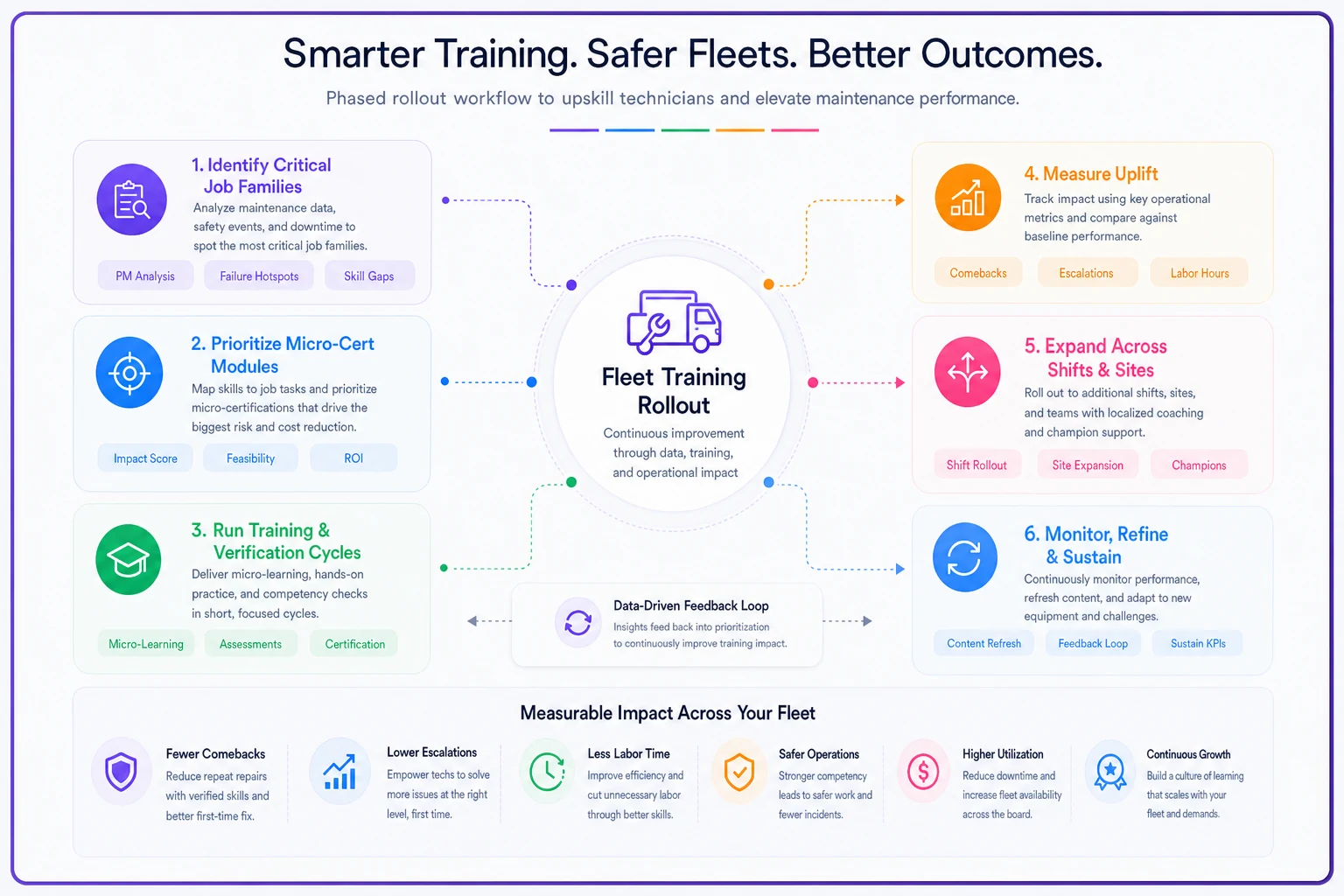
A small diagram like this makes it easier to explain why you sequence work the way you do and which KPI each phase is expected to move.
When this makes sense — and when it doesn't
Worth building when:
-
You run mixed makes/platforms and capability genuinely varies by system
-
You've had MTTR spikes traceable to specific people being unavailable
-
Comeback rates differ wildly between techs on the same job type
-
You're planning to add new platforms (EV, newer emissions systems) and need a repeatable way to bring the team up
Probably not worth it when:
-
You have five techs who all do everything competently — the matrix overhead won't pay back
-
Turnover is so high that people leave before uplift shows; fix retention first
-
You'd use the matrix purely as a discipline tool
That last point is the quiet killer. A competency matrix only works if people volunteer their weak spots. The moment techs think it's a firing list, they'll stop being honest about what they can't do, and the whole system's data goes garbage. Frame it as "here's your path to the next pay bump," not "here's the record we'll use against you."
Keeping the matrix alive without drowning in spreadsheets
The operational failure mode is predictable. The matrix gets built in a spreadsheet, looks great for a month, and never gets updated. Comeback rates keep flowing into the work-order system while the skills map sits frozen and slowly lies to you.
The fix is connecting the matrix to data you're already capturing. Your work order records already contain who did the job, the job type, and whether it came back. Fleet maintenance platforms that let you tag work orders by system and technician can surface comeback and labor-variance trends per person without anyone manually compiling them — which means the verification side of your micro-certs partly maintains itself. Instead of someone manually re-rating people every quarter, the system flags when a tech's comeback rate on a family drops enough to justify bumping them a level, or spikes enough to warrant a refresher. You still make the human call, but you're not mining spreadsheets to find it.
Prioritize integrating comeback and escalation flags from your CMMS first so the matrix can auto-signal verification candidates.
That's the difference between a matrix that decays and one that stays honest: the measurement has to ride on data that flows whether anyone remembers to update it or not.
A short real scenario
A regional delivery operation running around 60 mixed trucks — Freightliners, a batch of newer Internationals, a handful of hybrids — had a recurring pattern. Aftertreatment work orders sat an extra day or two whenever their one strong emissions diagnostician was off. MTTR on emissions jobs ran close to double the fleet average, and roughly one in four DPF-related closures came back within a few weeks.
They mapped a competency matrix and found exactly two people at L2+ on emissions across three shifts. They built four micro-certs targeting the specific comeback causes — mostly skipped regen verification and misread soot-load readings. Over about ten weeks they moved four more techs to L2 on that family. The result wasn't dramatic on paper but it mattered operationally: emissions comebacks dropped to somewhere around one in eight, and MTTR on those jobs stopped spiking whenever a single person was out. Nothing about the trucks changed. They just stopped having their emissions capability concentrated in one guy.
The takeaway
A mechanic upskilling program for a fleet isn't a training budget — it's a capability map you can schedule against and measure. Build it around job families that match how your work actually clusters, define levels by observable shop-floor outcomes instead of course completion, keep the certs small enough to finish in real gaps, and roll it out in phases that each produce a KPI you can point to.
Do that, and "who can do what" stops living in one person's head and starts being something you can actually run the shop on.
Do that, and "who can do what" stops living in one person's head and starts being something you can actually run the shop on.
Ready to maximize fleet uptime and reduce maintenance costs?
Join 2,000+ fleet managers using Fleetelyly to streamline maintenance workflows and improve vehicle reliability.