

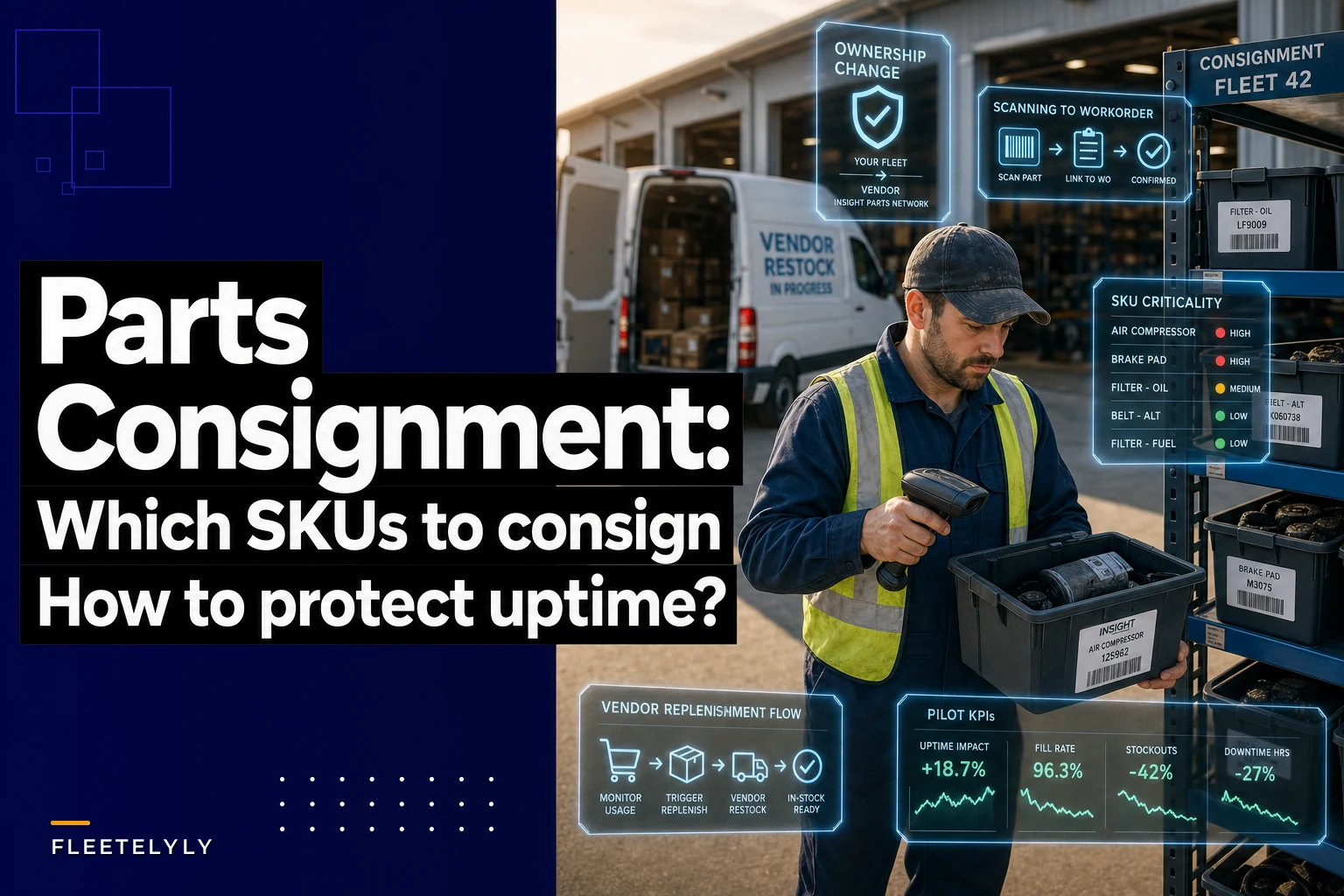

Most fleets sitting on a bloated parts room don't have a purchasing problem. They have a cash problem wearing a purchasing costume. You've got $180k–$250k in slow-moving inventory tied up on shelves, half of it "just in case," and finance keeps asking why the parts budget looks like a savings account with no interest.
Consignment is the obvious lever. Let the vendor own the inventory until you pull it, pay only when you consume it, keep the parts physically on your shelf. Sounds clean. But fleets that do this badly end up with a worse problem than the one they started with — because they consign the wrong SKUs, lose visibility into what's actually being used, and quietly start eating stockouts on the exact parts that keep trucks moving.
This is a decision playbook, not a pitch for consignment. Some SKUs should never be consigned. Some vendors shouldn't be trusted with it. The goal is to free capital without letting uptime slip a single point.
The mistake almost everyone makes first
The default instinct is to consign your most expensive parts. Big-ticket items tie up the most cash, so it feels like the fastest win. A $4,200 turbo, a $2,800 DPF assembly, a couple of remanned transmissions — move those to consignment and the balance sheet looks great overnight.
That's usually backwards.
High-cost, low-velocity parts are exactly the ones a vendor is least willing to consign on reasonable terms, and the ones where a stockout hurts least because you can actually plan around a slow-turning part. Meanwhile the parts that protect uptime — filters, sensors, common brake components, coolant hoses, the fast-moving stuff — are cheap individually but represent real cash in aggregate and cause immediate downtime when they're missing.
The pattern plays out like this: a fleet consigns $90k of expensive assemblies, frees the cash, and six months later realizes they still can't get a truck out the door because an $18 sensor wasn't on the shelf. The consignment program looked successful on paper and did nothing for availability.
Consignment should be evaluated per SKU on two axes simultaneously: how much cash it frees and how much stockout risk it introduces. Never one without the other.
The SKU selection rules
Run every candidate part through this filter before it goes anywhere near a consignment agreement.
Prevent costly breakdowns with proactive maintenance.
Fleetelyly helps you schedule, track, and manage every vehicle service efficiently.
- Automated maintenance reminders
- Real-time service tracking
- Parts inventory integration
No credit card required
| SKU characteristic | Good consignment candidate | Bad consignment candidate |
|---|---|---|
| Velocity | Predictable, steady pull | Erratic or rare (annual-ish) |
| Unit cost | Moderate to high | Very low (not worth the admin) |
| Criticality to uptime | Medium — planned repairs | Extreme — same-day downtime part |
| Shelf life / obsolescence | Stable, long life | Perishable or fast-superseded |
| Vendor lead time to replenish | Short and reliable | Long or unpredictable |
| Substitutability | Interchangeable across VINs | Highly VIN-specific one-offs |
The sweet spot is boring on purpose: moderate-cost, steady-velocity, medium-criticality parts with a vendor who can replenish reliably. Common alternators, standard brake kits for your dominant chassis, batteries, mid-tier sensors. These free meaningful capital and — because they turn predictably — a well-run consignment shelf can actually reduce stockout risk instead of raising it.
A few hard rules worth writing down:
-
Never consign a part where your only supplier is the consignor. Single-source plus consignment means the vendor controls both your inventory and your ability to replenish it. That's a leverage trap.
-
Don't consign parts with high supersession risk. If the OEM revises the part number every 18 months, you'll end up disputing who eats the obsolete stock.
-
Keep your true "line-down" parts owned. The handful of SKUs that, when missing, immediately park a revenue vehicle — own those outright and manage them under a tight reorder policy. Your spare-parts reorder policy for variable lead times is the right home for those criticality-tier decisions, not a consignment agreement.
-
Batch the boring stuff. The admin cost of tracking a consigned $6 part isn't worth it. Set a floor — somewhere around $40–$60 unit cost — below which you just buy and stock normally.
Batch the boring stuff. The admin cost of tracking a consigned $6 part isn't worth it. Set a floor — somewhere around $40–$60 unit cost — below which you just buy and stock normally.
Visibility is where consignment quietly falls apart
The dirty secret of consignment: the physical part is on your shelf, but ownership and usage tracking now live in two places. If your inventory system doesn't cleanly separate "consigned, unpaid" from "owned, on-hand," you lose the plot fast.
Here's how it breaks. A tech pulls a consigned water pump for a work order. Nobody scans it against the consignment ledger. Three weeks later the vendor's rep does a physical count, finds the shelf short, and invoices you — but your system shows it was never consumed. Now you're reconciling by hand, arguing over shrinkage, and finance no longer trusts the numbers. Multiply that across 400 SKUs and the "capital savings" get eaten by administrative chaos.
The non-negotiable visibility rules:
-
Every consumption event triggers an ownership change at the moment of pull — scanned to the work order, not counted after the fact.
-
Consigned stock is flagged distinctly in the WMS/CMMS, so on-hand quantity and paid-for quantity are never confused.
-
You reconcile on your consumption record, not the vendor's physical count. The count is a check, not the source of truth.
-
Min/max levels for consigned SKUs are visible to both sides, so replenishment triggers automatically instead of depending on a rep noticing an empty bin.
This is where operational software earns its keep — not as a magic fix, but because a system that ties every part pull to a work order and automatically reclassifies consigned stock as consumed removes the manual reconciliation entirely.
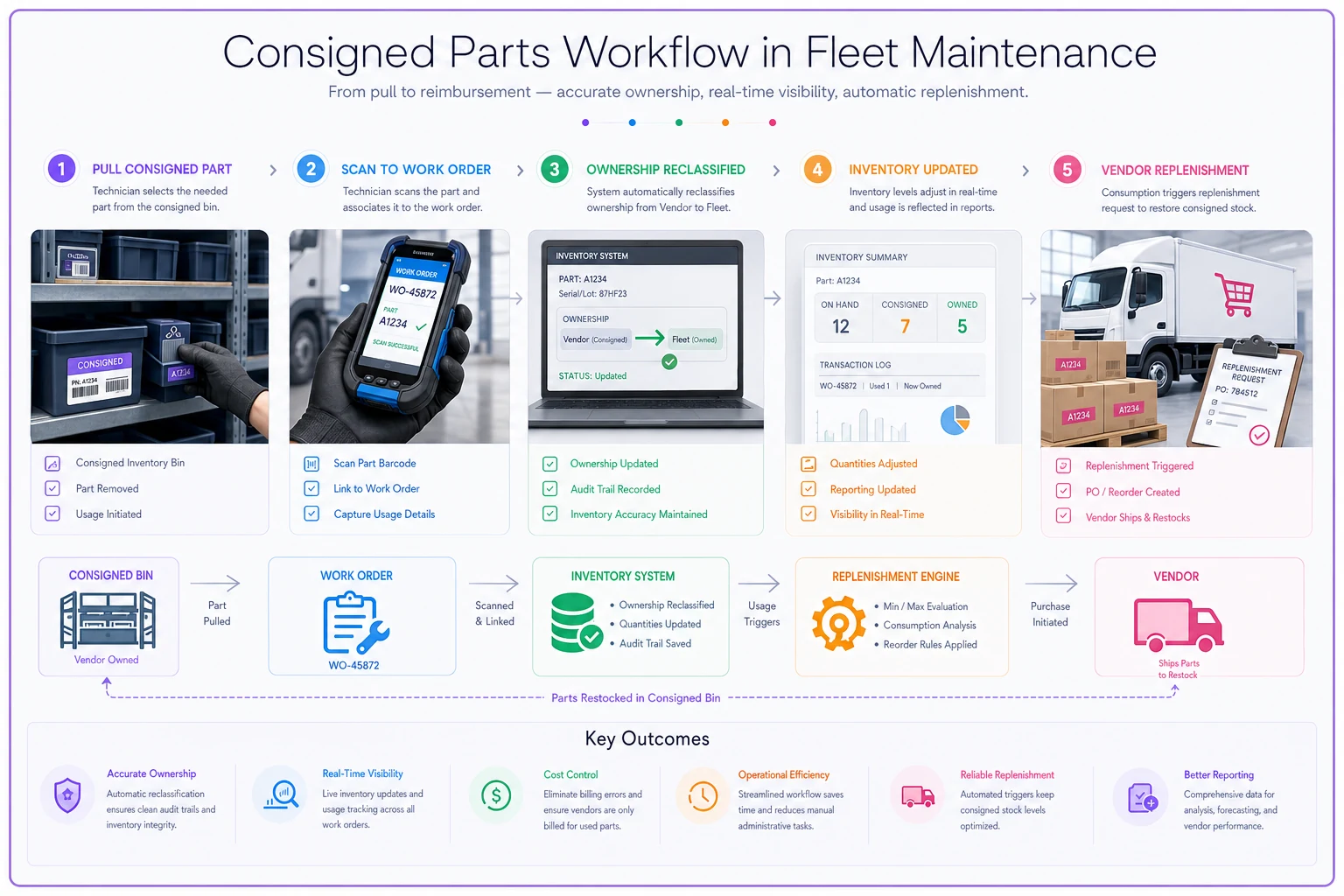
Make 'scan-to-work-order' mandatory and enforce it with a daily reconciliation report — most invoice disputes disappear when scanning is non-negotiable.
When the pull event itself updates the ledger, the monthly argument with the vendor just stops happening. Fewer places for a human to forget a step.
Invoicing rules that keep the cash benefit real
Consignment only frees capital if the payment terms actually defer cash. Fleets sign agreements that consign the inventory but require weekly invoicing at consumption — which barely improves cash flow over just buying with net-30 terms.
Push for these:
-
Pay-on-consumption, invoiced monthly in arrears. You consume across the month, get one invoice, pay net-30 from invoice date. That's real float.
-
Price locked at agreement, not at consumption. Otherwise the vendor can drift prices up on a shelf you can't shop around.
-
Defined true-up cadence — monthly reconciliation between your consumption record and their replenishment record, with a written dispute window.
-
Clear obsolescence ownership. If a part sits unconsumed past an agreed window — say 12–18 months — spell out whether the vendor rotates it out or you're on the hook. Get this in writing before signing, not during the dispute.
The invoicing schedule is not boilerplate. It's the entire financial point of the arrangement. A consignment deal with bad invoicing terms is just a storage arrangement pretending to be a cash win.
When consignment actually makes sense
There are a few conditions where this works well in practice:
-
You have a dominant chassis mix so a meaningful set of SKUs turn predictably.
-
You've got a reliable regional vendor with short replenishment lead times.
-
Your inventory system can cleanly separate consigned from owned stock and tie pulls to work orders.
-
You're carrying six figures of capital in mid-tier, steady-moving parts.
When all four of those line up, consignment is worth pursuing seriously. When one or two are shaky, the program will create more problems than it solves.
When it's a bad idea
Some situations where consignment consistently goes sideways:
-
Small, highly mixed fleets where nothing turns predictably enough to build a consignment shelf around.
-
Single-source parts where the consignor is also your only supplier.
-
Shops without disciplined parts-issue scanning — if techs pull parts without logging them now, consignment will amplify that chaos into invoice disputes.
-
Fleets whose real problem is overstocking owned inventory — sometimes the fix is a tighter reorder policy, not shifting who owns the same bloated shelf.
Fleets whose real problem is overstocking owned inventory — sometimes the fix is a tighter reorder policy, not shifting who owns the same bloated shelf.
Who should NOT do this yet
If your parts room can't tell you, right now, the consumption rate of your top 50 SKUs over the last six months, you're not ready.
Consignment demands better data discipline than owned inventory, not less. Fix your consumption tracking first, then consign. Doing it in the wrong order is how fleets end up worse off — free cash, broken visibility, rising stockouts.
Piloting it: KPIs that tell the truth
Don't roll consignment across the whole parts room. Run a 90-day pilot on one category — standard brake and filtration SKUs for your most common chassis, for example — and watch these:
-
Capital freed — dollar value of inventory moved off your books.
-
Stockout rate on consigned SKUs — must stay flat or improve. This is the number that kills the program if it moves the wrong way.
-
Fill rate at the shelf — how often the part was there when a tech reached for it.
-
Reconciliation variance — gap between your consumption record and the vendor's replenishment record. Anything above a few percent means your visibility rules aren't holding.
-
Invoice dispute count — should trend toward zero by month three. If it doesn't, the process is broken, not the concept.
The one to obsess over is stockout rate. If capital drops but availability slips even slightly, you've traded a cash problem for a downtime problem — and downtime always costs more than the capital you freed.
A real scenario
A regional last-mile fleet running about 140 vans, mostly one chassis family, had roughly $210k in parts inventory with a chunk of it slow-moving. Finance wanted it cut. Their first instinct was to consign the expensive stuff — remanned components, the big assemblies.
They flipped it instead. They consigned a category of mid-tier, fast-turning SKUs: brake kits, filters, common sensors, batteries — around 60 SKUs — with a regional vendor who could replenish in two to three days. Genuine line-down parts stayed owned and on a tight reorder policy.
Over the pilot they freed somewhere in the range of $55k–$65k of capital. The number that mattered more: stockout rate on the consigned category didn't rise — it dipped slightly, because the vendor kept the bins fuller than the fleet's old manual reorder habit did. Invoice disputes ran high in month one, dropped to near zero by month three once every part pull was scanned to the work order.
The expensive assemblies they'd originally wanted to consign? Left those owned. The vendor's terms on low-velocity, high-cost parts weren't worth the obsolescence risk.
The takeaway
Consignment isn't a balance-sheet trick you apply to your priciest parts. Done right, it's a targeted move on the boring, predictable, mid-tier SKUs where a reliable vendor can hold availability steady while your cash walks off the shelf. Get the SKU selection wrong, or let the visibility rules get sloppy, and you'll free capital and lose uptime — the exact trade no fleet manager can afford.
Run the two-axis filter on every candidate part, lock down consumption tracking before you sign anything, pilot on one category, and let the stockout number be your veto. That's the whole playbook.
Run the two-axis filter on every candidate part, lock down consumption tracking before you sign anything, pilot on one category, and let the stockout number be your veto. That's the whole playbook.
Ready to maximize fleet uptime and reduce maintenance costs?
Join 2,000+ fleet managers using Fleetelyly to streamline maintenance workflows and improve vehicle reliability.