


Most fleet parts SLAs fail in the same quiet way. Someone signs a supplier agreement promising "95% fill rate" and "next-day delivery on stock items," then eighteen months later nobody can tell you whether the supplier actually hit those numbers — because nobody defined what counts as a "fill," what "next-day" means when the order drops at 4:55 PM, or which parts even qualify for the fast lane.
The SLA exists. It's just unenforceable. And an unenforceable SLA is worse than no SLA, because it gives everyone the comfortable feeling that uptime is somebody else's contractual problem. This piece is narrow on purpose. It covers the specific clauses you need for a mixed fleet — fill-rate definitions, lead-time windows, emergency response — and how to tie scorecard triggers and phased enforcement to part criticality tiers so you're not treating a $4 cabin filter like a brake caliper that grounds a truck.
Why generic SLAs collapse the moment a truck is down
The core problem is that most parts SLAs are written as if all parts and all vehicles are interchangeable. In a mixed fleet they aren't. You've got Class 8 tractors, cargo vans, maybe some EV units, light-duty pickups — each pulling from different supplier networks with wildly different availability profiles.
A single blanket "95% fill rate, 24-hour lead time" clause flattens all of that into one meaningless average. The trap: a supplier can hit 95% fill overall while failing you on exactly the parts that ground vehicles. They stock the fast movers deep — oil filters, wiper blades, common belts — and those high-volume lines carry the average. Meanwhile the slow-moving, vehicle-critical SKUs (specific sensors, a particular water pump variant, an EV contactor) sit at 60% availability and nobody notices in the aggregate. Fill rate only means something when it's measured per criticality tier, not fleet-wide. The average is a lie that protects the supplier.
Define your criticality tiers before you write a single clause
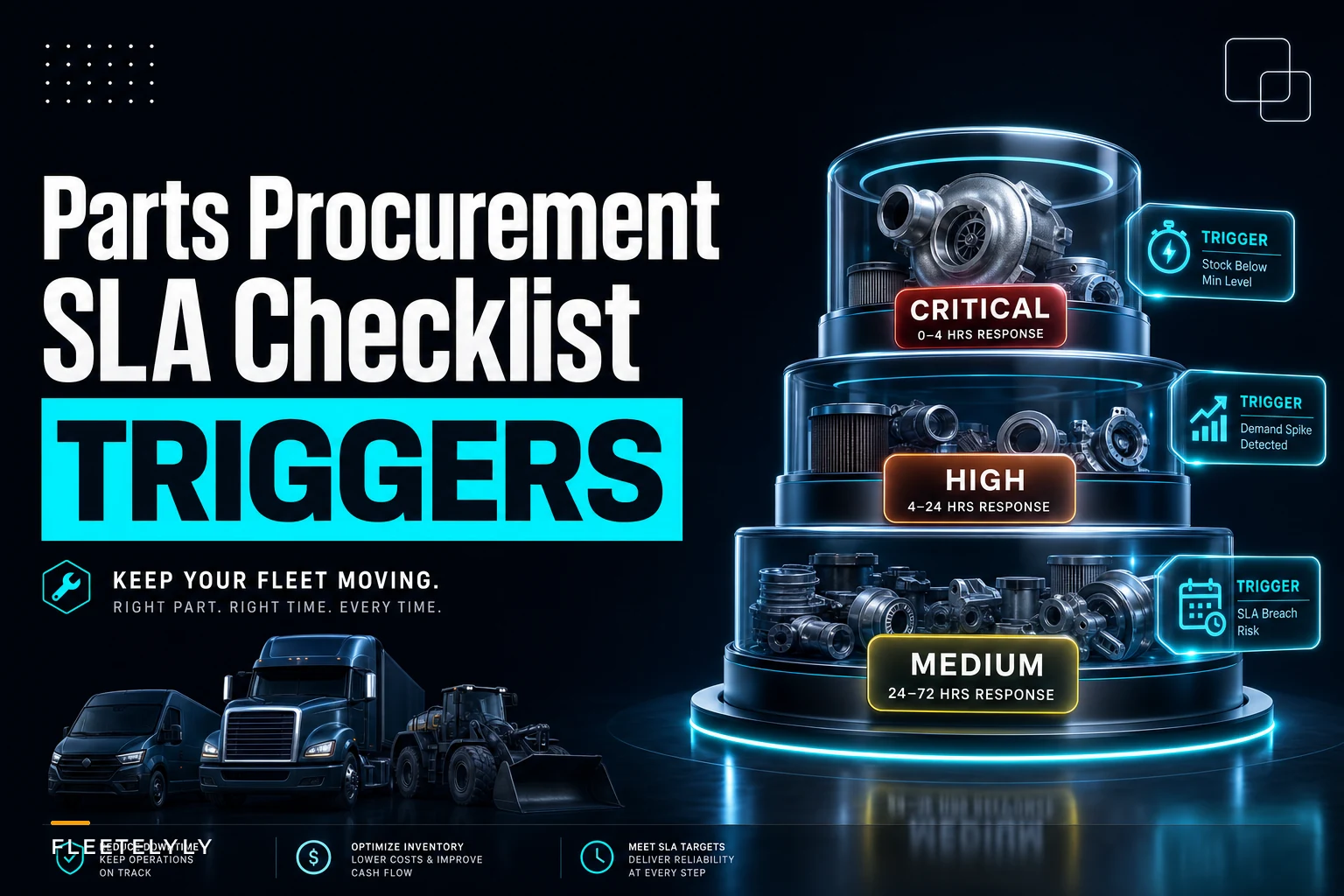
You can't write enforceable SLA language until you've sorted parts into tiers based on what their absence actually costs you. This isn't ABC analysis by spend — it's tiering by downtime impact. A workable three-tier structure:
Prevent costly breakdowns with proactive maintenance.
Fleetelyly helps you schedule, track, and manage every vehicle service efficiently.
- Automated maintenance reminders
- Real-time service tracking
- Parts inventory integration
No credit card required
| Tier | Definition | Example parts | What downtime costs |
|---|---|---|---|
| Tier 1 – Vehicle-down | Absence grounds the vehicle; no safe workaround | Brake calipers, steering components, EV traction contactors, turbo actuators | Full day(s) of lost revenue per unit |
| Tier 2 – Degraded/scheduled | Vehicle runs but repair can't be deferred past a window | Alternators, AC compressors, specific sensors, injectors | Rising risk, PM slippage, cascading failures |
| Tier 3 – Routine/consumable | Easily substituted or deferrable | Filters, wipers, bulbs, common belts | Minimal if backordered a day or two |
The tiers do the heavy lifting. Every SLA clause below hangs off them. If you've already built a reorder policy with criticality in mind — along the lines of this spare-parts reorder policy for variable lead times — you can reuse that same tier structure here so your inventory logic and your supplier contracts speak the same language. When they diverge, you get the worst outcome: safety stock sized for one definition of "critical" and SLA penalties written against another.
Fill-rate clauses that can't be gamed
Fill rate is where most of the fuzziness hides. Three things need to be nailed down in the clause itself.
1. Line fill vs. order fill. Line fill measures the percentage of individual order lines shipped complete and on time. Order fill measures whether the entire order shipped complete. For fleets, line fill is usually the honest metric — one missing Tier 1 part can ground a truck even if the other nine lines shipped. Specify line fill, measured at the SKU level.
2. "First-pass" fill, not eventual fill. A supplier who ships 70% today and the rest in four days should not get credit for a 100% fill. Define fill as shipped-complete on the first fulfillment attempt within the committed lead-time window. Backorders count as misses, full stop.
3. Tiered targets. Set different fill-rate floors per tier:
-
Tier 1
98% first-pass line fill (these cannot be out of stock)
-
Tier 2
95% first-pass line fill
-
Tier 3
90% first-pass line fill (you'll tolerate more slack here)
The common mistake is setting the Tier 1 target too close to Tier 3. If your most critical parts carry a 95% floor, you're contractually accepting a 1-in-20 miss rate on the exact items that ground vehicles. For true vehicle-down SKUs, 98–99% is the honest number — and if the supplier can't commit to that, that's a signal to dual-source or consign those specific lines rather than softening the clause.
Lead-time windows: the cutoff clause nobody writes
"Next-day delivery" is not a lead-time window. It's an argument waiting to happen. An order gets entered at 4:50 PM. The supplier's cutoff is 4:00 PM. They process it the next morning, ship the following day. Your "next-day" part arrives in 48 hours and both sides think they were right.
Real lead-time clauses need four components spelled out:
-
Order cutoff time (e.g., "orders received before 2
00 PM local ship same day")
-
The clock-start event — is it order placement, order acknowledgment, or payment clearance? Pick one and name it.
-
Delivery window, not a point — "delivered by 10
00 AM next business day" beats "next day"
-
Business-day definition — weekends, holidays, and whether the supplier's calendar or yours governs
Then tier it. Tier 1 parts should carry an emergency lead-time commitment (more on that below). Tier 2 gets a standard next-day or 48-hour window. Tier 3 can live on a 2–3 day standard with scheduled replenishment. One pattern worth flagging: suppliers often quote aggressive lead times on paper and quietly rely on your safety stock to absorb the variance. If your inventory policy and SLA aren't aligned, you end up carrying the cost of their inconsistency while they report great on-time numbers. Measure lead-time variability, not just the average. A supplier averaging 24 hours with a range of 12–72 hours is more disruptive than one that reliably delivers in 36.
Emergency response: the clause that saves vehicle-down situations
For Tier 1 vehicle-down events, standard lead times are irrelevant. You need a distinct emergency response clause, and most agreements don't have one.
What it should contain:
-
A defined trigger
what qualifies as an emergency (vehicle-down, Tier 1 part, no stock on hand)
-
A response-time SLA
acknowledgment within X minutes, part located/dispatched within Y hours
-
A sourcing obligation
supplier must pull from alternate branches or hotshot the part, at a pre-agreed emergency rate
-
A cap on emergency premiums so you're not hostage to surge pricing when you're already grounded
-
A named escalation contact — a person and phone number, not a ticket queue
The realistic scenario: a refuse fleet has a hydraulic pump fail on a route truck. Standard channel says the pump is 3 days out. Without an emergency clause, dispatch burns two hours calling branches, eventually pays a 40% hotshot premium nobody pre-negotiated, and the truck misses a day and a half of routes. With a proper emergency clause, the trigger is defined, the premium is capped, and the supplier's obligation to source from alternate branches is contractual rather than a favor.
Scorecard triggers: turning clauses into action
An SLA with no measurement cadence is decoration. The scorecard converts contract language into supplier behavior — but only if specific thresholds trigger specific actions automatically, rather than waiting for a quarterly review where everyone's forgotten the misses.
-
Tier 1 fill drops below 98% in any rolling 30-day window → immediate written notice + root-cause request within 5 business days
-
Tier 1 fill below 95% two months running → formal review meeting + remediation plan
-
Lead-time variability exceeds agreed range on more than 10% of Tier 1/2 orders → corrective action required
-
Any single vehicle-down emergency missed → logged as a critical incident, auto-escalates regardless of overall score
The weighting matters. A missed Tier 3 filter shouldn't move the needle the way a missed Tier 1 caliper does. Weight your composite supplier score so Tier 1 performance dominates. A supplier can have a glowing overall score and still be quietly failing you where it counts — the weighting is what surfaces that.
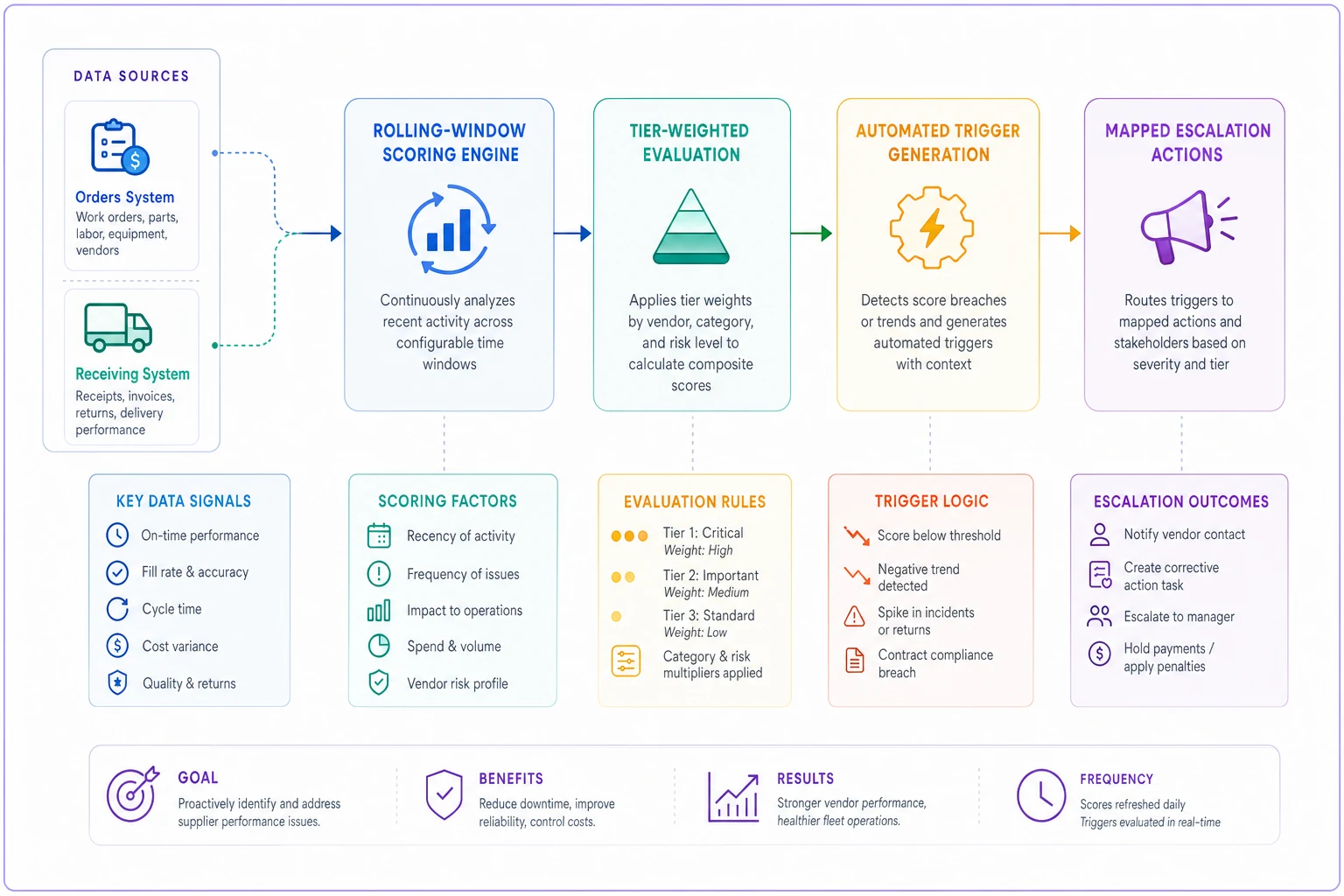
Use this flow to visualize how raw order/receiving data becomes triggers that feed the phased enforcement ladder.
Phased enforcement: don't fire a supplier over one miss
Enforcement is where fleets either overreact or do nothing. The answer is a documented escalation ladder tied to the scorecard triggers, so consequences are predictable and proportional rather than emotional.
-
Phase 1 – Notice & root cause. First trigger breach. Written notification, supplier owes a root-cause explanation. No penalty yet. Most misses are one-off and resolve here.
-
Phase 2 – Remediation plan. Repeated breach in the same tier. Supplier submits a corrective action plan with dates. You begin logging every subsequent miss against that plan.
-
Phase 3 – Financial consequence. Breach continues past the remediation window. Service credits, penalty on the next invoice, or loss of preferred-vendor status. This is the first time money moves.
-
Phase 4 – Dual-source / reallocation. Sustained failure. You begin shifting Tier 1 volume to a secondary supplier for the affected SKUs — not necessarily the whole account, just the lines they can't deliver.
-
Phase 5 – Exit. Documented, repeated failure across phases. You offboard with a clean paper trail, and because you've been dual-sourcing since Phase 4, uptime doesn't crater during the transition.
Suppliers respond to predictability. If they know exactly what Phase 2 looks like and that Phase 3 costs them money, most fix the problem before it gets there. Fleets that skip straight from "annoyed" to "cancel the contract" usually end up scrambling for a replacement at worse terms than they started with.
Where this breaks in practice
The honest weak point in all of this is measurement discipline. Writing tiered fill-rate clauses is easy. Actually tracking first-pass line fill by criticality tier, across multiple suppliers, over rolling windows — that's where most programs quietly die. People write the SLA, file it, and go back to firefighting.
Integrate order, receiving, and parts data into a single system so misses surface on dashboards without manual cross-referencing.
If every miss has to be caught manually by someone cross-referencing receiving logs against order timestamps, it won't happen consistently. Pulling order, receiving, and parts data into a single work-order and inventory system earns its keep here — not because software enforces the SLA, but because it makes the misses visible without someone doing detective work every month. When the fill-rate dip shows up on a dashboard automatically, Phase 1 notices actually get sent. When it lives in three spreadsheets, they don't.
A short real-world scenario
A regional distribution fleet — roughly 80 mixed units, vans and medium-duty trucks — ran a single primary parts supplier with a vague "95% fill, next-day" agreement. On paper the supplier scored around 94% fill. Uptime still felt worse than that number suggested. When they broke fill rate out by criticality tier, the picture flipped: Tier 3 consumables were sitting near 99%, carrying the average, while Tier 1 vehicle-down parts were hovering in the low 80s. Those misses were driving nearly all of their unplanned downtime.
They rewrote the agreement with tiered targets, an emergency clause capped at a pre-agreed premium, and a five-phase enforcement ladder. Over the next couple of quarters, Tier 1 first-pass fill climbed into the mid-90s. The supplier — facing a defined Phase 3 financial consequence — proactively started stocking two of the problem SKUs locally. Vehicle-down parts delays dropped noticeably, and the dual-sourcing groundwork from the enforcement template meant they had a fallback for the handful of parts the primary still couldn't commit to. Nothing about the fix was exotic. They stopped measuring one number and started measuring the right ones, per tier.
The checklist
Use this as your parts procurement SLA checklist when drafting or auditing a mixed-fleet supplier agreement:
-
Parts sorted into criticality tiers by downtime impact, not just spend
-
Fill rate defined as first-pass line fill at the SKU level
-
Separate fill-rate floors per tier (Tier 1 at 98%+)
-
Backorders explicitly count as fill misses
-
Order cutoff time named explicitly
-
Clock-start event defined (placement vs. acknowledgment vs. payment)
-
Delivery windows stated as times, not "next day"
-
Lead-time variability measured, not just average
-
Emergency response clause with trigger, response time, and capped premium
-
Named escalation contact — a person, not a queue
-
Scorecard triggers tied to rolling windows and tier-weighted
-
Five-phase enforcement ladder documented in the contract
-
Dual-source plan ready for Tier 1 SKUs before you need it
-
A reliable way to surface misses automatically, not manually
Get the tiers right and everything else hangs off them cleanly. Skip the tiers and you're back to a 95% number that looks fine on a dashboard while trucks sit in the yard waiting on the one part the average conveniently hid.
Get the tiers right and everything else hangs off them cleanly. Skip the tiers and you're back to a 95% number that looks fine on a dashboard while trucks sit in the yard waiting on the one part the average conveniently hid.
Ready to maximize fleet uptime and reduce maintenance costs?
Join 2,000+ fleet managers using Fleetelyly to streamline maintenance workflows and improve vehicle reliability.