
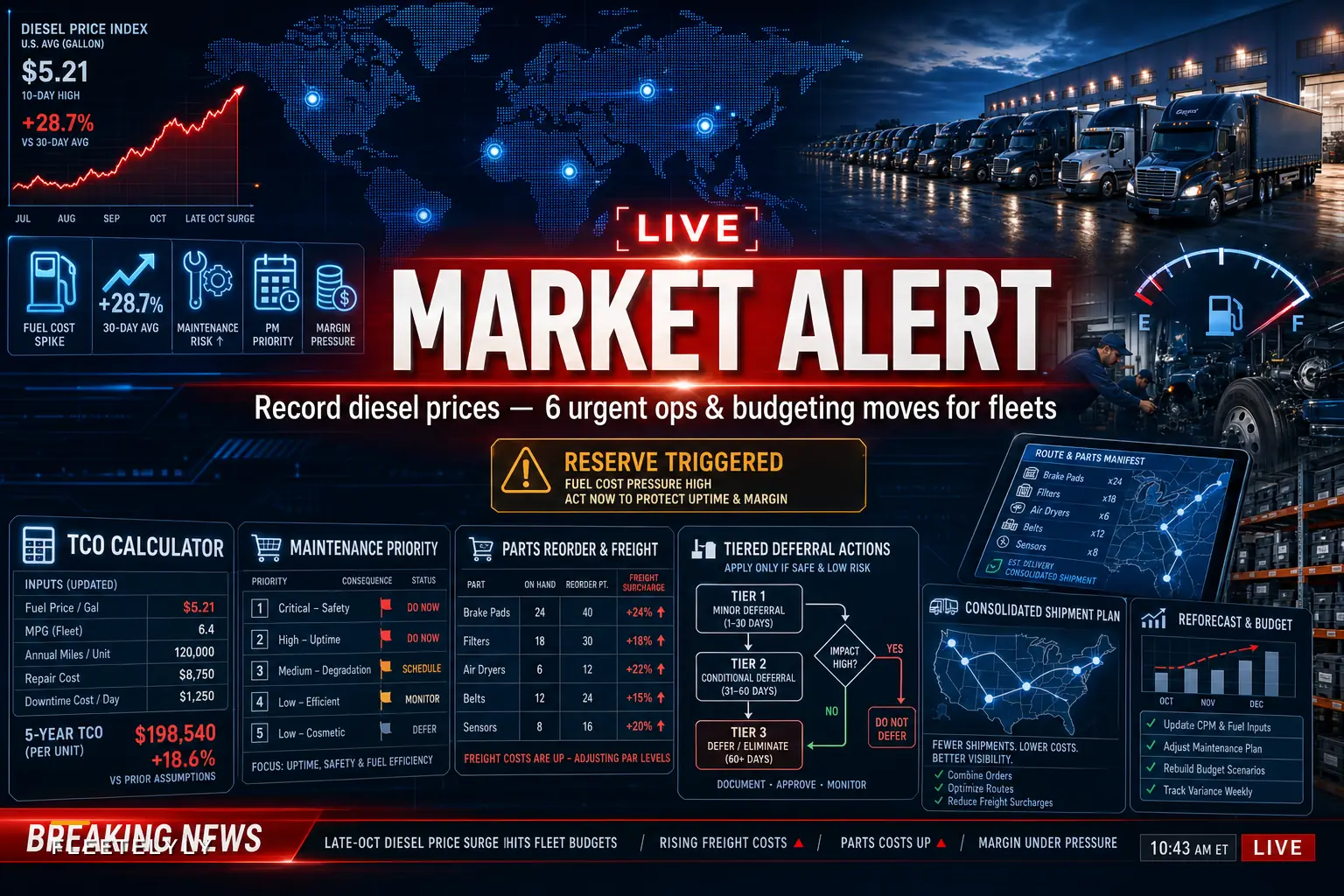

Diesel crossing $6 a gallon doesn't just show up on your fuel card statements. It quietly rewrites assumptions buried in three or four other line items you probably haven't touched since your last annual budget cycle. Parts freight. Mobile mechanic dispatch costs. Idle time during PMs. The deferral math on repair-vs-replace. All of it moves when fuel moves, and most fleets don't feel the full hit until two or three months later when the reserve looks thinner than it should.
The late-October spike — driven by Middle East supply disruptions and refinery capacity issues, with US officials pressing refiners to boost output — is the kind of event that exposes how fragile a lot of fleet budgets actually are. Not because fuel is a surprise. Everyone knows diesel is volatile. The problem is that most maintenance budgets treat fuel as someone else's line item, when in reality a diesel price surge bleeds directly into the cost of keeping trucks in the bay and parts on the shelf.
So skip the explanation of why diesel went up. You've already seen the headlines. What matters now is what actually breaks in your operation and what to do in the next 30 days.
The hidden places diesel inflation shows up in maintenance
When fuel jumps, your pure fuel line goes up — obviously. But the second-order costs are where budgets quietly blow out, and those land squarely in maintenance.
Take a mid-size regional fleet, say 120 trucks. The direct fuel increase is painful but visible, so leadership tracks it. What nobody flags until later:
-
Parts freight surcharges. Suppliers pass fuel costs through as freight adjustments. On expedited parts, that can add $40–$90 per shipment, and if you're running hot on backorders you're expediting more than usual.
-
Mobile mechanic mileage. If your roadside or depot-to-depot coverage is reimbursed per mile or burns company diesel, every service call costs more.
-
Idle and reposition fuel during PMs. Trucks shuffled between yards for scheduled service, warm-up time, hydraulic PTO work — all of it burns fuel that's now 15–25% more expensive than it was.
-
Deferral pressure. When fuel eats the operating budget, the instinct is to defer PMs and non-urgent repairs. That's where a fuel problem turns into a reliability problem.
A recent CNBC analysis of the diesel surge pointed out how broadly these costs ripple through freight-dependent operations. For a fleet, the ripple doesn't stop at the pump — it ends up distorting the maintenance reserve, because that reserve is usually the first place managers raid when the P&L gets tight.
The underlying problem: static budgets can't absorb a moving input
The real issue a diesel spike exposes isn't the price of fuel. It's that most fleets budget maintenance on a fixed annual number divided into twelve, with maybe a crude seasonal adjustment. That works fine when inputs are stable. It falls apart the moment a major cost input — fuel, parts, labor — moves 20% in a quarter.
Prevent costly breakdowns with proactive maintenance.
Fleetelyly helps you schedule, track, and manage every vehicle service efficiently.
- Automated maintenance reminders
- Real-time service tracking
- Parts inventory integration
No credit card required
When your budget is static and your costs are dynamic, you end up with one of two bad outcomes. Either you overspend and blow the reserve, or you panic-defer work to protect the number and quietly accumulate reliability debt that surfaces as roadside failures in Q1.
Fleets that handle a shock like this well aren't the ones with bigger budgets. They're the ones running rolling forecasts tied to reserve triggers — so when an input moves, they already know which levers to pull and in what order. If you haven't built that yet, the current diesel spike is a decent forcing function. We go deep on the mechanics in our guide to rolling forecasts, reserve triggers and repair-vs-replace rules, and the moves below assume you're moving toward that kind of dynamic model.
The 6 moves to make in the next 30 days
These aren't theoretical. They're the specific things that separate fleets that absorb a fuel shock cleanly from the ones that spend the next quarter chasing failures they deferred themselves into. Work through them in order — the first two set up everything else.
1. Re-run your per-mile maintenance cost with the new fuel baseline
Your cost-per-mile (CPM) model almost certainly has a fuel assumption baked in that's now stale. Pull it, update the diesel input to current pump prices plus a buffer, and re-run. The point isn't precision — it's catching where maintenance activities that consume fuel (repositioning, PTO work, test drives) got more expensive without anyone noticing.
A fleet running CPM at an assumed $4.40/gal diesel suddenly operating at $6.10 will find their maintenance-adjacent fuel burn up by roughly a third on those specific activities. Small as a share of total, but it's real money that was invisible before.
2. Rank your PMs by failure consequence, not by calendar
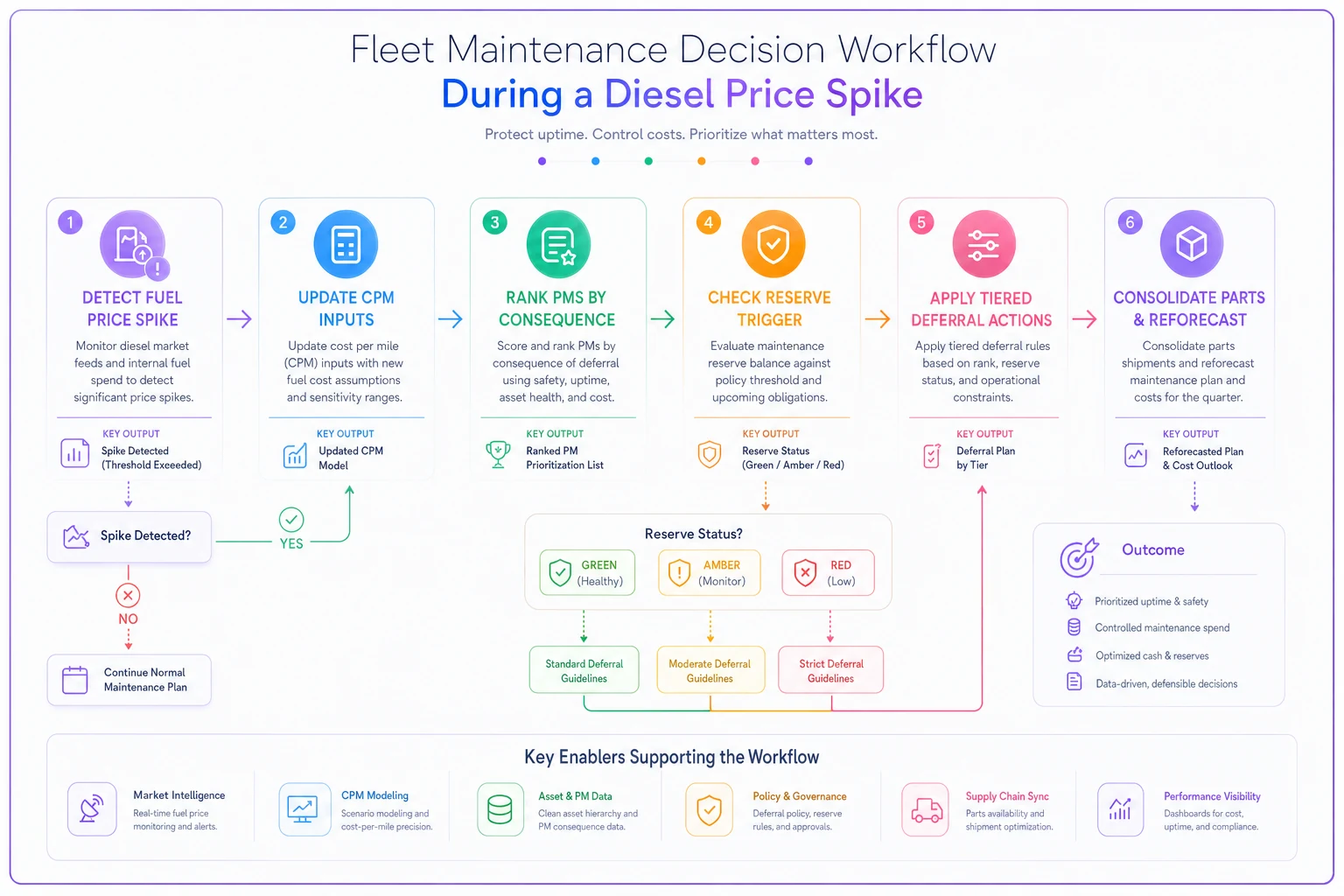
Deferral is going to happen under budget pressure. The question is whether it's deliberate or reactive. Reactive deferral means someone cancels whatever's easiest to cancel. Deliberate deferral means you've already sorted every PM into tiers:
-
Non-negotiable brake systems, safety-critical inspections, anything with DOT exposure.
-
Protect at all costs PMs that prevent high-dollar failures — oil analysis cadence, cooling system, aftertreatment.
-
Flexible window cosmetic, comfort, or low-consequence items you can slide 2–4 weeks without real risk.
If diesel pressure forces cuts, you cut from the bottom tier only, and you cut on purpose. The mistake most fleets make is treating all overdue PMs as equally skippable. They aren't.
Here's a quick decision workflow for applying Tier-based PM deferral and reserve triggers.
3. Lock parts freight terms before surcharges compound
Call your top three or four suppliers now. Fuel surcharges on freight tend to lag the pump by a few weeks, then stick around after prices ease. Ask two things: what's the current surcharge structure, and can you consolidate shipments to reduce per-order freight cost.
Expedited single-part orders are brutal under high fuel. If you can batch non-urgent parts into scheduled bulk deliveries, you often cut freight cost per part meaningfully without hurting uptime.
Batch non-urgent parts to scheduled PM windows to reduce expedited charges and extra handling.
4. Freeze non-essential CAPEX, but keep the fuel-efficiency projects alive
There's a reflex to freeze everything when the budget tightens. Resist freezing the wrong things. Shop equipment upgrades, bay expansions, nice-to-have tooling — fine to pause. But projects that reduce fuel burn (aerodynamic retrofits, idle-reduction tech, telematics-driven routing improvements) now have a shorter payback than they did last month, because the fuel you're saving is more expensive fuel.
A diesel spike actually improves the ROI on efficiency work. That's counterintuitive under budget stress, but the math is simple: higher fuel price means faster payback on anything that cuts consumption.
5. Set an explicit reserve trigger tied to fuel
If your maintenance reserve doesn't have a defined trigger point, set one this week. Something concrete: "If sustained diesel exceeds $5.75/gal for more than 30 days, we shift to Tier-3 PM deferral and re-forecast the quarter." The value isn't the specific threshold — it's removing the emotional decision-making from the moment of crisis.
Fleets that decide these rules in advance don't panic. Fleets that don't end up making the deferral call in a hallway conversation with no real data behind it.
6. Reforecast the quarter, not the year
Don't touch the annual number yet. Reforecast the next 90 days with the new inputs and see what it tells you. Rolling 90-day forecasts catch input shocks fast and let you adjust before damage compounds. Updating the annual budget is a slower, more political exercise — do that once you know whether this spike is sticky or temporary.
A quick comparison: static vs rolling budget response to the spike
Static budgets and rolling forecasts behave completely differently under a fuel shock. It's not about which one is more sophisticated — it's about whether your rules exist before the pressure hits or get invented on the fly when the P&L is already bleeding.
| Dimension | Static annual budget | Rolling forecast with triggers |
|---|---|---|
| Time to detect the hit | 60–90 days (shows up in variance) | 1–2 weeks |
| Deferral decision quality | Reactive, cut what's easy | Deliberate, cut by consequence tier |
| Reserve protection | Raided first, no rules | Defended by predefined triggers |
| Parts freight response | Noticed after invoices pile up | Renegotiated proactively |
| CAPEX discipline | Freeze everything in panic | Freeze selectively, protect efficiency ROI |
The difference isn't sophistication. It's whether you decided your rules before the shock or during it.
The fleets on the right side of that table aren't necessarily better funded. They just made their decisions earlier, when there was no pressure to cut corners.
A real scenario
A last-mile delivery fleet running about 85 diesel vans and box trucks hit the October spike with a static budget — one annual maintenance number, split evenly by month, no fuel-linked trigger. By the third week of elevated prices, the operating budget was tight enough that the ops lead started canceling PMs to free cash. No system to it. Whatever the scheduler could push, got pushed.
Within about six weeks they had two cooling-system failures and an aftertreatment issue that almost certainly would've been caught on the deferred PMs. Roadside and tow costs plus the emergency repairs ran somewhere in the range of $11k–$14k — more than the PMs would have cost, and that's before counting the delivery delays.
After that, they rebuilt their approach around a 90-day rolling forecast and a three-tier PM priority list. Next time diesel spiked, the deferral decisions were already mapped out: flexible-tier PMs slid, everything consequence-critical stayed on schedule. The budget still took a hit — you can't dodge $6 diesel — but it was a controlled hit instead of a cascade of surprise failures.
The takeaway wasn't "spend more." They spent about the same. Just in the right order.
When aggressive deferral actually makes sense — and when it doesn't
Deferring PMs under cost pressure isn't automatically wrong. It makes sense when:
-
The deferred item is genuinely low-consequence and has a documented safe window.
-
You're sliding it weeks, not months, and tracking it so it doesn't get lost.
-
You've looked at the failure risk and it's acceptable.
It's a bad idea when:
-
You're deferring safety-critical or DOT-exposed work to hit a number.
-
There's no tracking, so "deferred" quietly becomes "forgotten."
-
You're cutting the exact PMs that prevent expensive failures — which is often what panic-cutting targets, because those PMs feel skippable right up until they aren't.
The fleets that get burned almost always skip the tracking step. A deferred PM with no owner and no new date isn't a decision — it's a liability waiting to surface on a shoulder somewhere.
Where better data tightens all of this
Most of these moves depend on one thing: being able to see your real costs fast enough to act. If your maintenance costs, parts freight, and PM compliance live in spreadsheets that get reconciled monthly, you're always reacting late.
Fleets that respond well to a fuel shock tend to have their work orders, parts spend, and PM schedules centralized somewhere that a reforecast takes an afternoon instead of a week — and where deferral tracking doesn't depend on someone remembering to follow up. AI-powered operational software can help here, not by solving the fuel problem, but by making the data available fast enough that you're making decisions with current numbers instead of last month's.
That's less about any specific platform and more about not flying blind during a cost shock. A diesel price surge is exactly the moment when the gap between "we have the data" and "we think we know" gets expensive.
Closing thought
Diesel will ease eventually, or it won't — nobody running a fleet should be betting the maintenance budget on a price forecast. What you can control is whether your operation absorbs the next shock with rules already in place or scrambles to cut whatever's easiest. The six moves above aren't dramatic. They're mostly about deciding, before the pressure hits, which levers you'll pull and in what order.
Fuel volatility is a permanent feature of running diesel trucks. The fleets that handle it best just stopped treating every spike as a surprise and started treating it as a scenario they'd already planned for.
Ready to maximize fleet uptime and reduce maintenance costs?
Join 2,000+ fleet managers using Fleetelyly to streamline maintenance workflows and improve vehicle reliability.