


Writing a good SOP is the easy part. Any decent maintenance supervisor can sit down over a weekend and produce a clean brake-inspection procedure or battery-handling checklist that reads perfectly on paper. The problem shows up about three weeks later, when you walk the bays and realize half the technicians are still doing it the old way, the second-shift crew never got trained at all, and the one guy who was enthusiastic has quietly reverted because nobody reinforced anything.
That gap — between a published SOP and an SOP people actually follow — is where almost every rollout dies. And it's not because technicians are stubborn. It's because the rollout was designed as an announcement instead of a change. A real maintenance SOP change management playbook needs three things: a structured pilot, a trainer-of-trainers layer, and a 90-day reinforcement cycle that measures adoption instead of assuming it.
Here's how the whole thing actually plays out in a shop — not how it looks in a slide deck.
The failure pattern: "we trained everyone" doesn't mean anything
The sequence that kills adoption is remarkably consistent across fleets of all sizes.
A new SOP gets written. Leadership schedules a one-hour all-hands where someone reads through the document. Everybody signs an acknowledgment sheet. The SOP goes into a binder or a shared drive. And then nothing. No one checks whether the work actually changed.
-
A small number of techs who adopted it fully
-
A larger group doing a half-version based on what they remember
-
A group that either missed the session or reverted the moment they hit a busy day
The real tell is when you ask a supervisor "are we following the new torque-verification SOP?" and they say "yeah, we rolled that out in March." Rolling it out and following it are two completely different measurements. One is an event. The other is a behavior you have to maintain.
Mass training fails for a simple reason: you can't reinforce 40 people at once, and reinforcement — not instruction — is where behavior change actually happens. A one-hour session transfers information. It doesn't build a habit, and it definitely doesn't survive the first chaotic Monday when nine vehicles are down and everyone's rushing.
The structure that works: pilot → trainer-of-trainers → reinforce
Instead of training everyone at once, you compress the rollout into a small controlled group, build internal trainers from that group, then run a deliberate 90-day reinforcement cycle. Three phases, each with a clear job.
Prevent costly breakdowns with proactive maintenance.
Fleetelyly helps you schedule, track, and manage every vehicle service efficiently.
- Automated maintenance reminders
- Real-time service tracking
- Parts inventory integration
No credit card required
| Phase | Duration | Goal | Who's involved | Key metric |
|---|---|---|---|---|
| Pilot | 2–3 weeks | Prove the SOP works in real conditions, fix the friction | 3–5 techs, 1 supervisor | SOP completion rate, defects caught |
| Trainer-of-trainers | 1–2 weeks | Turn pilot techs into credible floor trainers | Pilot techs + shift leads | Trainer certification, teach-back quality |
| Reinforce | 90 days | Make the behavior the default | Full shop, all shifts | Adoption %, drift incidents, audit pass rate |
The whole idea is that you're not relying on a document to change behavior. You're relying on a handful of respected technicians who've already lived the new process and can coach their peers through the awkward first weeks.
Visual workflow of the pilot→trainer→reinforce process.
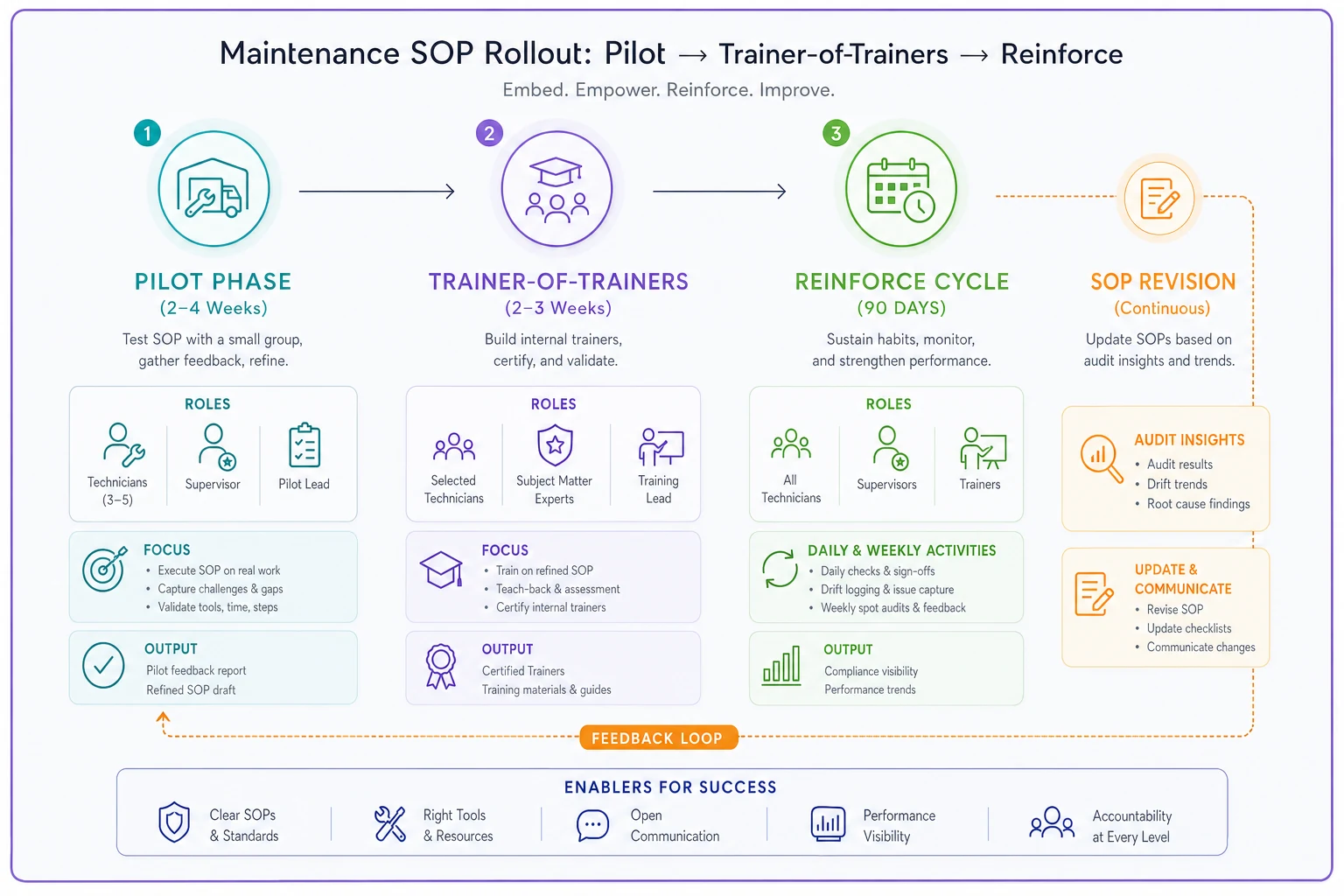
If you've already built out decision gates and review cadences — the kind of structure covered in a maintenance governance framework for mixed fleets — this rollout model plugs directly into those gates. The pilot becomes your first gate; the 90-day reinforcement data becomes what you review quarterly.
Phase 1: The pilot (where you find out the SOP is slightly wrong)
The point of the pilot isn't to show off a polished procedure. It's to run the SOP under real shop pressure and catch everything the author missed — because there's always something.
Pick 3 to 5 technicians who are good but not your absolute top performers. You want people who are credible with their peers and honest about friction, not the one superstar who can make any process work through sheer skill. Run the SOP on live work orders for two to three weeks. During that window, the supervisor's main job is to watch and collect friction points.
Choose pilot techs who are respected by peers and honest about friction—avoid selecting only your superstars.
A typical example: a fleet introduces a new coolant-system inspection SOP that requires photographing the reservoir level before and after top-off. Sounds clean on paper. Two days into the pilot, techs point out that the reservoir on one of the most common chassis in the fleet is behind a shroud that takes four minutes to remove — so the "quick photo" step is actually adding ten minutes per unit. You either revise the SOP, source a different tool, or accept the time cost. But you only learn that by piloting.
Things to track during the pilot:
-
How long the SOP actually takes vs. the estimate
-
Steps that are consistently skipped (those are either unnecessary or badly worded)
-
Points where techs ask "wait, what do I do if..." — those are missing exception rules
-
Defects the SOP successfully caught that the old process missed
That last one matters a lot. If the pilot doesn't catch anything the old way missed, the SOP might not be worth the disruption — and it's much cheaper to learn that with five techs than after you've trained the whole shop.
Phase 2: Trainer-of-trainers (your pilot techs become the rollout engine)
This is the step almost everyone skips, and it's the one that makes the whole thing scale.
Once your pilot techs have run the SOP for a couple of weeks, they understand it better than the person who wrote it. They know where people will stumble, which steps feel pointless but aren't, and how to explain it in shop language instead of document language. That's exactly what you need.
A trainer-of-trainers session doesn't have to be elaborate. It's essentially a half-day where each pilot tech:
-
Walks through the SOP on a real vehicle while others watch
-
Explains the why behind the two or three steps people resist most
-
Does a teach-back — they train one other person while you observe
-
Gets a short list of common objections and how to respond
The reason this works is credibility. A technician learning a new torque-sequence SOP will tune out a binder and a supervisor. But when a respected peer says "yeah, I thought this step was pointless too, until it caught a cross-threaded stud on a unit I'd have signed off" — that lands. Peer trainers carry authority that memos never will.
Certify your trainers before they go to the floor. "Certified" just means they can perform the SOP cleanly, teach it, and handled the common objections during the teach-back. Keep a simple record of who's certified on what — you'll need it when tracking coverage across shifts.
Manager scripts: what supervisors actually say during reinforcement
The weakest link in reinforcement is usually the supervisor who doesn't know what to say, so they say nothing. Give them scripts — not word-for-word robot lines, just short repeatable prompts that make reinforcement a normal part of the day instead of a confrontation.
During the first two weeks of floor rollout:
> "Walk me through how you're doing the new coolant inspection — I want to see the before/after step." (Observation, not accusation. You're checking the behavior, not interrogating the person.)
When you catch someone doing it the old way:
> "I noticed you skipped the photo step on that last unit. Is that because it's slow on this chassis, or did it just not stick yet?" (This separates a process problem from a habit problem. You need to know which one you're dealing with.)
When someone's doing it right:
> "That's exactly the sequence — appreciate you staying with it when the bay's slammed." (Reinforcing correct behavior out loud is worth more than correcting the wrong one. Techs notice who gets acknowledged.)
At shift handoff:
> "Two things on the new SOP: here's one thing that went well today, here's one thing we're still working on." (Keeps it alive without turning it into a lecture.)
The point of scripting is consistency across shifts. When every supervisor reinforces the same way, the SOP starts to feel like "how we work here" instead of "that thing day-shift cares about."
The 90-day reinforcement cycle
Reinforcement isn't a mood, it's a schedule. The intensity front-loads and tapers — heavy in the first weeks, lighter once the behavior becomes the default.
Days 1–14 — Saturation Daily spot-checks by supervisors using the scripts above. Trainers float the floor. Log every drift incident (someone doing it the old way) by reason, not just by count. The reason codes tell you whether you have a training gap or an SOP design problem.
Days 15–30 — Correction Review the drift log. If the same step keeps getting skipped across different techs, the SOP is the problem — fix the document, don't keep retraining people. If it's the same two techs, that's a coaching conversation. Re-certify anyone who's clearly struggling.
Days 31–60 — Stabilization Spot-checks drop to a few times a week. Introduce a short audit: pull a random sample of completed work orders and verify the SOP steps were actually done — photos attached, torque logged, sign-offs present. Adoption should be climbing toward normal here.
Days 61–90 — Lock-in Weekly audit, published adoption number. Fold the SOP into onboarding so every new hire learns it as the standard — never as "the new thing." By day 90 you want the SOP indistinguishable from how the shop normally operates.
The adoption metrics that actually matter
-
Adoption rate
% of applicable work orders where the SOP was fully completed (not started — completed)
-
Drift incidents
count per week, trending down, tagged by reason
-
Audit pass rate
% of sampled work orders that fully comply
-
Shift parity
adoption on second/third shift vs. first (this gap is where SOPs quietly die)
-
Trainer coverage
% of techs who have a certified trainer on their shift
That shift-parity number is the one people forget. A rollout sitting at 90% on day shift and 40% on nights isn't a 65% rollout — it's a rollout with a hole in it that'll undermine everything over time.
A real scenario: a mid-size regional fleet
A regional delivery operation running about 140 vehicles rolled out a new brake-inspection-and-documentation SOP after a couple of warranty claims got denied for missing evidence. Their first attempt was the classic all-hands session. Six weeks later, an internal audit showed roughly 50–55% of brake jobs actually had the required documentation. The SOP technically existed. Almost nobody was following it.
They restarted with the pilot → trainer → reinforce structure. Four technicians piloted it for about two and a half weeks and surfaced two real problems the original SOP missed — one photo step was redundant, and the sign-off field didn't match what their work-order system could capture. Both got fixed. Those four became trainers, and the floor rollout ran on a 90-day cycle with weekly audits.
By the end of the 90 days, audit pass rates on brake documentation were sitting in the high 80s to low 90s, and the day/night shift gap had narrowed to a few points. The difference wasn't a better document — the second SOP was barely different from the first. The difference was that the rollout was built as a behavior change with reinforcement, not a one-time announcement.
Where software quietly helps — and where it doesn't
A reinforcement cycle generates a lot of small data: drift logs, audit samples, which techs are certified on what, adoption by shift. Tracking that in a spreadsheet works for one SOP. It falls apart when you've got a dozen SOPs in various stages across multiple shifts.
This is where a maintenance platform genuinely earns its keep. If your work-order system can flag which SOP applies to a job, require completion steps before close-out, and let you pull a random audit sample in a couple of clicks, the 90-day cycle becomes something a supervisor can actually sustain. Adoption metrics generate themselves from work-order data instead of being manually tallied.
But a tool won't save a rollout that skipped the pilot and the trainers. Software measures and enforces behavior — it doesn't create buy-in. The order matters: build the human structure first, then use the platform to keep it honest and visible. A fleet that buys software hoping it'll replace the trainer-of-trainers step just ends up with a system full of ignored required fields and techs who've learned to click through them without thinking.
When this full structure makes sense — and when it's overkill
The pilot-trainer-reinforce model is worth the effort when the SOP is safety-critical, warranty-relevant, or compliance-tied — brake work, documentation that protects claims, anything with regulatory exposure. Those are the SOPs where sloppy adoption costs real money or creates real risk.
It's probably overkill for a minor procedural tweak. Changing which field a mileage number goes in doesn't need a 90-day cycle — a short demo and a couple of spot-checks is plenty. Don't burn trainer credibility and supervisor attention on low-stakes changes, or people stop taking the big rollouts seriously.
Who should not do this: a shop that hasn't actually fixed the SOP's underlying friction. If the procedure genuinely adds ten minutes of pointless work per vehicle, no amount of reinforcement will make it stick — and frankly, it shouldn't. You'll just be forcing people to comply with a bad process. Fix the SOP in the pilot first. Reinforcement is for good procedures that need to become habit, not bad ones that need to be enforced.
The takeaway
Most SOP rollouts fail for a boring reason: they treat a behavior change like a memo. Techs don't resist new procedures because they're lazy — they resist them because a single training session was never going to change how someone works under pressure, and nobody reinforced anything afterward. The pilot catches the SOP's real-world flaws before they poison the rollout. The trainer-of-trainers layer gives you peer credibility that no memo can buy. And the 90-day reinforcement cycle, with real adoption metrics and shift parity tracked, is what turns a published document into the actual default on the floor. Get those three phases right and the SOP sticks. Skip them, and you'll be rolling out the same procedure again next quarter.
Ready to maximize fleet uptime and reduce maintenance costs?
Join 2,000+ fleet managers using Fleetelyly to streamline maintenance workflows and improve vehicle reliability.