

Most fleets don't have a continuous-improvement problem. They have a propagation problem.
Walk into almost any mid-sized fleet and you'll find pockets of genius. A tech in Bay 3 figured out how to cut brake job time by 20 minutes. A supervisor at the Phoenix depot built a pre-inspection routine that catches leaks before they become roadside failures. A parts clerk quietly reworked the reorder trigger for a fast-moving SKU and stopped three stockouts last quarter.
None of it spreads. The Bay 3 trick stays in Bay 3. The Phoenix routine dies when that supervisor transfers. Every depot reinvents the same fixes, makes the same mistakes, and celebrates the same "wins" that another location already solved 18 months ago.
That's the real failure mode of a maintenance continuous improvement program. Not that fleets can't improve — it's that improvements stay local, undocumented, and unvalidated. You get a thousand small experiments and zero institutional memory.
This article is about the system that fixes that: a centralized program with a shared taxonomy, standard experiment templates, real success thresholds, honest A/B validation, and a propagation cadence that turns proven pilots into SOPs across every location. Not a suggestion box. An actual machine for improvement.
The core problem: improvement without a system is just noise
Here's what happens across most fleets that try CI without central structure.
Someone declares a "continuous improvement initiative." There's a kickoff. People are encouraged to submit ideas. For about six weeks, ideas flow. Then the submissions pile up because nobody knows how to evaluate them, half of them contradict each other, and the two that got implemented weren't measured — so nobody can say whether they worked.
The deeper issue is that improvement work has no shared language. One depot calls it a "trial," another calls it a "test," a third just quietly changes their process and never tells anyone. When you can't describe experiments the same way across the org, you can't compare them, can't validate them, and definitely can't scale the winners.
-
No classification. Every idea is treated as equal — a $200 shop-layout tweak gets the same attention (or lack of it) as a $40k parts-strategy change.
-
No threshold for "it worked." People run a change for two weeks, feel good about it, and roll it out based on vibes.
-
No propagation rule. Even genuine wins have no defined path from "this one shop proved it" to "this is now how everyone does it."
Fix those three and you have a program. Skip them and you have a bulletin board.
Start with a CI taxonomy: classify before you experiment
You can't run a program at scale without a way to categorize what you're improving. A taxonomy sounds bureaucratic, but it's the thing that lets a fleet with 6 depots and 40 techs actually coordinate.
Prevent costly breakdowns with proactive maintenance.
Fleetelyly helps you schedule, track, and manage every vehicle service efficiently.
- Automated maintenance reminders
- Real-time service tracking
- Parts inventory integration
No credit card required
The taxonomy does two jobs. First, it routes ideas to the right owner and the right level of scrutiny. Second, it lets you cluster experiments so you can see patterns — like realizing that eight of your last twelve improvement wins came from parts-flow changes, which tells you where the real leverage is.
Here's a taxonomy structure that works for most fleets:
| CI Category | What it covers | Typical owner | Validation rigor |
|---|---|---|---|
| Bay/process | Repair sequence, layout, tooling, standard work | Shop supervisor | Medium — time & rework metrics |
| Parts & inventory | Reorder logic, kitting, staging, consignment | Parts manager | Medium — stockout & carry cost |
| Diagnostics/triage | Fault-code routing, inspection routines | Maintenance lead | High — false-positive risk |
| PM & scheduling | Interval tuning, resource loading, surge plans | Planner | High — uptime & compliance risk |
| Safety & compliance | Procedures with regulatory or injury exposure | EHS + supervisor | Highest — no shortcut experiments |
| Data & systems | Work-order flow, telematics config, reporting | Ops/IT | High — cross-system blast radius |
The category isn't just a label — it sets how carefully you validate. A bay-layout experiment can fail cheaply. You lose a bit of time and move on. A PM-interval experiment that's wrong can put a truck on the road with a failing component. Those don't get the same threshold, and pretending they do is how programs create disasters while chasing efficiency.
One pattern worth flagging: fleets consistently under-scrutinize diagnostics and PM changes because they feel like small tweaks. "We'll just extend the oil interval by 2k miles and see." That's not a tweak. That's a bet against a failure curve, and it needs the highest tier of validation.
Standardize the experiment template so every test is comparable
Once ideas are classified, every experiment runs through the same template. This is probably the single highest-leverage move in building a maintenance continuous improvement program, because it forces people to think before they change anything — and it makes results comparable across locations.
-
Hypothesis — a specific, falsifiable statement. Not "improve brake job speed." Instead: "Pre-staging the caliper kit will reduce brake job cycle time by at least 15% without increasing rework."
-
Baseline — the current-state number, measured before you touch anything. If you can't state the baseline, you're not ready to run the experiment.
-
Success threshold — the number that decides win/lose, set before you start.
-
Scope & duration — one bay, one depot, how many work orders, over what window.
-
Guardrail metrics — the things that must NOT get worse. A brake-time experiment that speeds things up but doubles comebacks isn't a win.
-
Owner and reviewer — who runs it, who signs off on the result.
-
Decision — adopt, kill, or iterate.
The template does something subtle but important: it separates people who believe their idea works from people who can show it. In real shops, a lot of resistance to CI comes from techs who've watched management roll out changes that made their jobs harder based on somebody's gut. When every change has to clear the same template — including changes leadership proposes — the whole thing feels fairer, and adoption gets easier.
Pro-tip: Design experiments to move a single variable so you can tell which change caused the result.
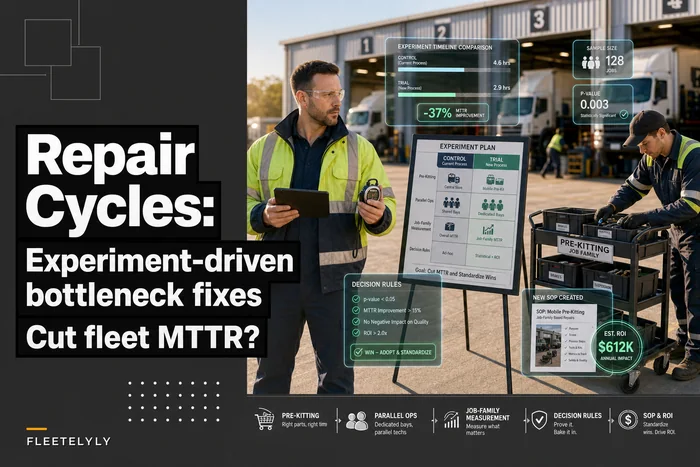
A related discipline is designing the experiment so a single variable moves. If you re-sequence the repair and change the tooling and add pre-staging all at once and cycle time drops, you learn nothing about which change actually did it. This connects directly to the mindset behind experiment-driven bottleneck fixes to cut fleet MTTR — isolate the variable, or you can't propagate the win.
Set success thresholds before you run anything
This is where most programs quietly cheat.
If you don't define "success" in advance, you'll define it after, based on whatever number you got. Ran the experiment and cycle time dropped 6%? Suddenly 6% feels like a win. But if you'd been asked beforehand, you might have said you needed 15% to justify the disruption of retraining every tech across six depots.
Thresholds should reflect the cost of propagation, not just the size of the improvement. A change that saves 8% but costs almost nothing to roll out might clear the bar. A change that saves 8% but requires new tooling at every location and two weeks of retraining probably doesn't.
A workable threshold framework:
-
Minimum effect size — the smallest improvement worth the propagation cost.
-
Confidence — how sure you need to be it's real and not noise. Small samples lie constantly. Three good work orders don't prove anything.
-
Guardrail limits — hard lines on rework, safety, and compliance that override any efficiency gain.
-
Payback window — for anything requiring spend, how fast it needs to return the investment.
Fleets that skip the confidence piece end up "adopting" wins that were pure variance. They roll out a change based on one good month, the effect regresses to the mean the next quarter, and everyone concludes CI "doesn't work here." It worked fine. The measurement didn't.
A/B validation without pretending you're a lab
You're running a shop, not a clinical trial. You won't get perfectly randomized samples. But you can get honest comparisons, and honest beats perfect.
The practical version of A/B validation in a fleet looks like this:
-
Split by bay or crew within one depot — one crew runs the new method, one runs the current method, same vehicle mix, same period. This controls for seasonality and demand swings that would wreck a before/after comparison.
-
Split by depot for changes that need location-level testing — one depot as the pilot, a comparable depot as the control. Match them on fleet age, vehicle mix, and volume, or the comparison is worthless.
-
Staggered rollout when you can't run true parallel — measure the same site before and after, but require a longer window and watch for external factors that could explain the change.
The thing that kills fleet A/B tests isn't the method. It's contamination. The control crew hears about the new method and starts copying it. The pilot depot gets a batch of newer trucks mid-experiment. Someone changes the parts supplier in the middle of your test window. Half your job as the program owner is protecting the integrity of the comparison — noting anything that changed, and being willing to throw out a compromised test rather than trust bad data.
Build in a regression check too. When something clears validation and gets adopted, re-measure it 60–90 days later. Real wins hold. Noise fades. If your "improvement" evaporated after rollout, you want to know before you've built an SOP around a ghost.
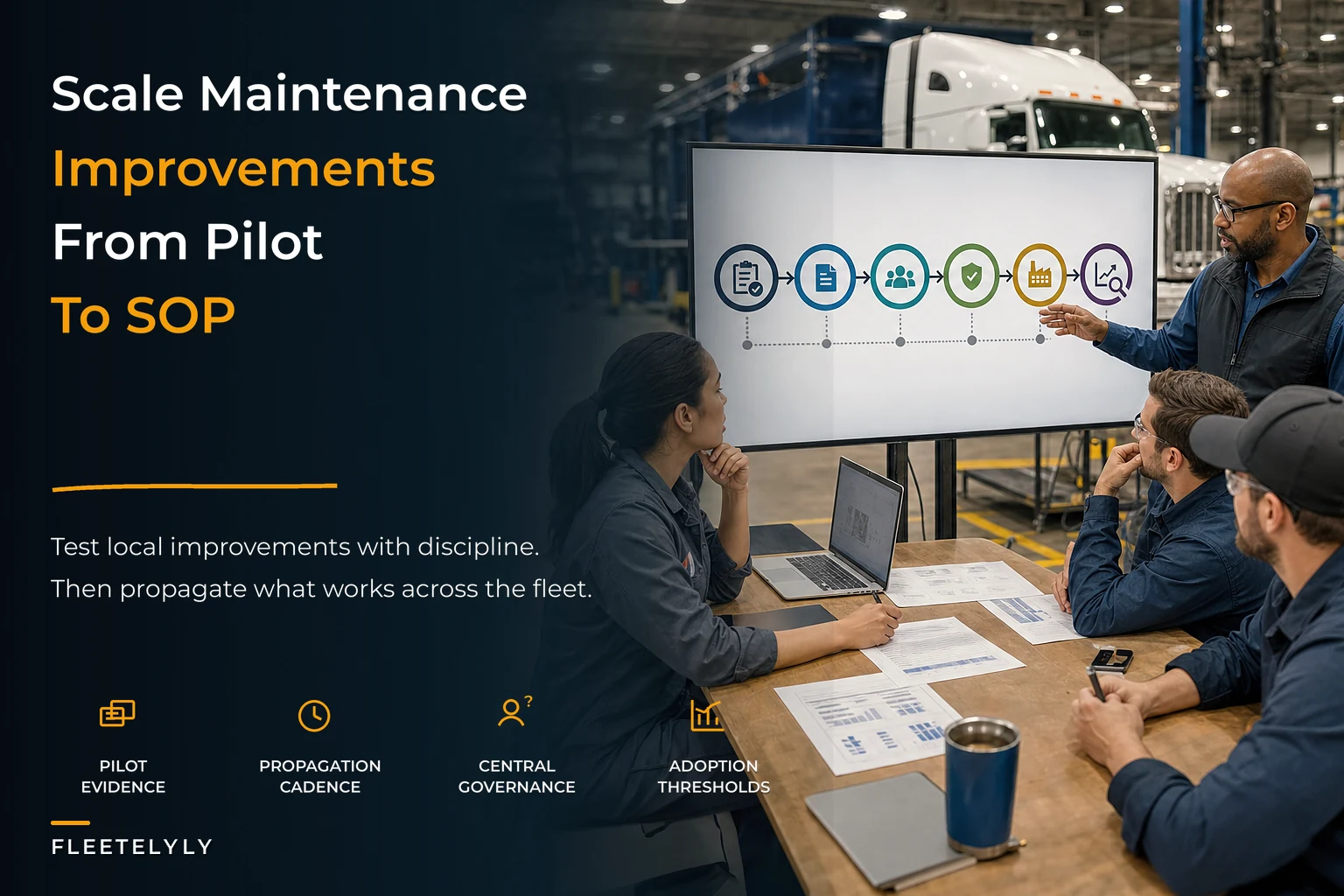
Propagation cadence: turning proven pilots into SOPs
This is the part almost nobody does well. You proved a change works at one depot. Now what?
Without a propagation rule, one of two things happens. Either the win never spreads — the common case — or it spreads instantly and chaotically. Someone announces it in a meeting, three depots try to copy it from memory, and it degrades into six different versions that no longer resemble the thing that was validated.
A propagation cadence gives adoption a defined rhythm:
-
Validate at the pilot site against the pre-set threshold.
-
Document the winning method as a draft SOP — the actual steps, tooling, and measured expected result. Not a summary. The real instructions.
-
Pilot-replicate at one different site to confirm the win isn't specific to the original crew or conditions. Wins that don't replicate are local, not systemic — and that's fine, just don't force them everywhere.
-
Ratify the SOP centrally once it holds at two sites.
-
Roll out on a scheduled cadence — a defined wave, not a scramble — with training and a defined go-live date per location.
-
Confirm adoption by measuring the same metric at each rolled-out site, so you know the SOP is actually being followed, not just distributed.
Step 6 is the one everyone skips. Distributing an SOP is not the same as adopting it. A rolled-out change that isn't measured at the receiving sites tends to quietly revert to the old way within a quarter, because the new method takes effort and nobody's checking.
The cadence matters as much as the steps. Trying to propagate everything continuously overwhelms shops — techs get change fatigue and start ignoring all of it. A predictable rhythm, say a monthly ratification review and quarterly rollout waves, gives people room to absorb one change before the next lands.
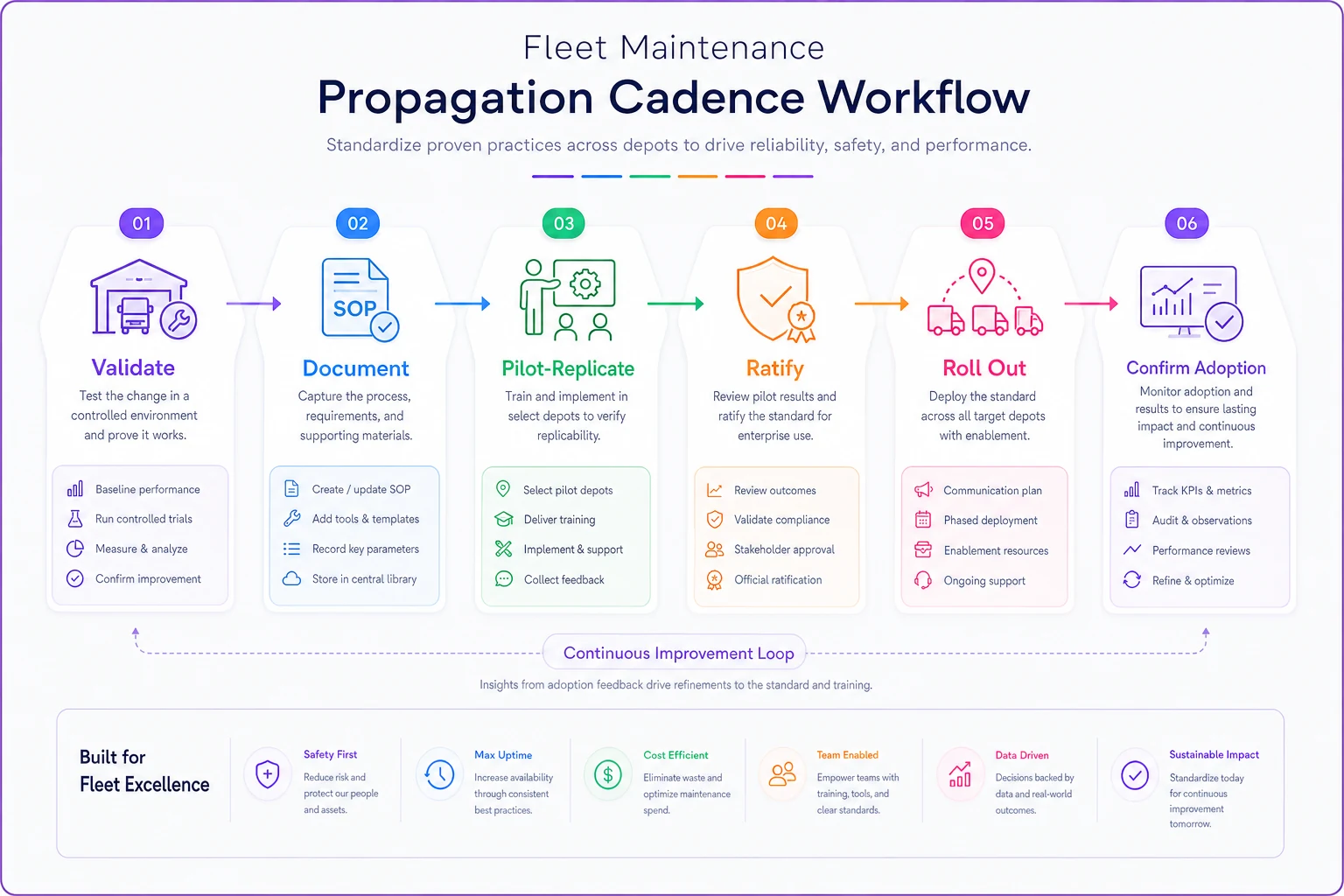
This diagram visualizes the cadence from validation to confirmation and helps teams see when to pause, replicate, and scale.
Central oversight: the governance that keeps it honest
A centralized program doesn't mean HQ dictates every change. It means there's a central function that maintains the taxonomy, guards the thresholds, arbitrates propagation, and keeps a record of what's been tried.
That last piece — institutional memory — is underrated. Without a central log, fleets re-run failed experiments constantly. A depot proposes an oil-interval extension that another depot already tested and killed two years ago because of premature wear. If nobody remembers, you repeat the failure. A central program has one answer to "has anyone tried this?" and that answer alone saves a lot of wasted effort.
Central oversight typically owns:
-
The taxonomy and experiment template standards
-
Threshold and guardrail policy (especially for safety/compliance categories)
-
The propagation decision — what gets ratified into an SOP
-
The experiment registry — every test, its result, and why
-
Cross-depot pattern analysis — spotting where the leverage actually is
The governance instinct that works here mirrors the broader idea in a maintenance operations capability framework for fleets: improvement isn't a one-off event, it's a capability you build deliberately, with defined ownership and cadence, so it survives staff turnover and keeps compounding.
One governance mistake worth avoiding: making the central function a bottleneck that approves every small bay-level tweak. That kills speed and resentment builds fast. Let low-risk categories self-serve with light review. Reserve heavy central scrutiny for high-blast-radius changes — PM intervals, diagnostics routing, safety procedures, cross-system data changes.
When a centralized CI program makes sense — and when it doesn't
When it makes sense:
-
You run more than two or three locations and improvements aren't spreading between them.
-
You've noticed the same problems getting re-solved independently at different sites.
-
You have enough volume to actually measure changes — a shop doing 15 work orders a week can't validate much.
-
Turnover has cost you undocumented knowledge before.
When it's a bad idea (or premature):
-
You're a single shop with one crew. You don't need a taxonomy and propagation cadence — you need a shared whiteboard and a habit of writing things down. Formalizing too early just adds overhead with no return.
-
You don't have baseline data yet. If you can't measure your current cycle times, stockout rates, or comeback rates, you can't run credible experiments. Fix measurement first.
-
Leadership wants CI as a slogan, not a commitment. A program that isn't backed with real time for people to run and document experiments becomes theater, and theater burns credibility fast.
Who should not run this the heavy way: fleets in the middle of a major system migration or reorg. Trying to run controlled experiments while your work-order system, staffing, or depots are in flux gives you uncontrollable variables. Stabilize first, then optimize.
A real scenario: how this looks when it works
A regional fleet running around 220 vehicles across four depots had the classic pattern — good ideas, zero spread. Their comeback rate (repairs that came back for the same issue) sat somewhere between 9–11% depending on the depot, and nobody could explain why one depot was consistently better.
They put in a lightweight program: a simple taxonomy, one experiment template, and a monthly review. The first real win came from the best-performing depot, where a maintenance lead had a two-stage post-repair verification step that the other three depots didn't use. It had never been documented anywhere — it just lived in that one lead's routine.
They ran it as a proper experiment. Baseline comeback rate at a second depot was about 10%. Threshold: get it under 7% over roughly 8 weeks without adding more than a few minutes per work order. It landed around 6%, guardrails held, and they ratified it into an SOP.
Rolling it across all four depots took a full quarter — deliberately staggered, with the adoption-confirmation step at each site. A quarter later, fleet-wide comebacks were sitting in the 6–7% range, down from 9–11%. Nothing exotic. One good routine, validated once, documented properly, and propagated with discipline instead of dying in one person's head.
The interesting part wasn't the single fix. It was that the machine was now running. Over the next year they pushed a dozen more changes through the same pipeline. Roughly half cleared their thresholds and became SOPs. The other half got killed with data — which is exactly what a real program is supposed to do. Not adopt everything, but tell the difference between a win and a hunch.
Keeping the record: where tooling earns its place
For a while, a shared spreadsheet and a monthly meeting will carry a program. As it scales — more depots, more concurrent experiments, more SOPs to track adoption on — the record-keeping becomes the constraint. You lose track of which experiments are live, which SOPs are actually being followed, and whether last quarter's win is still holding.
This is where an operational platform that centralizes work-order data, tracks experiments against baselines, and flags when a rolled-out SOP's metrics start drifting back toward baseline stops being a nice-to-have. Not because software runs the program — people do — but because the program's honesty depends on clean, comparable data across locations, and manual tracking quietly rots as you grow. The value isn't automation for its own sake; it's that the central function can actually see the whole system instead of chasing scattered spreadsheets.
The bottom line
A maintenance continuous improvement program isn't a set of clever tricks. It's the infrastructure that lets clever tricks spread — a shared way to classify ideas, a common template so experiments are comparable, thresholds set before results skew judgment, honest A/B validation that protects against noise, and a propagation cadence that turns proven pilots into SOPs everyone actually follows.
Fleets that skip this don't lack good ideas. They lack the machinery to keep and multiply them. Build the machine, keep it honest with central oversight, and your improvements stop being one-off wins that evaporate — and start compounding, depot by depot, quarter by quarter.
Ready to maximize fleet uptime and reduce maintenance costs?
Join 2,000+ fleet managers using Fleetelyly to streamline maintenance workflows and improve vehicle reliability.