


Most fleets don't fail at maintenance because they lack good mechanics. They fail because the organization around those mechanics never grew up. A shop running 40 units on tribal knowledge and one very tired lead tech works fine — until you're at 120 units, three locations, and suddenly nobody can answer basic questions like "who's qualified to sign off on brake work at the north yard?" or "why does our per-mile maintenance cost swing 30% between sites doing identical work?"
That gap — between having skilled people and having a system that reliably produces skilled outcomes — is what a maintenance operations capability framework is supposed to close. Not a training plan. Not an org chart. An operating model that ties roles, competencies, KPIs, and funding together so the whole thing improves on purpose instead of by accident.
This is the piece most fleets skip, and it's why so many "improvement initiatives" fizzle after six months.
Why capability breaks down as fleets grow
There's a pattern that shows up constantly. A small fleet has one or two experienced techs who are the process. They know which tractors eat wheel seals, which vendor lies about lead times, and how to triage a fault code without a decision tree. Everything runs through their heads.
Then the fleet grows. Maybe you add a second shift, maybe you acquire another yard. Suddenly knowledge that lived in two people has to live in twelve, across shifts and locations, and it doesn't transfer cleanly. Diagnoses get inconsistent. Warranty claims get missed because a new tech doesn't know the evidence rules. Comebacks climb. And nobody can tell you why, because there was never a defined standard for what "good" looks like at each role.
The deeper problem is that capability isn't something you fix once with a training day. Every new vehicle platform, every telematics rollout, every EV added to the mix partially resets the competency baseline. If your operating model doesn't have a way to re-level people against new demands, you're always behind. The shop looks busy, but actual capability — measured as consistent, correct, first-time-right work — quietly erodes.
There's also a coordination cost nobody budgets for. When roles are fuzzy, decisions bounce. A tech isn't sure if he's allowed to condemn a component, so he asks the lead, who asks the supervisor, who checks with the manager. That's three interruptions and a half-day delay for something that should have had a clear ownership boundary. Multiply that across a busy shop and you lose real throughput to indecision, not to actual wrenching.
The four layers of a capability framework
A useful framework has four moving parts that have to line up. When one is missing, the whole thing wobbles.
Prevent costly breakdowns with proactive maintenance.
Fleetelyly helps you schedule, track, and manage every vehicle service efficiently.
- Automated maintenance reminders
- Real-time service tracking
- Parts inventory integration
No credit card required
-
Role map — who does what, and where authority sits
-
Competency levels — what "capable" means at each role, in measurable terms
-
Role-based KPIs — how you know the role is actually delivering
-
Funding and chargeback model — how the capability gets paid for and defended at budget time
Most fleets have a rough version of the first one and maybe some shop-wide KPIs. Almost nobody connects all four. And it's the connection that matters — a role map without competency levels is just titles, and KPIs without a funding model get cut the first time finance goes looking for savings.
Layer 1: The role map
A role map isn't your org chart. Your org chart shows reporting lines. A role map shows decision rights and work ownership. Who can condemn a part. Who can approve outside repair over a dollar threshold. Who owns the accuracy of a work order before it closes. Who signs off that a PM was actually completed to spec versus rubber-stamped.
The clearest role maps use a simple ownership grid: for every recurring decision or workflow, exactly one role is Accountable, and it's written down. When you do this honestly, you almost always find two or three decisions that nobody owns — usually the ones that keep going wrong.
A workable role structure for a mid-size fleet looks something like:
-
Technician (Levels 1–3) — executes work; authority scales with level
-
Lead Technician / Diagnostician — owns complex diagnosis, mentors, first escalation point
-
Shop Supervisor — owns bay throughput, scheduling, quality gates
-
Maintenance Manager — owns KPIs, vendor decisions, budget
-
Reliability / Planning role — owns PM strategy, RCA, data quality (often missing in fleets under ~150 units, and often the first hire that pays for itself)
That reliability/planning role is the one small fleets resist and larger fleets can't live without. Below a certain size, the manager wears that hat. But there's a crossover point — usually somewhere around 100–150 units — where the planning work becomes a full-time job. If nobody owns it, PM compliance and root-cause work are the first things to fall off.
Layer 2: Competency levels
This is where most frameworks turn into vague HR language — "demonstrates proficiency in diagnostic procedures." Useless. Nobody can be measured against that.
Competency levels only work when they're observable and gated. Level 2 electrical means: can trace a parasitic draw to the circuit without escalation, can perform and document a specific set of procedures, has cleared a hands-on assessment. Not "understands electrical." Can do, verified.
The actual matrix and micro-credential rollout are covered in detail in the mechanic upskilling and micro-certification post, so no need to rebuild that here. The point for the operating model is this: competency levels have to connect upward to the role map (a Level 3 tech has different decision rights than a Level 1) and outward to the KPIs. You should be able to see whether higher-certified techs actually produce lower comeback rates — and if they don't, your certification is measuring the wrong things.
Tie re-assessment schedules to platform introductions so certifications stay current as your fleet changes.
A quiet failure mode worth calling out: fleets certify people and then never re-check. Certification becomes a one-time trophy instead of a live status. Real capability decays. A tech certified on a platform you retired two years ago is carrying a credential that means nothing. Build in expiry and re-assessment from day one, or the matrix rots.
Layer 3: Role-based KPIs
Shop-wide KPIs hide problems. "MTTR is 4.2 hours" tells you nothing about where capability is thin. Role-based KPIs push accountability to the level where someone can actually act on it.
| Role | Primary KPI | Secondary KPI | What it reveals |
|---|---|---|---|
| Technician | First-time-fix rate | Comeback % on their work orders | Individual capability gaps |
| Lead / Diagnostician | Escalation resolution time | % diagnoses confirmed correct | Whether diagnosis is actually strong |
| Supervisor | Bay utilization / schedule adherence | WO data completeness | Coordination and flow health |
| Maintenance Manager | Cost per mile (normalized) | PM compliance | Whether the system is under control |
| Reliability / Planning | Repeat-failure rate | RCA closure rate | Whether root causes get killed |
The mistake isn't usually picking bad metrics — it's picking too many. A role with nine KPIs effectively has zero. Pick one or two that the role can genuinely move, and make sure they don't fight each other. Bay utilization pushed too hard quietly kills documentation quality, which later kills your warranty recovery. KPIs need to be read as a system, which is why they should sit inside your broader governance rhythm rather than float on a dashboard nobody reviews. If you don't already have that review cadence built out, the maintenance governance framework post covers how to structure the decision gates and quarterly reviews these KPIs feed into.
Layer 4: Funding and chargeback
Capability that isn't funded on purpose gets defunded by default. This is the layer that determines whether your framework survives the next budget cycle.
The core question is who pays for building capability, and who benefits. In a centralized model, maintenance owns training and certification cost as overhead. In a chargeback model, the operating units absorb it through their maintenance rates. Each has failure modes.
Sample funding patterns:
-
Central overhead — training funded from a maintenance department budget. Simple, but it's the line finance cuts first because the ROI isn't tied to any operating unit.
-
Loaded labor rate — capability cost baked into the internal hourly rate charged back to operations. More durable because it's invisible and continuous, but it can make your shop look expensive versus outside vendors if you're not careful.
-
Dedicated capability reserve — a small protected percentage, often around 2–4% of the maintenance labor budget, fenced off for certification, cross-training, and re-assessment. Harder to raid, easier to defend.
The chargeback approach connects directly to how you forecast and defend maintenance spend overall. If your rates and reserves aren't set up to absorb capability investment, it becomes the first thing that dies when costs get tight. The mechanics of rolling forecasts and reserve triggers are covered in the fleet maintenance budgeting and chargebacks post, and capability funding should live inside that same structure — not as a separate ask.
The 90 / 180 / 365 adoption plan
A framework on paper changes nothing. The rollout is where it lives or dies, and the biggest mistake is trying to stand up all four layers at once. You'll overwhelm supervisors and burn credibility fast.
First 90 days — make it real, small. Publish the role map and get honest agreement on decision rights. Pick one role and define its competency levels and a single primary KPI. Start baseline measurement — you need a "before" number or you'll never prove anything. Don't roll out certifications yet. The goal is a working spine, not full coverage.
By 180 days — expand and gate. Extend competency levels to the remaining technician roles. Launch the first micro-certifications tied to the highest-risk work — the stuff driving comebacks and warranty losses. Wire role-based KPIs into your existing review cadence. This is also where the funding model has to be locked, because now you're spending real money on assessment and training time.
By 365 days — embed the loop. Re-assessment cycles are running. KPIs are reviewed on a fixed rhythm and actually change decisions. Certification status is live, with expiries. The reliability/planning role is staffed or clearly scheduled to be. At this point capability improvement is something the organization does to itself, not a project someone is pushing uphill.
The fleets that succeed treat the first 90 days as deliberately narrow. The ones that fail try to do everything at once and have nothing to show at the quarterly review, so leadership loses interest and the whole thing quietly dies.
A simple rollout workflow:
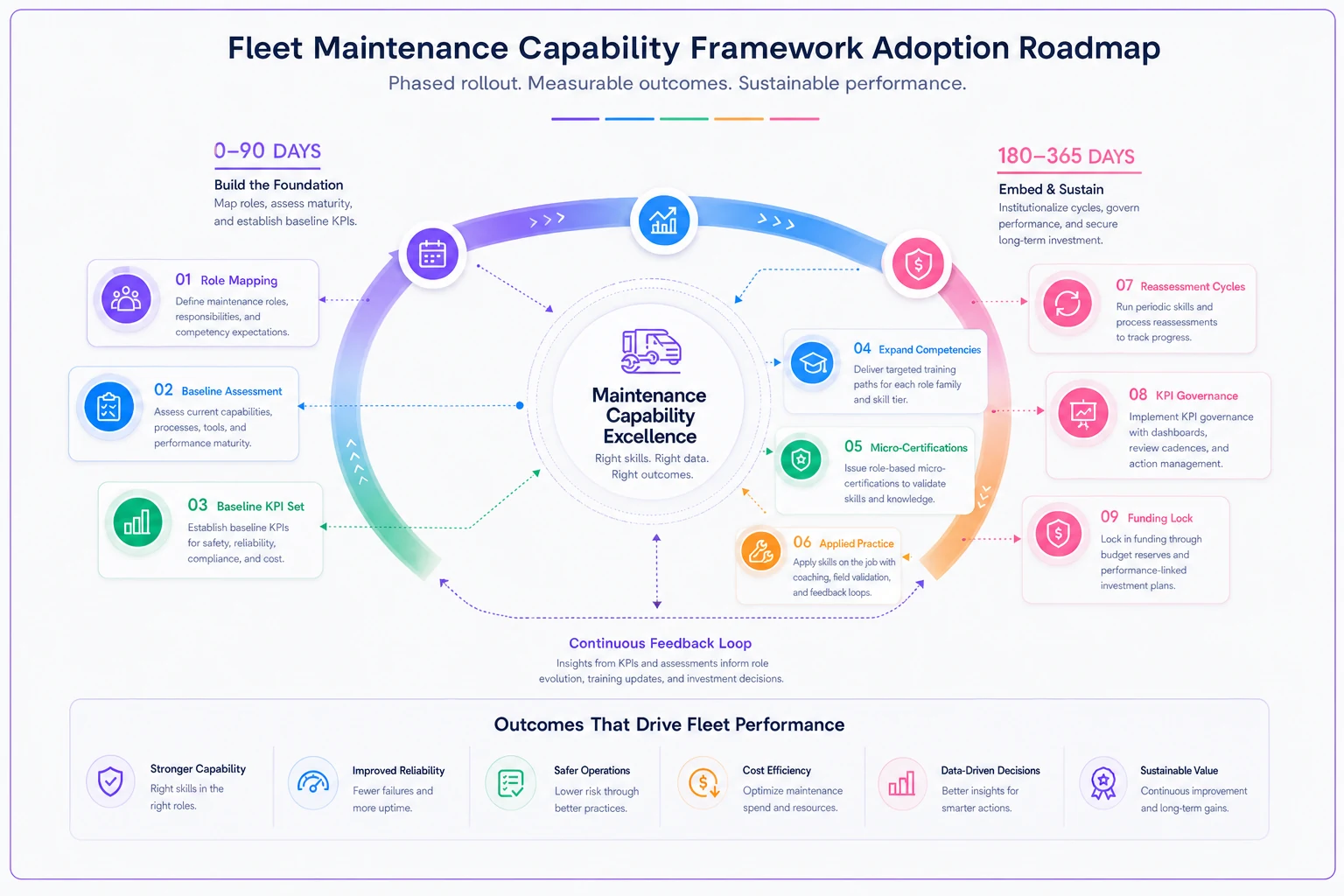
Use this visual as a quick reference when planning the phased rollout and explaining it to stakeholders.
Manager scripts that actually get used
The soft part breaks more rollouts than the technical part. Supervisors need words for conversations they're not used to having. Two that matter most:
-
The re-leveling conversation "This isn't about whether you're good — it's about matching what you're certified on to the work we're putting in front of you. Here's the gap, here's the assessment, here's the timeline." Framed as system alignment, not judgment.
-
The KPI conversation "Your comeback rate is the one number I'm going to ask you about. Not because I'm counting mistakes, but because it's the fastest signal of where you need support. If it's climbing, that's my problem to help solve, not just yours."
What works: managers frame every capability conversation as the system supporting the person, never the person being audited by the system. The moment techs feel certifications are a way to build a firing case, adoption dies and the good ones start job-hunting.
A real scenario
A regional service fleet — around 130 mixed units across two yards, mostly medium-duty with a growing EV segment — had a comeback problem nobody could pin down. Overall first-time-fix looked fine in the aggregate, hovering somewhere in the mid-80s. But warranty recoveries were soft and repeat electrical failures kept eating bays.
When they broke KPIs down by role instead of shop-wide, the picture changed. The comebacks clustered on a specific band of techs doing electrical and telematics-related work — people who'd been thrown at newer platforms without any re-leveling. Nobody was incompetent. The system had just never defined or checked capability against the new work.
They ran a narrow 90-day start: mapped decision rights, defined competency levels for electrical work only, and stood up two micro-certifications on the highest-comeback procedures. They funded it through a small protected reserve rather than begging for a training budget line.
Over the next couple of quarters, comebacks on that work band dropped noticeably — not to zero, but enough that the freed bay time was real. Warranty capture improved too, mostly because certified techs were finally documenting failures to the standard the claims required. The number that convinced finance wasn't the fix rate — it was the reserve paying for itself in recovered warranty dollars and fewer repeat teardowns.
When this framework makes sense — and when it doesn't
When it's worth it: You're past roughly 80–100 units, running multiple shifts or locations, or adding new vehicle platforms fast enough that skills can't keep up informally. If capability currently lives in two or three people's heads, you're one resignation away from a real problem, and the framework is cheap insurance.
When it's overkill: A single-location shop with a stable crew of experienced techs and a vehicle mix that barely changes doesn't need four formal layers. You'll add bureaucracy without adding capability. A light role map and a couple of shop KPIs is plenty.
Who should NOT start here: If your work-order data is a mess — inconsistent codes, half-empty records, no reliable comeback tracking — fix that first. Every layer of this framework depends on being able to measure capability, and you can't measure it on bad data. Standing up KPIs on top of unreliable records just gives you confident wrong answers.
Where the whole thing usually falls apart
The failure isn't usually dramatic. It's slow. The role map gets published and quietly ignored because decision rights were never enforced. Certifications get issued and never expire. KPIs land on a dashboard nobody opens between quarterly panics. The funding gets absorbed into general overhead and cut in the next squeeze.
What holds it together is treating capability as a live system with an owner, a review rhythm, and protected money — the same way you'd treat parts availability or PM compliance. The fleets that get this right stop asking "do we have good mechanics?" and start asking "does our operating model reliably produce good outcomes regardless of who's on shift?" That second question is the whole point, and it's the one that keeps paying off as you grow.
What holds it together is treating capability as a live system with an owner, a review rhythm, and protected money — the same way you'd treat parts availability or PM compliance. The fleets that get this right stop asking "do we have good mechanics?" and start asking "does our operating model reliably produce good outcomes regardless of who's on shift?" That second question is the whole point, and it's the one that keeps paying off as you grow.
Ready to maximize fleet uptime and reduce maintenance costs?
Join 2,000+ fleet managers using Fleetelyly to streamline maintenance workflows and improve vehicle reliability.