

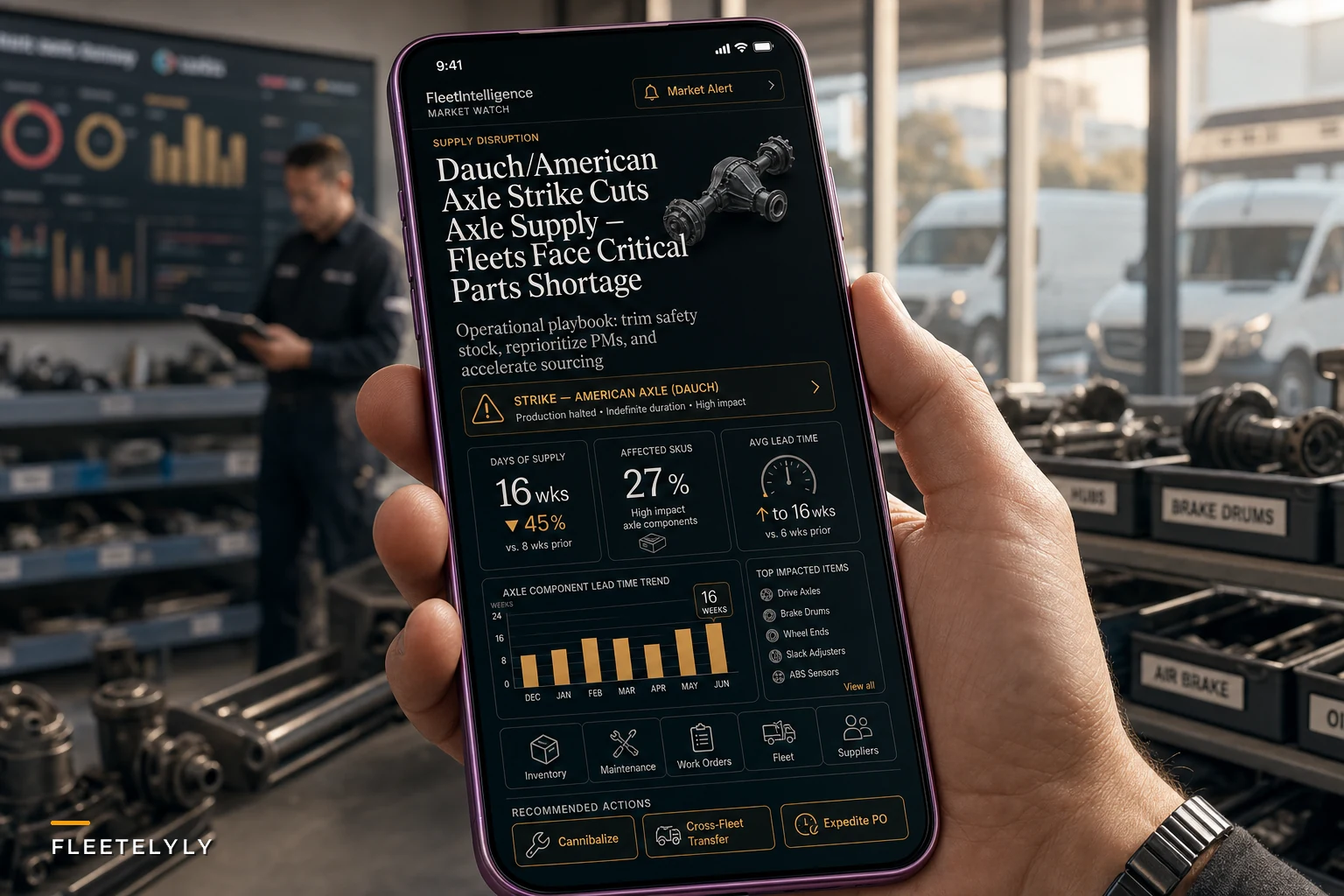

The axle supplier strike at Dauch Corp's Three Rivers facility just upended parts availability for thousands of fleet operations running GM pickups and heavy-duty trucks. According to CNBC's coverage, the UAW work stoppage has already halted production at a facility that supplies critical drivetrain components to GM's truck lines. With automakers reporting limited on-hand inventories, we're looking at weeks—maybe days—before the ripple effects hit maintenance bays across the country.
For fleet managers running 50+ vehicles, this isn't just another supply hiccup. This is the kind of event that turns your carefully planned maintenance schedules into scrambled emergency protocols. If you're running GM 2500/3500 series trucks or any vehicles that share axle components from the same supplier network, you're about to face some tough operational decisions.
The Immediate Parts Crunch Nobody Prepared For
Most fleet operations keep around 15-20 days of critical parts inventory. That calculation assumes normal supplier lead times, maybe a small buffer for occasional delays. Nobody plans for their primary axle supplier to suddenly drop to zero production capacity.
What happens next: distributors start rationing their existing stock. The wholesaler who usually ships you axles within 48 hours suddenly has a three-week backlog. Your secondary suppliers start quoting prices 40-60% above normal because they know you're desperate. That truck sitting in bay 3 waiting for a rear differential? It just became a very expensive paperweight.
The fleet parts shortage creates this cascading failure pattern. First, your emergency stock gets consumed faster than planned. Then your mechanics start pulling parts from vehicles scheduled for PM next month. Before you know it, you're cannibalizing trucks that should be revenue-generating just to keep your critical units rolling.
A midwest trucking operation faced a similar crisis when a tornado took out their transmission supplier's warehouse. Within 10 days, they had 18 trucks down, were paying $8,000 premiums on expedited parts, and had to turn away $140,000 in contracted hauls. The real damage wasn't just the immediate costs—it was the three months of catch-up maintenance and overtime labor that followed.
Adjusting Your Parts Strategy When Lead Times Go Haywire
The standard reorder formulas everyone uses assume relatively stable lead times. You calculate your min/max levels, set your safety stock based on historical consumption, and trust the system to keep parts flowing. But when a major supplier strike hits, those calculations become worthless overnight.
Prevent costly breakdowns with proactive maintenance.
Fleetelyly helps you schedule, track, and manage every vehicle service efficiently.
- Automated maintenance reminders
- Real-time service tracking
- Parts inventory integration
No credit card required
Right now, you need to completely recalculate your critical parts thresholds. Your existing safety stock calculations probably assumed a worst-case scenario of maybe 7-10 extra days of lead time. We're now looking at potential delays measured in weeks or months for specific axle components.
Start by identifying which SKUs are actually affected. Not every axle component comes from the struck facility—many aftermarket suppliers source from multiple manufacturers. Your Meritor replacement axles might still be available while OEM GM parts are completely frozen. This granular visibility becomes critical when you're deciding which vehicles to prioritize for repairs.
The fleet managers who survive these shortages are the ones who immediately shift from consumption-based ordering to availability-based procurement. Stop looking at your historical usage rates. Start calling every supplier, broker, and salvage yard within 500 miles to understand what's actually available right now. Buy what you can find, even if it means temporarily inflating your inventory costs.
Creating a Triage Protocol That Actually Works
When parts become scarce, you can't maintain every vehicle equally. Some trucks need to keep rolling no matter what, while others can sit for weeks without destroying your operation.
Most fleet triage systems fail because they're too simplistic—usually just ranking vehicles as "critical" or "non-critical." During a real shortage, you need more granular prioritization. Consider breaking your fleet into five categories:
Revenue-critical units get first priority on any available parts. These are vehicles directly tied to contracted routes or time-sensitive deliveries where downtime triggers penalty clauses.
High-utilization workhorses need to stay operational but might handle minor issues through temporary fixes. Your 60,000+ miles-per-year trucks that generate the bulk of operational capacity fall here.
Redundant capacity vehicles become your parts donors if necessary. These are trucks that duplicate routes or functions where other units can absorb the workload.
Specialty or low-mileage units can often wait longer for repairs without major impact. Vehicles with unique configurations or those running under 30,000 miles annually fit this category.
Near-retirement assets become immediate cannibalization candidates. Trucks already scheduled for disposal or replacement within 6 months.
Document these decisions formally. When you pull an axle from truck 47 to keep truck 12 running, record exactly what was taken, why the decision was made, and what the restoration plan looks like. Your mechanics need this documentation, your accounting team needs it for asset tracking, and you'll need it when explaining utilization rates to upper management.
Here's a simple workflow to guide triage decisions during a parts shortage.
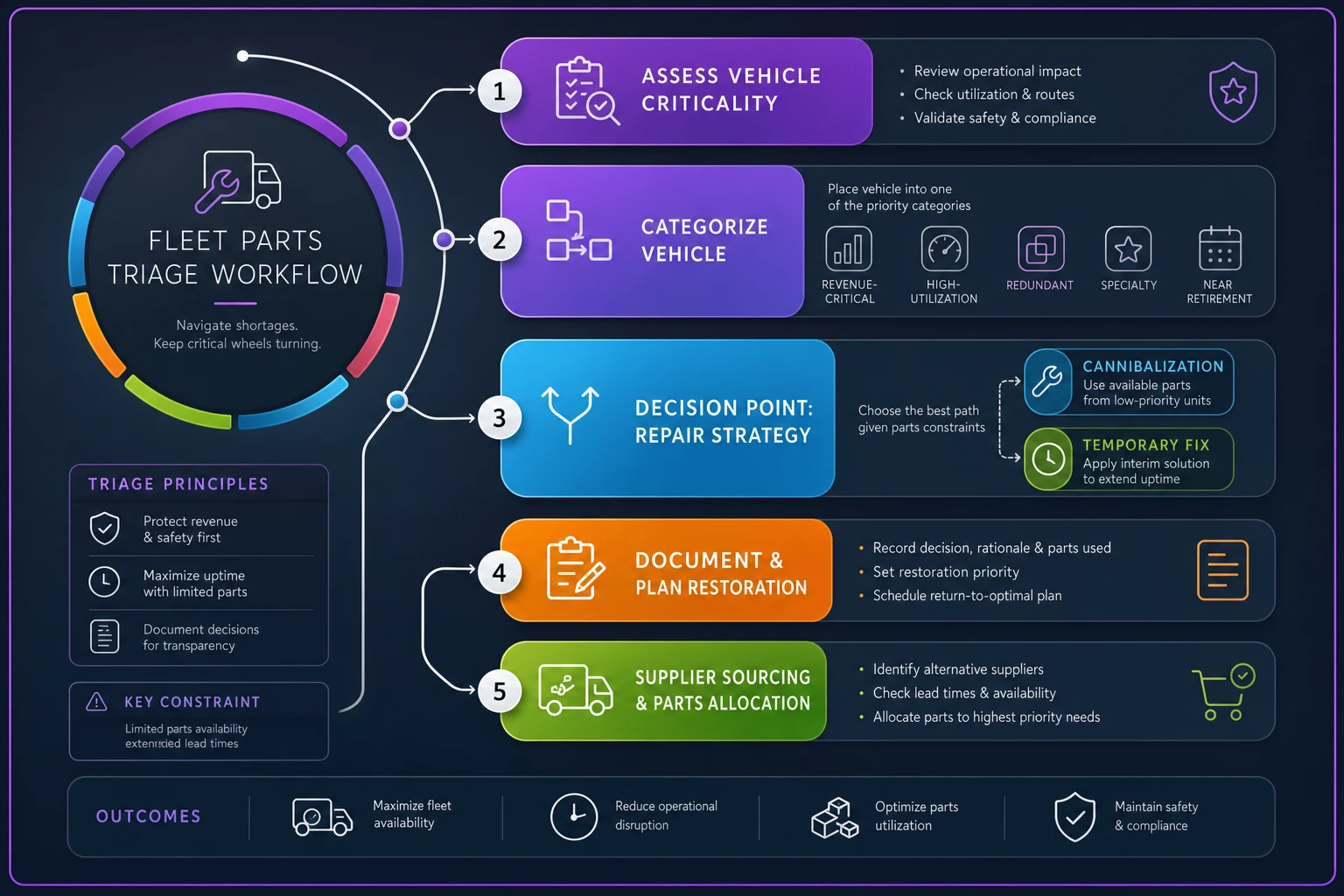
Keep records of every cannibalization action and restoration timeline so you can justify decisions and plan recovery.
Maintenance Schedules During Crisis Mode
The temptation during parts shortages is to defer everything except emergency repairs. This approach creates a maintenance debt that compounds quickly—especially with heavy-duty vehicles operating at capacity.
Instead of blanket deferrals, implement what works better: selective service modification. Keep critical preventive maintenance on schedule but adjust the scope based on parts availability. For instance, if you can't get replacement u-joints for a scheduled driveline service, still perform the inspection, lubrication, and alignment checks. Document what was deferred and why.
Modified PM checklist for shortage conditions:
Continue Without Modification:
-
Fluid changes (oil, coolant, hydraulic)
-
Filter replacements (air, fuel, cabin)
-
Brake adjustments and minor repairs
-
Tire rotations and pressure checks
-
Electrical system diagnostics
Modify Based on Parts Availability:
-
Suspension component replacement (inspect thoroughly, defer if marginal)
-
Driveline services (lubricate and inspect, defer replacements if possible)
-
Exhaust system repairs (temporary patches acceptable)
-
Non-critical sensor replacements
Document and Defer:
-
Cosmetic repairs
-
Comfort system fixes
-
Non-safety lighting repairs
-
Auxiliary equipment maintenance
Your maintenance software becomes crucial here. If you're still tracking services on spreadsheets or paper forms, a shortage crisis will overwhelm your ability to manage deferrals and catch-up work.
Working Your Supplier Network Differently
During normal operations, most fleet managers stick with 2-3 primary suppliers and rarely venture outside established relationships. A major shortage forces you to completely rethink this approach.
Start mapping your extended supplier network immediately. This includes primary OEM dealers who might have old stock or cancelled orders available. Regional parts distributors who serve different market segments. Salvage yards specializing in commercial vehicles—many have barely-used components from insurance write-offs. Independent rebuilders who can restore your existing cores faster than waiting for new parts. Fleet liquidation auctions where entire parts inventories occasionally surface.
One distribution company discovered their competitor was liquidating their maintenance facility just as the shortage hit. They acquired 18 months worth of critical drivetrain components at 40% of market value, essentially buying their way out of the crisis.
Build these relationships before you desperately need them. The salvage yard owner who's never heard from you won't prioritize your emergency call. But if you've been sending them steady business for non-critical parts, they'll remember when you need that emergency axle assembly.
Keep contact details and typical response times for salvage yards and independent rebuilders in your supplier map so you know who will respond fastest in an emergency.
The salvage yard owner who's never heard from you won't prioritize your emergency call. But if you've been sending them steady business for non-critical parts, they'll remember when you need that emergency axle assembly.
Communicating Impact Without Creating Panic
Your drivers, customers, and leadership all need different messages about the shortage situation. Getting this communication wrong creates unnecessary panic or unrealistic expectations about service continuity.
For drivers, focus on operational impact. Explain that vehicle assignments might change, some units will have extended shop time, and everyone needs to report even minor driveline issues immediately. Don't hide the situation, but avoid speculation about how long it might last.
Customers need transparency about potential service impacts without excessive detail about your internal challenges. A simple message: "Due to industry-wide parts constraints, we're implementing contingency protocols to maintain service levels. We'll communicate any changes to your delivery schedules with maximum advance notice."
Leadership wants numbers—how many vehicles affected, cost impact, mitigation strategies, and recovery timelines. Create a simple dashboard:
| Metric | Current Status | 30-Day Projection | 60-Day Projection |
|---|---|---|---|
| Vehicles Operational | 87% | 78% | 72% |
| Parts Cost Premium | +35% | +45% | +40% |
| Deferred PM Services | 12 | 28 | 45 |
| Revenue Impact | -$85,000 | -$180,000 | -$240,000 |
Update these projections weekly as the situation evolves. Include both pessimistic and optimistic scenarios so leadership can plan accordingly.
The Technology Gap That Makes Everything Worse
Most operations are trying to manage this crisis with disconnected systems that can't talk to each other. Your parts inventory system doesn't know what your maintenance scheduler has planned. Your procurement software can't see real-time vehicle conditions. Your mechanics update one system while purchasing checks another.
This disconnection means you're making critical decisions with partial information. You might have three trucks waiting for the same axle component while another sits unused in a different warehouse location. Or you're expediting parts orders for vehicles that won't be operational for other reasons.
AI-powered operational platforms can automatically flag when specific parts shortages will impact scheduled maintenance, suggest alternative suppliers based on historical procurement data, and even recommend vehicle rotation strategies to minimize shortage impact. Platforms that incorporate automation can predict which vehicles are most likely to need specific components based on usage patterns and preventive maintenance history, helping you allocate scarce parts before failures occur.
When a shortage hits, fleets running integrated operational systems adapt faster. They can instantly see inventory across all locations, identify which vehicles can donate parts without compromising their own reliability, and automatically adjust PM schedules based on parts availability. AI agents built into these platforms continuously monitor supplier catalogs, flagging when scarce parts become available and even executing purchases within pre-set parameters.
The manual alternative—calling suppliers, checking multiple spreadsheets, and coordinating through emails—simply can't match the speed needed during crisis response. By the time you've confirmed parts availability and gotten purchase approval, another fleet with automated procurement has already secured the inventory.
Beyond the Current Crisis
This axle shortage won't last forever. The strike will eventually resolve, production will restart, and supply chains will stabilize. But the next disruption is always one natural disaster, labor dispute, or global event away.
The fleets that thrive through these cycles are the ones that build resilience into their operations. This means maintaining higher safety stock levels for truly critical components—even if it increases carrying costs. It means diversifying suppliers across geographic regions and manufacturing sources. And it means investing in systems that provide real-time visibility into parts availability, vehicle conditions, and maintenance requirements.
Start documenting every decision, workaround, and lesson learned during this shortage. Which suppliers came through when it mattered? Which vehicles proved most reliable under deferred maintenance? What early warning signs did you miss that could have triggered earlier action?
Your spare parts reorder policy needs a complete overhaul after this event. The assumptions about lead time variability, supplier reliability, and safety stock calculations all need updating based on this real-world stress test.
Making It Through the Storm
The fleets that survive parts shortages aren't necessarily the largest or best-funded. They're the ones that adapt fastest, make tough decisions clearly, and maintain operational discipline when everything wants to fall apart.
Your focus needs to be on maintaining maximum vehicle availability with minimum parts consumption. This means fixing problems right the first time, preventing failures through enhanced inspections, and being creative about temporary solutions that keep trucks rolling safely.
Track every shortage-related cost: expedited shipping, premium parts pricing, lost revenue from downed vehicles, overtime labor for emergency repairs. You'll need these numbers both for insurance claims if applicable and for justifying future investments in inventory buffers or system improvements.
Consider establishing emergency parts sharing agreements with other fleets in your region. When one operation has excess inventory of critical components while another faces shortages, structured sharing agreements benefit both parties. Just make sure the legal framework is clear about ownership, replacement obligations, and liability.
The current shortage will test every aspect of your fleet operation. Your maintenance team's creativity, your procurement network's depth, your planning systems' flexibility—all get stressed simultaneously. The operations that emerge stronger are the ones that treat this crisis as an opportunity to identify weaknesses, build better processes, and prepare for the next disruption.
Because in fleet management, the next crisis isn't a question of if, but when. The question is whether you'll be scrambling for solutions or executing a tested response plan. The choice you make now, during this shortage, determines which category you'll fall into next time.
Because in fleet management, the next crisis isn't a question of if, but when. The question is whether you'll be scrambling for solutions or executing a tested response plan. The choice you make now, during this shortage, determines which category you'll fall into next time.
Ready to maximize fleet uptime and reduce maintenance costs?
Join 2,000+ fleet managers using Fleetelyly to streamline maintenance workflows and improve vehicle reliability.