


Most fleets recover somewhere between 40% and 60% of the warranty dollars they're actually owed. The gap almost never comes from OEMs being cheap. It comes from claims that arrive incomplete, arrive late, or arrive with the wrong evidence attached — and by the time anyone notices, the claim window has closed and the money is gone.
This isn't about fighting manufacturers. It's about building an evidence discipline so tight that the claims adjuster has nothing left to deny. That's what a real fleet warranty recovery playbook does. It treats each claim like a small legal case: the burden of proof is on you, the standard is defined by the OEM's own manual, and the timeline is fixed whether you're ready or not.
Below is a breakdown of exactly where claims die, what evidence satisfies each OEM expectation, and the scripts that unstick a claim once it's been kicked back.
Why claims get denied (and it's rarely the reason on the denial letter)
The denial letter says "insufficient documentation" or "failure to follow diagnostic procedure." What actually happened is usually one of these:
-
The failure got repaired before it got documented. A tech pulls a leaking water pump, tosses it in the core bin, and the photo of the failed seal never gets taken. Now you have a repair with no failed part and no image. That claim is dead on arrival.
-
The mileage and hours don't tie out. The claim says 118,400 miles, the telematics feed says 121,000, and the work order says something in between. Adjusters flag mismatches instantly because it's the fastest way to reject a batch.
-
The complaint-cause-correction narrative doesn't match the labor op. Someone wrote "check engine light on" as the complaint and claimed a 4.2-hour turbo replacement. There's no diagnostic thread connecting the two.
-
The claim missed the submission window. Most OEM warranty programs give you 30 days from repair completion, some as tight as 15. Nobody was tracking the clock.
This usually happens when warranty work runs through the same queue as regular repairs, with no separate discipline. The tech's job is to get the truck back on the road. Nobody's job is to build the evidence package — so it doesn't get built.
The fleets that recover 80%+ made warranty documentation a step in the repair workflow, not a paperwork chore that happens later from memory.
What OEMs actually expect: mapping evidence to requirements
Every OEM warranty manual is a checklist in disguise. The problem is that the checklist is scattered across 90 pages of policy language. Here's the core evidence set mapped to what the adjuster is actually verifying.
Prevent costly breakdowns with proactive maintenance.
Fleetelyly helps you schedule, track, and manage every vehicle service efficiently.
- Automated maintenance reminders
- Real-time service tracking
- Parts inventory integration
No credit card required
| Evidence element | What it proves to the OEM | Where fleets fail |
|---|---|---|
| Failed part retained + tagged | The failure is real and the part is returnable for inspection | Part scrapped or mixed into core bin without a claim tag |
| Time-stamped failure photos (before disassembly) | Failure mode matches the claimed cause | Photos taken after teardown, or not at all |
| VIN + odometer + engine hours, all matching | Unit is in-warranty and data is consistent | Manual entry mismatches telematics |
| Diagnostic trace (fault codes, test results) | Correct procedure was followed before replacement | "Replaced based on experience" — no trace |
| Complaint-Cause-Correction narrative | Repair logic is sound and labor is justified | Vague complaint, no cause, over-claimed labor |
| Parts invoice with OEM part numbers | Genuine parts were used | Aftermarket part numbers voiding coverage |
| Labor time vs. published standard | Labor claim is within OEM flat-rate | Actual hours claimed instead of book time |
| Prior repair history on the component | No pre-existing abuse or prior non-warranty fix | Missing history makes OEM assume abuse |
The single highest-impact habit: photograph the failure before anyone touches it. A cracked housing, a scored bearing, a burnt connector — the image taken before teardown is worth more than three pages of narrative. Adjusters trust what they can see.
The evidence package template that survives an audit
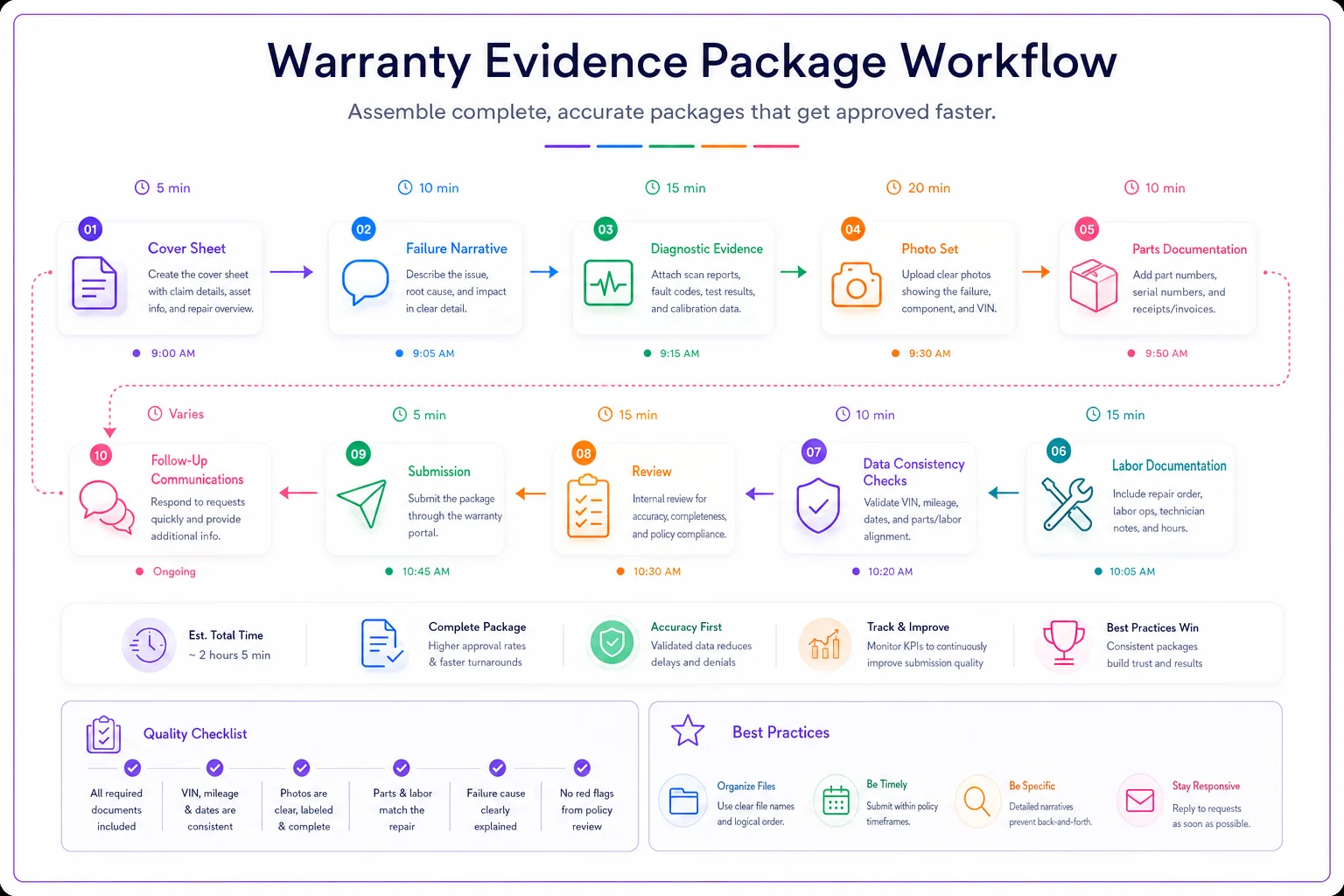
Build one standard package per claim. Don't improvise per truck. Here's the structure that holds up:
-
Cover sheet — VIN, unit number, in-service date, current odometer/hours, claim type, repair order number, and the specific warranty provision being claimed.
-
Failure narrative — Complaint, cause, correction in three clean sentences. Tie the complaint to a symptom, the cause to a diagnosed failure mode, and the correction to the labor op.
-
Diagnostic evidence — Fault code snapshot, test readings, and the decision path that led to the repair. If a component was condemned by measurement, show the measurement against spec.
-
Photo set — Minimum four
the installed failed part in place, the removed failed part showing the failure mode, the part number/date code stamp, and the replacement installed.
-
Parts documentation — Invoice with OEM part numbers, quantities, and the core tag number if the part is being returned.
-
Labor documentation — Claimed operation code, book time, and technician ID. If you're claiming diagnostic time separately, show it separately with justification.
-
Data consistency page — Odometer and hours pulled from telematics, matched against the RO, with the pull timestamp. This kills the mismatch denial before it starts.
A template beats freeform for one simple reason: every adjuster reviews the same way, so give them the same package every time. When your submissions are predictable and complete, they get approved faster and challenged less. Consistency is a recovery strategy on its own.
The single highest-impact habit: photograph the failure before anyone touches it.
This evidence discipline also overlaps heavily with root-cause work. If you've already built an RCA process with evidence templates and escalation triggers, you're halfway there — the same failure photos and diagnostic traces that prevent recurring repairs are exactly what the warranty adjuster needs to approve reimbursement.
A simple flow showing how the evidence package moves from closeout to submission.
When your submissions are predictable and complete, they get approved faster and challenged less. Consistency is a recovery strategy on its own.
Timelines: the clock nobody's watching
The submission window is the most preventable loss in the entire process. Here's a realistic timeline mapped to a standard 30-day OEM window:
-
Day 0 (repair complete) Evidence package assembled at closeout. Not tomorrow. At closeout, while the part and the tech are still available.
-
Day 0–2 Warranty coordinator reviews the package for completeness against the template. Kicks back anything missing while the truck and tech are still fresh.
-
Day 2–5 Claim submitted to OEM portal.
-
Day 5–20 OEM review. Track every claim's status. Silence is not approval.
-
Day 20–25 Follow up on anything still pending. This is where a phone call moves a claim.
-
Day 25–30 Final push on anything at risk of aging out. Escalate if needed.
Claims submitted in the first five days get approved at noticeably higher rates than claims submitted at day 25. Not because the evidence is better — because early submissions signal a well-run program, and adjusters tend to process clean, early files with less scrutiny. Late files look sloppy even when they aren't.
Core returns have their own clock. Many OEMs give you a separate window — often 15 to 30 days — to physically ship the failed part back for inspection. Miss that and the claim gets reversed even after approval. Track core return deadlines separately from claim submission deadlines. They are two different countdowns and fleets constantly conflate them.
Escalation scripts that actually move claims
When a claim gets denied or stalls, most people either give up or fire off an angry email. Neither works. Escalation is a process, and it works best when it's calm, specific, and points to the OEM's own manual.
Script 1 — Denial for "insufficient documentation":
> "Claim [number] was denied for insufficient documentation. Per section [X] of the warranty policy manual, the required evidence for this failure type is [list]. All items are attached in the resubmission: failure photos dated [date], diagnostic trace, and matching odometer verification. Please advise the specific element you find deficient so I can address it directly."
The move here is forcing specificity. "Insufficient" is a blanket rejection. Making them name the exact deficiency either gets the claim approved or gives you a concrete thing to fix.
Script 2 — Claim stalled past normal review window:
> "Claim [number] was submitted on [date] and remains in review at day [X]. Your published review window is [Y] days. Can you confirm current status and expected decision date? This claim's submission window closes [date] and I want to ensure it doesn't age out on a processing delay."
This puts the timeline pressure back on them, politely. You're documenting that any delay is on their side.
Script 3 — Escalation to the dealer/regional rep:
> "I've had three claims this quarter denied for reasons that don't hold up against the policy manual, totaling roughly $9k. I'd like to review these together to align on documentation expectations so we stop cycling on the same issues. Can we set up a call this week?"
Batching escalations is far more effective than fighting them one at a time. A single denied claim is a nuisance. A pattern of questionable denials worth several thousand dollars gets a regional rep's attention, and it reframes the conversation from "please approve my claim" to "let's fix a process problem."
KPIs that tell you if the program is actually working
Track these, review them monthly, and you'll see reimbursement uplift you can defend in a budget meeting:
-
Recovery rate — Warranty dollars recovered ÷ warranty dollars claimable. Anything below 70% means evidence or timeliness is broken.
-
First-pass approval rate — Claims approved without resubmission. Low here means your evidence packages have gaps.
-
Average days to submission — Repair complete to claim submitted. Push this under 5.
-
Denial reason mix — Categorize every denial. If "documentation" dominates, fix the package. If "out of window" dominates, fix the clock.
-
Core return compliance — Percentage of cores shipped within the OEM window. A blind spot that quietly reverses approved claims.
-
Recovered per unit per year — Normalizes recovery across a mixed fleet so you can compare programs, not just totals.
The denial reason mix is the most underused metric. Most fleets track how much they recovered but never categorize why claims failed. Once you tag every denial, the fix becomes obvious — you stop guessing and start attacking the one or two failure modes doing most of the damage.
A real scenario: mid-size regional fleet
A regional freight operation running about 140 trucks was recovering roughly $95k a year in warranty, and everyone assumed that was normal. When they finally categorized denials, two patterns jumped out: nearly a third of denials were "out of window," and another chunk were failed parts scrapped before documentation.
The fix wasn't complicated. They moved evidence assembly to repair closeout, assigned one coordinator to run the completeness check within 48 hours, and put a hard rule on the core bin — no warranty part goes in without a photo and a tag. They also started tracking submission-day and core-return deadlines separately.
Within about two quarters, recovery climbed to somewhere around $140k–$150k on roughly the same repair volume. The parts didn't change. The trucks didn't change. The only thing that changed was that the evidence got built while it still existed, and the claims went out before the clock ran down. That's an extra $45k–$55k a year that was always owed — just never collected.
Where a system helps (and where it doesn't)
You can run this on spreadsheets and shared folders. For smaller operations it's fine. But the two failure modes that cause most losses — missed windows and incomplete packages — get worse as volume grows.
This is where an operational platform earns its keep, not by doing anything magical, but by making the discipline automatic. When your maintenance system captures failure photos at closeout, pulls odometer and hours straight from telematics so the numbers always tie out, and flags any claim approaching its submission or core-return deadline, the two biggest leaks close on their own. AI automation can pre-check a package against the OEM's required evidence list before submission — catching a missing photo or diagnostic trace while the truck and tech are still available, not three weeks later when the claim bounces.
The point isn't the software. The point is that the recovery discipline stops depending on someone remembering to do it right under pressure.
When to invest heavily in this — and when not to
If your fleet is newer, heavily under warranty, or running expensive drivetrain components, warranty recovery is one of the highest-ROI processes you can tighten. The dollars are real and the claim windows are the only thing standing between you and reimbursement.
If your fleet is aging out of coverage, the math shifts. Chasing recovery on units that are mostly out of warranty burns coordinator time for shrinking returns. Put that effort into extended-warranty tracking and end-of-warranty inspections instead — the last chance to claim before coverage lapses is often where the biggest single recoveries hide.
And if you're a very small operation running a handful of trucks, don't over-build. A simple template, a calendar reminder for submission windows, and a strict core-bin rule will capture most of the available money without a dedicated coordinator.
The habit that changes everything
Warranty recovery comes down to one shift in thinking: the evidence has a shelf life. The failed part, the failure photo, the tech's memory of what they saw — all of it decays fast. The fleets that recover what they're owed capture the proof at the moment of repair, submit early, and treat every denial as a specific problem to solve rather than a final answer.
Build the package while the evidence still exists. Watch the clock like it's money, because it is. And when a claim gets denied, don't argue — point to the manual, name the evidence, and make the adjuster tell you exactly what's missing. Do that consistently and your recovery rate climbs without any argument at all.
Build the package while the evidence still exists. Watch the clock like it's money, because it is. And when a claim gets denied, don't argue — point to the manual, name the evidence, and make the adjuster tell you exactly what's missing. Do that consistently and your recovery rate climbs without any argument at all.
Ready to maximize fleet uptime and reduce maintenance costs?
Join 2,000+ fleet managers using Fleetelyly to streamline maintenance workflows and improve vehicle reliability.