

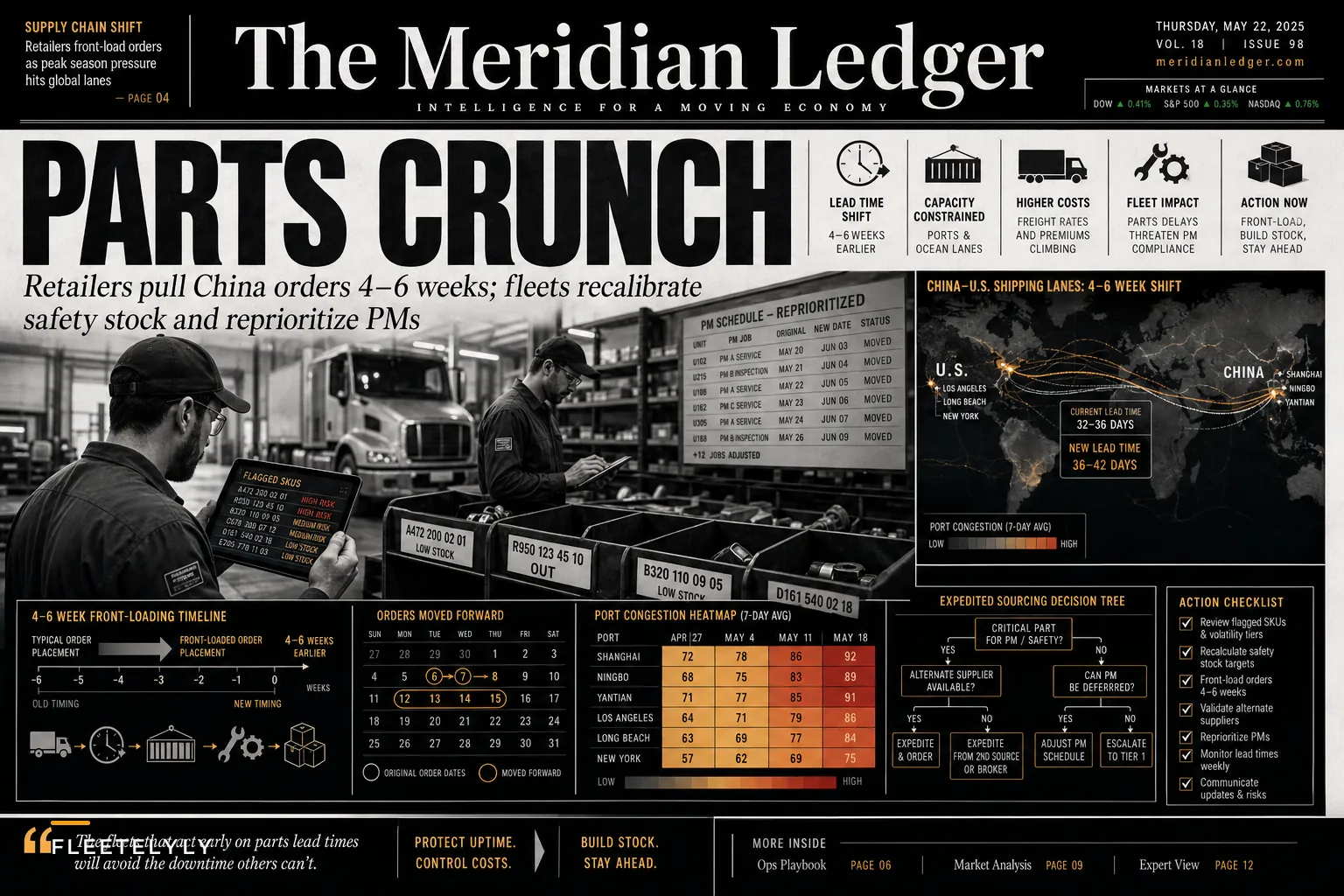

My maintenance manager called me at 6 AM last week. "Remember those brake rotors we ordered three weeks ago? Supplier just pushed delivery out another month. Says the container got bumped for holiday merchandise."
That conversation pretty much captures what's happening across fleet operations right now. According to Reuters, major retailers have started pulling forward their China orders by 4-6 weeks, cramming shipping lanes that normally see lighter summer traffic. The ripple effects are hitting fleet parts supply chains hard — and most maintenance teams are scrambling to catch up.
Why Your Parts Lead Times Just Became Unpredictable
The retail front-loading phenomenon isn't just about Christmas decorations arriving early. When Walmart, Target, and Amazon shift their ordering patterns, they consume massive chunks of ocean and air freight capacity. Everything else — aftermarket parts, filters, brake components, electrical supplies — gets pushed into whatever space remains.
For fleet managers, this creates a nasty compound problem. Your usual 21-day lead time for transmission filters might suddenly stretch to 45 days. And you won't know it's 45 days until week three, when the supplier finally admits the container didn't make the ship.
This is playing out differently depending on fleet type. A municipal bus fleet in Ohio just had their battery order pushed back six weeks. A food distributor in Texas can't get specific DEF sensors for their newer trucks. A construction company running Caterpillar loaders discovered their hydraulic hose supplier shifted everything to air freight — tripling the cost per unit.
If you're running mostly domestic trucks with strong dealer networks, you might only feel it on consumables and third-party components. Operations with mixed fleets — especially those running imported equipment or relying on aftermarket suppliers — are seeing lead times swing wildly week to week.
The Hidden Operational Cascade
Most fleet managers focus on the obvious problem: parts taking longer to arrive. The real damage happens in the cascade that follows.
Prevent costly breakdowns with proactive maintenance.
Fleetelyly helps you schedule, track, and manage every vehicle service efficiently.
- Automated maintenance reminders
- Real-time service tracking
- Parts inventory integration
No credit card required
Technicians start hoarding parts. I've seen shops where mechanics literally hide critical components in their toolboxes because they don't trust the supply chain anymore. One fleet supervisor found around $8,000 worth of filters and belts stashed around the shop — all ordered "just in case" by different shift leads.
Then comes the cannibalization spiral. A delivery truck needs a specific sensor. The part won't arrive for three weeks, so you pull it from a truck that's already down for transmission work. Now that truck needs two parts instead of one. The backlog compounds.
Meanwhile, your PM schedule starts breaking down. You can't do a proper 30,000-mile service without the right filters, so you defer it. Then another one. Suddenly you're running vehicles 5,000 miles past service intervals, hoping nothing catastrophic happens before the parts show up.
The financial hit comes from multiple angles — expedite fees for critical parts can run 3-4x normal freight cost, replacement vehicle rentals drag on while repairs stall, and technicians spend more time hunting for parts than actually wrenching.
Adjusting Your Reorder Strategy for Volatile Lead Times
The traditional min/max inventory model assumes relatively stable lead times. When those assumptions break, you need a different approach. Here's what's actually working right now:
Start by segmenting your parts into volatility tiers. Not criticality tiers — volatility tiers. Which parts have seen lead times swing by more than 50% in the last 90 days? Those need different treatment than stable-supply items.
For high-volatility parts, abandon traditional reorder points. Instead, maintain a "coverage target" — enough inventory to cover your maximum observed lead time plus around 20%. Yes, this means higher carrying costs. But it's cheaper than equipment downtime or emergency air freight.
Track lead time variance monthly and flag parts with >50% swings.
Create supplier redundancy for anything with volatile lead times. This doesn't mean five suppliers for every part. It means identifying 2-3 alternative SKUs that can substitute in a pinch — maybe you can't get OEM brake pads, but you've pre-qualified a couple of aftermarket options that meet your specs.
Track lead time variance, not just average lead time. If a supplier quotes 21 days but delivers anywhere from 14 to 42 days, that variance matters more than the average. High-variance suppliers need larger safety stock buffers.
For a deeper dive into building resilient reorder policies, check out our guide on spare-parts reorder policy for variable lead times.
Building Your Emergency Response Framework
When a critical part jumps from 3-week to 8-week delivery, you need predetermined escalation paths — not a Friday afternoon debate about whether it's worth $800 in air freight for a $200 part.
Tier 1 Response (1-2 week delays):
-
Check cross-fleet transfer options
-
Verify alternative supplier availability
-
Assess PM schedule flexibility
-
Calculate expedite cost vs. downtime cost
Tier 2 Response (3-4 week delays):
-
Initiate vendor-managed inventory discussions
-
Explore dealer consignment programs
-
Consider temporary equipment rentals
-
Evaluate partial repair options
Tier 3 Response (5+ week delays):
-
Approve controlled cannibalization
-
Implement vehicle rotation schemes
-
Negotiate priority allocation with suppliers
-
Consider equipment lease extensions
Document these decisions in advance. The whole point is to remove the guesswork before you're already in a hole.
The Data You Actually Need to Track
Standard KPIs don't tell you much during supply chain volatility. You need different metrics — ones that reflect what's actually happening on the ground:
| Metric | What It Measures | Warning Threshold |
|---|---|---|
| Lead Time Stability Score | Standard deviation of supplier lead times over 60 days | >7 days variance |
| Stockout Recovery Time | Time from recognizing a stockout to part in hand | Varies by part criticality |
| Substitution Success Rate | How often alternative parts actually solve the problem | Below 85% needs review |
| Expedite Spend Ratio | Expedited shipping as % of total parts budget | Above 8% signals systemic issues |
A regional trucking company I worked with recently discovered that roughly 60% of their expedite spending came from just 12 part numbers — all from the same supplier. That one insight let them pre-position inventory for those specific items while keeping overall carrying costs flat.
Managing Vendor Relationships During Chaos
Your parts suppliers are dealing with the same freight capacity issues you are. The difference is they're juggling hundreds of customers while you're trying to keep your fleet running. That dynamic creates opportunities if you approach it right.
Stop treating every order as transactional. Suppliers allocate scarce inventory to customers they view as partners. Schedule monthly calls with your top 3-4 suppliers to talk through upcoming needs and potential bottlenecks — not just to place orders.
Share your maintenance forecast. If you know you'll need 40 sets of brake pads in September, tell suppliers now. They can't guarantee delivery, but they can flag potential issues early. Most suppliers appreciate it because it helps them plan too.
Negotiate allocation agreements for critical parts. One fleet operator secured a guarantee for 20% of their supplier's monthly filter allocation. It cost them a 5% premium but eliminated emergency scrambles entirely.
Consider vendor-managed inventory for high-velocity parts. Several aftermarket suppliers are offering these programs specifically because of current volatility — let them own the inventory risk while you maintain availability.
Technology Solutions That Actually Help
Most fleet management systems weren't designed for extreme lead time volatility. They assume predictable patterns and stable suppliers. When those assumptions fail, you need additional tools.
Real-time inventory visibility across locations becomes critical. If your Phoenix shop has extra alternators while Denver runs short, you need to know immediately — not at the end of the week when someone finally checks the spreadsheet.
Automated reorder point adjustments based on actual lead time data prevent both stockouts and excess inventory. The system should factor in recent delivery performance, not just historical averages. Static reorder points are a liability right now.
Exception alerting for unusual patterns helps you catch problems early. If a supplier's lead time jumps 40% overnight, you want to know before you hit a stockout.
AI-powered operational software can monitor supplier performance patterns and flag concerning trends before they turn into real problems. Rather than reacting to stockouts, you're adjusting inventory strategies based on leading indicators. These platforms also help centralize communication between purchasing, maintenance planning, and the shop floor — which matters a lot when you're making daily adjustments to parts strategy.
Here's a simplified view of how that workflow typically flows when lead time volatility triggers a response:
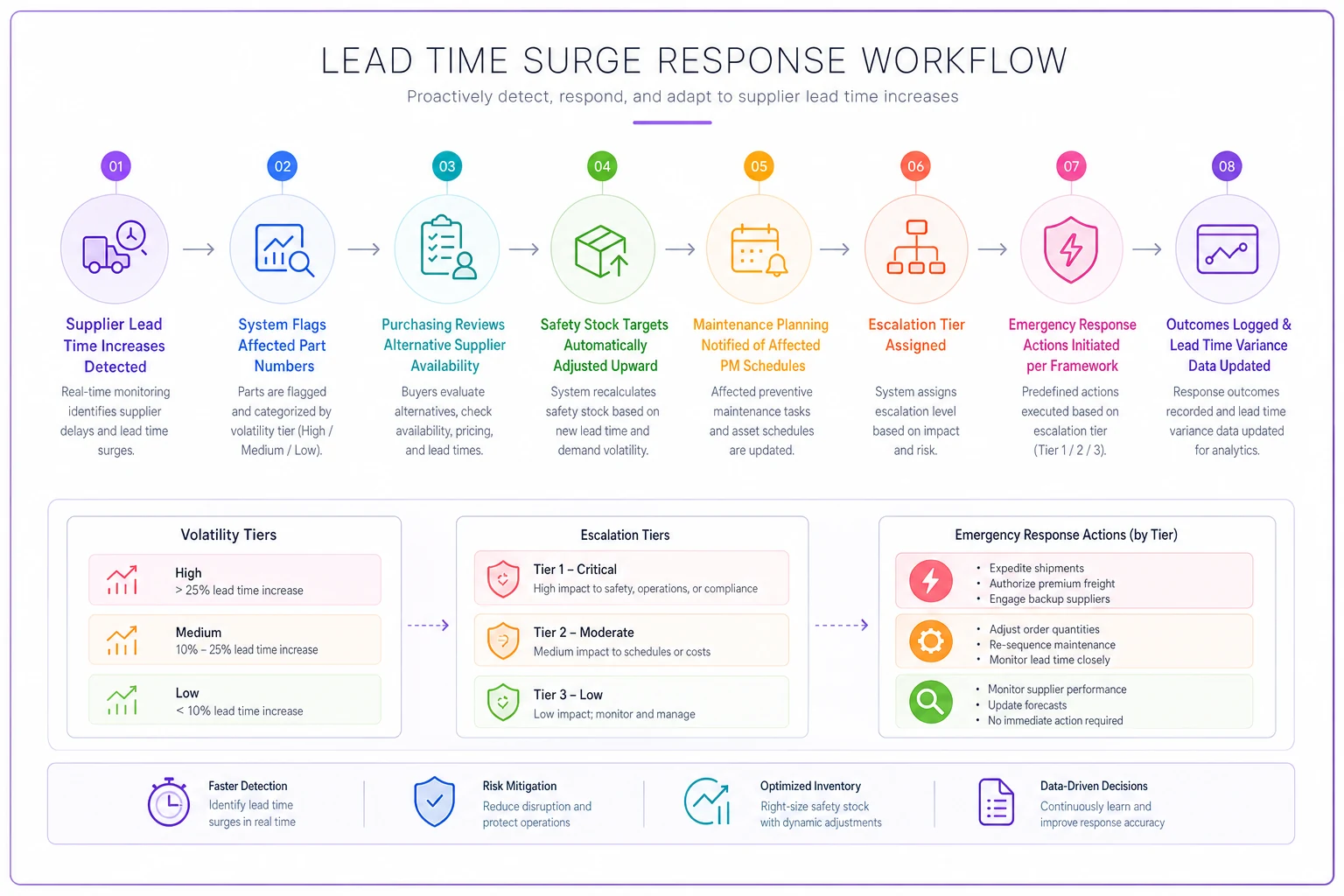
Getting this flow documented and supported by your systems means fewer 6 AM phone calls.
What This Means for Near-Term Planning
The current volatility isn't a temporary blip. Even after retailers finish their front-loading sprint, other factors will keep parts lead times unpredictable — port labor negotiations, shipping route changes, manufacturing consolidation. Diesel prices add another layer of cost pressure on top of all of this.
Build volatility assumptions into your maintenance budgets. Add 15-20% contingency for expedited shipping and emergency purchases. Better to return unused budget than blow through allocations by October.
Revisit service contracts with lead time guarantees. Some dealers and OEM suppliers offer priority service agreements that become genuinely valuable during shortage periods — worth asking about if you haven't already.
Consider strategic inventory investments where you have the capital and storage. One fleet pre-bought roughly $200k in filters and fluids earlier this year, avoiding both stockouts and a 15% price increase that hit their competitors. Buying ahead during availability windows is a legitimate hedge, not just hoarding.
Evaluate equipment standardization where possible. Running five different engine types means managing five different parts streams. Consolidating to 2-3 configurations meaningfully reduces complexity when lead times swing.
The Path Forward
The retail front-loading surge is a good reminder of how fast external factors can destabilize fleet parts supply chains. You can't control when Target decides to order Christmas inventory early, but you can build systems that absorb these shocks without blowing up your maintenance schedule.
Start with visibility — know your actual lead times, not what suppliers promise. Build flexibility into your inventory strategy, even if it means accepting higher carrying costs for stability. Strengthen supplier relationships before the next crisis, not during it.
-
Audit your top 20 parts for lead time variance over the last 90 days
-
Assign each to a volatility tier and adjust safety stock accordingly
-
Identify one alternative supplier for your three most volatile parts
-
Build your tiered emergency response framework and share it with your team
-
Set up lead time tracking in your fleet management system
Traditional parts management assumes a stability that doesn't really exist anymore. The fleets that adapt their processes and metrics to handle volatility will hold uptime while others scramble.
The current shipping crunch will ease, but another disruption is always somewhere in the pipeline. The question isn't whether your parts supply chain will face another shock — it's whether your operation will be ready when it does.
Ready to maximize fleet uptime and reduce maintenance costs?
Join 2,000+ fleet managers using Fleetelyly to streamline maintenance workflows and improve vehicle reliability.