

Most fleet maintenance pilots don't fail because the idea was bad. They fail because nobody owns them after the pilot slide deck gets presented. The predictive maintenance trial that cut unplanned downtime by 18% in one depot never spreads to the other four. The parts kitting SOP that worked beautifully in Bay 3 lives in one supervisor's head. Six months later, a reorg happens, that supervisor moves to another region, and the whole thing evaporates.
A maintenance center of excellence (CoE) is the organizational answer to that problem. Not a committee. Not a quarterly steering meeting. An actual operating unit with staff, a funding model, and a defined way of taking something that works in one place and packaging it so it runs everywhere.
This is the part most fleets skip, and it's why they keep paying for the same lessons over and over.
Why pilots evaporate without a CoE
Here's the pattern you see across fleets of almost every size: a sharp supervisor or a motivated engineer runs an experiment. Maybe it's telematics fault-code triage, maybe it's a new reorder policy, maybe it's a 5S rollout in one bay. It works. Metrics improve. Everyone's happy in the readout.
Then nothing scales.
The reason is almost always structural, not technical. The person who ran the pilot was borrowing time from their day job. They had no budget line to fund the rollout. There was no mechanism to hand the working process to the next depot without them personally flying out and babysitting it. And nobody was tracking whether the gains held after month three.
A CoE exists to close exactly those gaps. It's the difference between "we tried predictive maintenance once" and "predictive maintenance is now standard practice across the fleet, with a known cost per vehicle and a documented rollout kit."
In real operations, the failure usually looks like this: a 220-vehicle regional fleet runs a successful parts consignment trial that frees up roughly $40k in working capital. Leadership loves it. But the engineer who built it gets pulled onto an EV charging project, and nobody owns the relationships with the two suppliers involved. Within a year the consignment terms drift, nobody renegotiates, and the savings quietly leak back out. The pilot "succeeded" and still delivered almost nothing long-term.
What a maintenance center of excellence actually does
Strip away the buzzword and a maintenance CoE fleet function does four concrete jobs:
Prevent costly breakdowns with proactive maintenance.
Fleetelyly helps you schedule, track, and manage every vehicle service efficiently.
- Automated maintenance reminders
- Real-time service tracking
- Parts inventory integration
No credit card required
-
Proves things in a controlled setting — runs or sponsors pilots with real experiment design, not vibes.
-
Packages what works — turns a working process into a repeatable playbook other depots can actually use.
-
Hands it off — moves ownership from the CoE to line operations with a defined transition, not a thrown-over-the-wall handoff.
-
Measures whether it stuck — tracks sustained performance, not just the pilot spike.
If your CoE only does job one, you have a lab that produces interesting results nobody uses. If it tries to do all four but keeps job three forever, you've created a permanent dependency where depots can't operate without the central team. Both are common failure modes.
The CoE is not supposed to run maintenance. It's supposed to make maintenance better and then get out of the way. That distinction drives almost every design decision below.
Staffing models: lean, embedded, or hybrid
The single biggest early mistake is overstaffing the CoE as a shiny new department. You end up with eight people, a nice org chart, and a line-operations team that resents them as overhead. The second biggest mistake is understaffing it to one person who burns out and leaves, taking all the institutional knowledge with them.
There are three staffing models worth considering, and the right one depends mostly on fleet size and how distributed your operation is.
| Model | Best for | Core staff | Main risk |
|---|---|---|---|
| Lean core | 100–300 vehicles, 1–3 depots | 1 lead + 1 analyst (part-time) | Single point of failure, slow rollout |
| Embedded champions | 300–800 vehicles, many depots | 1 lead + rotating depot champions | Champions stretched thin, inconsistent quality |
| Hybrid cell | 800+ vehicles, multi-region | 2–4 dedicated + embedded liaisons | Becomes a permanent bureaucracy if unchecked |
The lean core is where most mid-size fleets should start. One person who owns the CoE charter, plus a shared analyst who already lives in your data. The trick is giving them explicit authority to pull in line staff for specific rollouts, so they're not trying to do everything alone.
The embedded champions model is underrated. Instead of hiring new people, you designate a maintenance supervisor or senior tech at each depot as the local CoE champion, give them maybe 15–20% of their time back, and run a monthly sync. The quality varies by champion, but the handoff problem basically disappears because the person receiving the process helped build it.
The hybrid cell only makes sense at real scale. The danger is obvious: once you have four full-time people whose job is "excellence," they need to justify their existence, and they do that by inserting themselves into everything. Build a sunset review into the charter from day one.
Pro-tip: Pair the pilot owner with a backup and document each step as you go.
One staffing pattern worth following regardless of model: never let the person who ran the pilot be the only person who understands it. Pair them. Document as you go. If knowledge lives in one skull, you don't have a CoE, you have a bus-factor problem.
The funding model is where most CoEs die
Staffing gets the attention. Funding kills more CoEs than anything else.
The trap looks like this: the CoE gets stood up with a one-time budget, often carved out of a modernization initiative. That money funds the first year. Then budget season comes, finance looks at the CoE as a cost center with soft returns, and the line gets cut or frozen. The team limps along, can't fund rollouts, and slowly becomes a reporting function that produces slides.
You need a funding mechanism that ties the CoE's money to the value it generates. A few models that actually hold up:
-
Savings reinvestment The CoE keeps a defined share (commonly 20–30%) of documented savings from its rollouts for the next year's budget. This creates a flywheel and forces honest measurement.
-
Internal chargeback Depots that adopt a CoE playbook pay a small per-vehicle or per-rollout fee back to the central function. Keeps the CoE accountable to its "customers."
-
Capitalized rollouts Larger rollouts — telematics pipelines, charging readiness — get funded as projects with their own CAPEX case, while the CoE core runs on a thin OPEX line.
A realistic structure for a mid-size fleet: a small fixed OPEX budget covering the core staff, enough to keep the lights on, plus a savings-reinvestment share that scales with results. In year one the fixed budget does most of the work. By year two, if the CoE is real, the reinvested savings should fund the majority of new rollouts.
The uncomfortable truth: if your CoE can't document savings well enough to justify a reinvestment model, it probably isn't delivering enough to keep funding anyway. The funding mechanism doubles as a forcing function for rigor.
Handoff mechanisms: the part everyone underbuilds
This is where good pilots go to die, so it deserves the most attention.
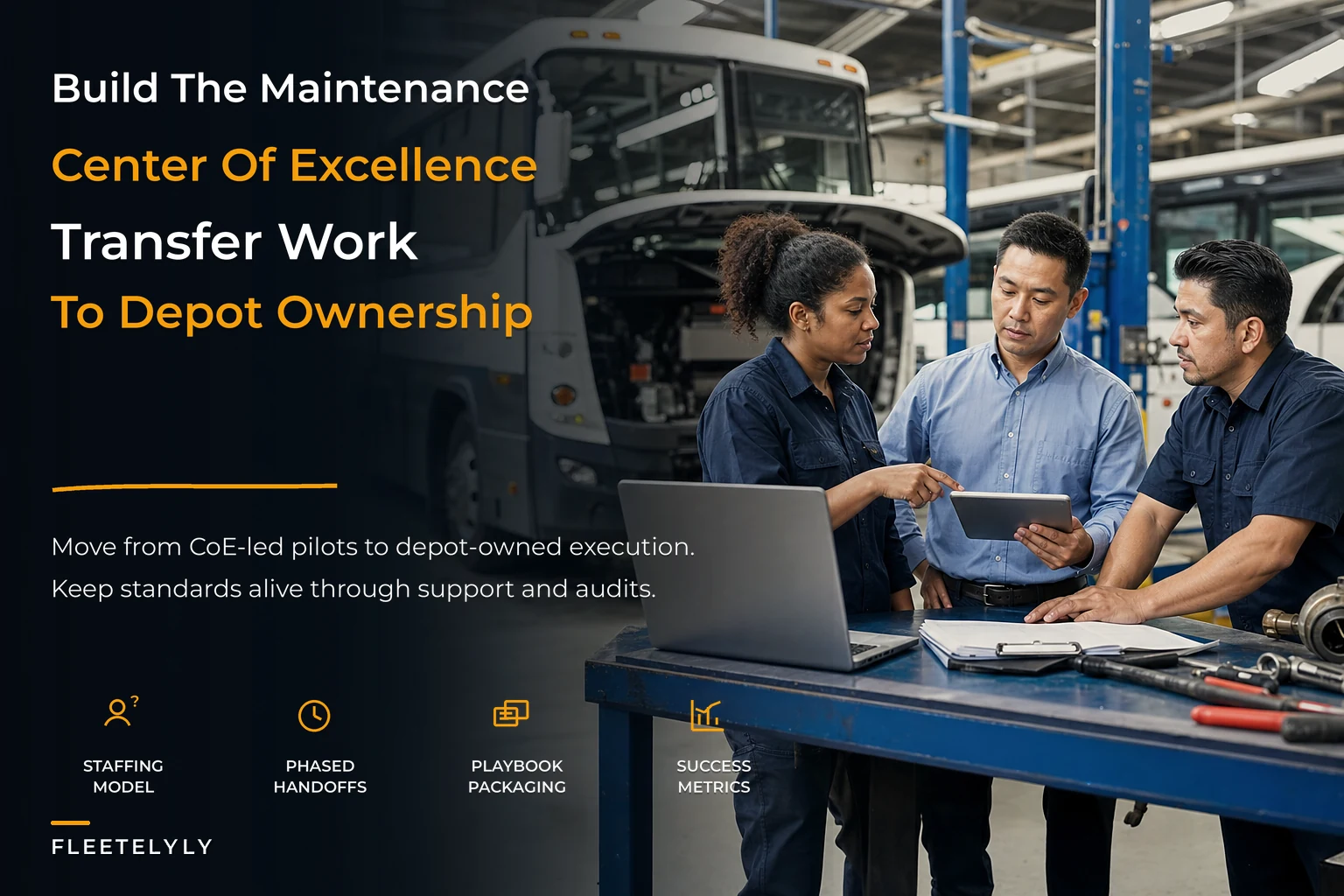
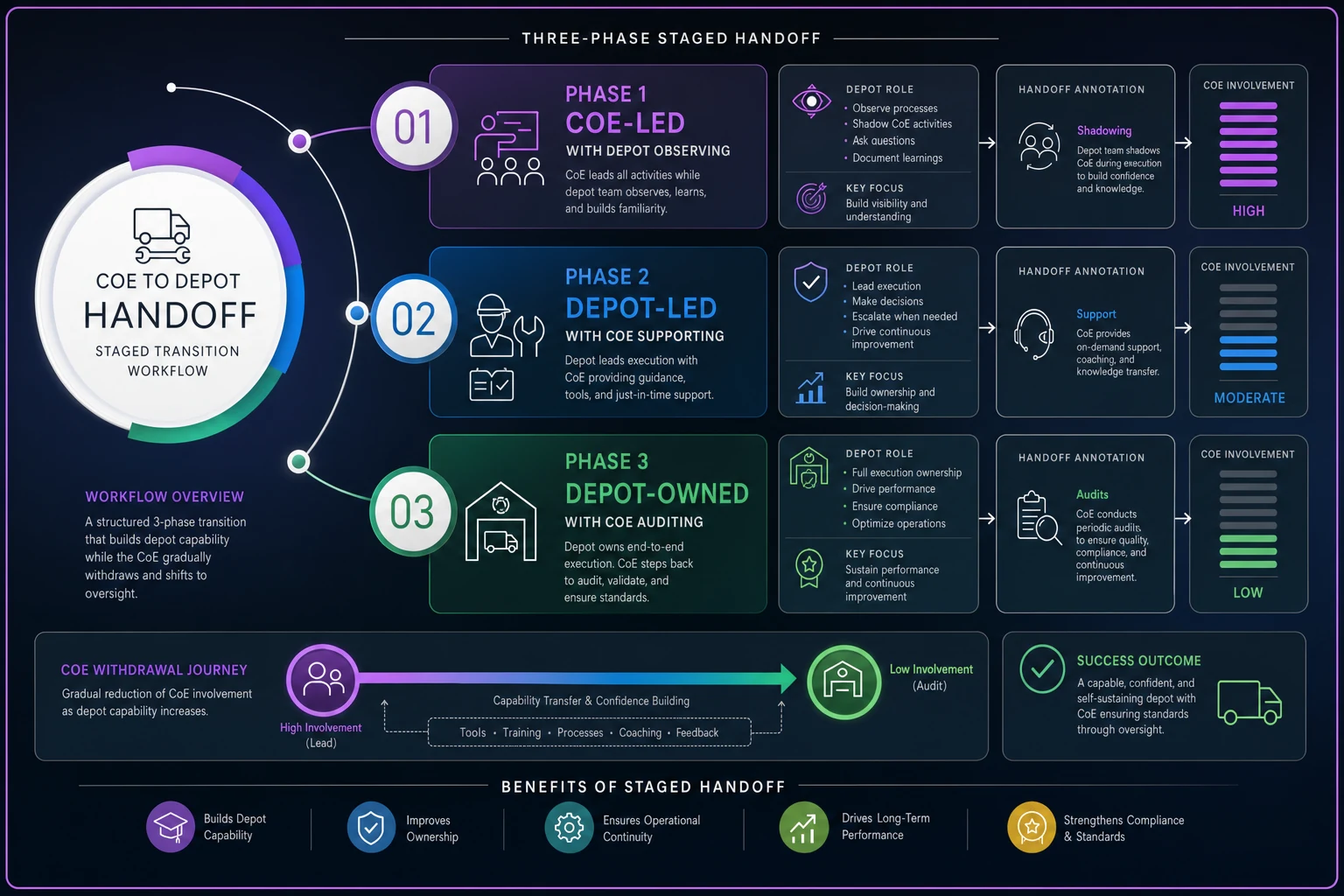
A handoff is not an email that says "here's the SOP, good luck." A real handoff is a staged transition where ownership moves from the CoE to the depot in defined steps, with the CoE pulling back support gradually as the depot proves it can run the process alone.
Phase 1 — CoE-led, depot observing. The CoE runs the process at the target depot, with local staff shadowing. This is where you discover the tacit knowledge that never made it into the written SOP — the little judgment calls, the exception handling, the "oh, we always check X first" steps.
Phase 2 — Depot-led, CoE supporting. Local staff run it. The CoE is on call, reviews the metrics weekly, and jumps in on exceptions. Most of the real learning happens here, because the depot hits edge cases the pilot never did.
Phase 3 — Depot-owned, CoE auditing. The depot fully owns it. The CoE checks in at a defined cadence — monthly, then quarterly — purely to confirm the gains held and the process didn't drift.
The mistake fleets make is compressing all three into one. They hand off the SOP and declare victory, which is really just Phase 1 with no follow-through. Three months later the process has quietly reverted to the old way because nobody was there to catch the drift.
Here's a simple visualization of the three-phase handoff workflow.
A handoff template that works keeps it simple. For every process being transitioned, you want:
-
Owner before / owner after — names, not roles
-
The working SOP — with exception handling, not just the happy path
-
Required training — who needs what competency, tied to your existing mechanic competency matrix
-
The metrics that define "working" — baseline, pilot result, and the threshold that triggers a rollback
-
The support schedule — when the CoE pulls back, phase by phase
-
The audit cadence — how often someone checks it's still holding
That rollback threshold matters more than people think. If a depot can't sustain the gains, you need a predefined point where you either re-engage or formally retire the process. Otherwise you get zombie playbooks — officially adopted, actually ignored.
Packaging the playbook so it's actually reusable
A playbook that only its author can run isn't a playbook. It's a personal workflow with a title page.
The packaging quality is what determines whether a process spreads or stalls. Processes that scale have their messiness captured. The ones that die were documented as if everything always goes right.
Good playbook packaging includes the stuff people hate writing down:
-
The decision logic, not just the steps — "if the fault code is intermittent, do X; if persistent, do Y"
-
The exceptions, because exceptions are where line staff get stuck and give up
-
The data and inputs the process depends on, and what to do when they're missing or late
-
The failure modes — what goes wrong, and how you'll know early
-
The metrics and their definitions, so two depots measure the same thing the same way
That last point quietly causes more trouble than almost anything. Two depots both claim they adopted the playbook, but one measures MTTR from work-order creation and the other from wheels-stopped. Their numbers aren't comparable, and the CoE can't tell what's working. Nail down definitions in the packaging or your cross-fleet reporting turns to mush.
This is also where connecting to your broader modernization effort pays off. A CoE doesn't operate in a vacuum — it should slot into a phased roadmap for fleet maintenance modernization with quarterly gates so that what the CoE proves feeds directly into the next gate decision. And the capabilities the CoE is trying to build out should map back to a shared maintenance operations capability framework for fleets, so you're measuring progress against something consistent rather than reinventing the scorecard for every rollout.
KPIs that keep the CoE honest
A CoE measured only on activity — pilots launched, playbooks published — will optimize for activity. You get a busy team producing documents nobody runs.
The metrics that matter split into three layers:
Did the pilot work?
-
Measured uplift vs. control (downtime, MTTR, cost per repair — whatever the pilot targeted)
-
Statistical confidence that it wasn't noise
Did it transfer?
-
Number of depots that adopted the playbook
-
Time from pilot success to first full handoff
-
Percentage of rollouts that passed their Phase 3 audit
Did it stick?
-
Sustained performance 6 and 12 months after handoff
-
Rate of playbook drift (how many adopted processes reverted)
-
Documented savings retained vs. savings projected
The sustainment metrics are the ones everyone skips and the ones that actually tell you if your CoE is real. A CoE with ten published playbooks and a 40% drift rate is in worse shape than one with four playbooks that all held. Fewer, stickier wins beat a wide graveyard of adopted-then-abandoned processes.
One number worth watching that rarely makes it onto a dashboard: time-to-second-depot. How long between proving something at depot one and running it live at depot two? If that number is measured in quarters, your handoff machinery is broken no matter how good your pilots are.
A real scenario: regional parcel fleet, 180 vehicles
A regional parcel operation running about 180 vehicles across three depots had the classic problem. Their best depot had figured out a telematics fault-code triage process that was cutting roadside breakdowns noticeably — the supervisor there was just good at it. The other two depots were still running every alert straight to a work order, drowning in false positives.
They stood up a lean-core CoE: one maintenance engineer at roughly 60% time, plus shared access to a data analyst. First move was packaging the good depot's triage logic properly — decision trees, exception handling, metric definitions. That packaging took about six weeks, mostly because so much of it had lived only in the supervisor's head.
The handoff to depot two ran the three-phase way. Phase 1 took two weeks of the engineer being on-site. Phase 2 ran about a month, during which depot two hit a batch of edge cases the original depot never saw — different vehicle mix, different fault patterns. Those edge cases got folded back into the playbook, which made the depot-three rollout smoother and faster.
Results after roughly two quarters: unplanned roadside events across the two adopting depots dropped somewhere in the range of 20–25%. Just as important, the funding held, because the CoE could point to a documented reduction in tow-and-recovery spend — real money finance could see. The savings-reinvestment share funded the next rollout, which was a reorder policy cleanup. The machine started turning.
What made it work wasn't the pilot. The pilot already existed. It was the packaging and the staged handoff that turned one good supervisor's habit into a fleet-wide standard.
When a formal CoE makes sense — and when it doesn't
A CoE is not free. It's organizational overhead, and for some fleets it's the wrong move.
It makes sense when:
-
You run multiple depots and keep re-solving the same problems independently
-
Good practices die when people move or reorg
-
You have pilots that work but never scale
-
You have enough volume that a 15–20% improvement is worth real money
It's a bad idea when:
-
You run a single depot where everyone already talks daily — you don't need a transfer mechanism for knowledge that's already shared
-
You can't fund even a lean core past year one, in which case you'll just create and kill one more initiative
-
Leadership wants a CoE for the org chart, not for the outcomes — a CoE with no authority to pull line resources is theater
Who should hold off: fleets still fighting basic data hygiene. If your work-order data is a mess and your metrics aren't trustworthy, a CoE will produce confident-looking rollouts built on sand. Fix the foundation first, then build the function that scales improvements on top of it.
Bringing it together
A maintenance center of excellence isn't about creating a center of smart people who do special projects. It's about building the machinery that takes something proven in one corner of your operation and reliably installs it everywhere else — with funding that survives budget season, handoffs that don't collapse into zombie SOPs, and metrics that tell you whether the gains actually held.
The fleets that get this right stop paying tuition on the same lessons. The ones that don't will keep running impressive pilots that look great in a readout and change nothing six months later. The pilot was never the hard part. Sustaining it was.
Ready to maximize fleet uptime and reduce maintenance costs?
Join 2,000+ fleet managers using Fleetelyly to streamline maintenance workflows and improve vehicle reliability.