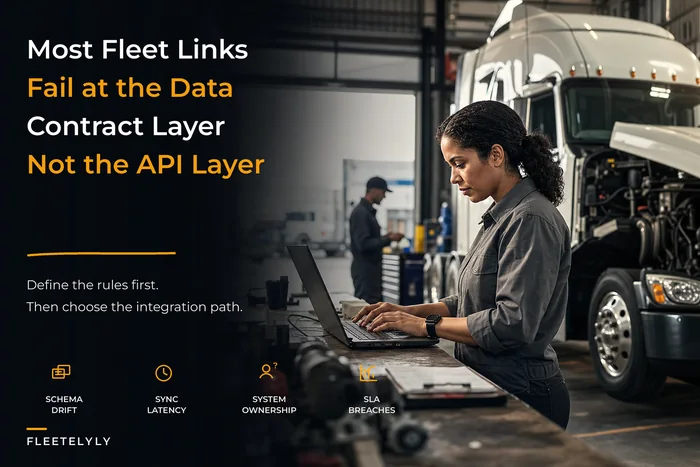


Most fleet teams treat their integrations like plumbing: invisible until something leaks. The telematics feed flows into the work-order system, fault codes turn into tickets, parts get reserved, and nobody thinks about the pipes until a vendor pushes a "minor" API update on a Tuesday and suddenly 40% of your automated work orders stop generating.
That's the quiet failure mode of fleet integrations. It's rarely one dramatic outage. It's slow drift — a field renamed here, a response format changed there, a deprecated endpoint that still "works" but silently drops payload fields. By the time anyone notices, you've got a backlog of PM schedules that never triggered and a maintenance manager asking why three trucks went past their service interval.
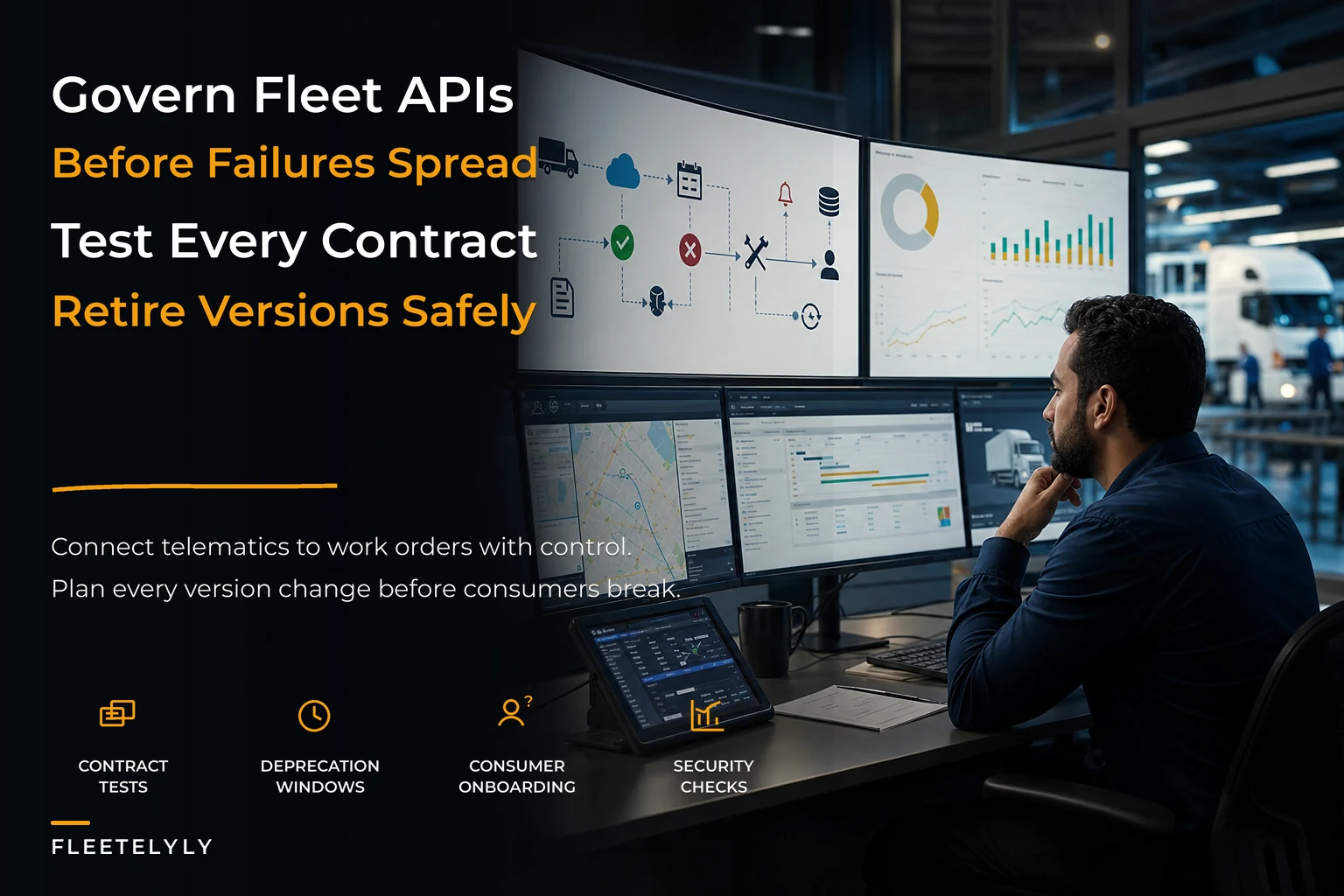
This is a governance problem, not a coding problem. API governance for fleet maintenance is the discipline that keeps the telematics→work-order flow stable while vendors, integrations, and your own internal systems keep changing underneath you. Here's how the whole thing holds together — and where it tends to fall apart as you add vehicles, vendors, and complexity.
Why integration governance quietly becomes a fleet problem
The number of integrations doesn't grow linearly with fleet size. It grows with the number of relationships between systems.
A 40-vehicle fleet with one telematics provider and one maintenance platform has maybe two or three integration points. Fine. You can manage that with a shared Slack channel and a vendor contact who answers email.
Scale that to 300 vehicles across two depots, add a second telematics vendor (because you ran a pilot and never fully migrated), bolt on a parts inventory system, a warranty portal, and a fuel card feed — and now you've got a web. Every one of those connections has its own API, its own release cadence, its own idea of what a "vehicle ID" means, and its own habit of changing things without telling you.
What breaks at scale isn't the technology. It's the coordination. Nobody owns the question: "What happens to the work-order pipeline when telematics vendor A changes their fault-code schema?" Without an owner and a policy, the answer is always the same — you find out when the tickets stop.
A lot of this traces back to weak contracts between systems in the first place. If you haven't nailed down what each integration promises to deliver, versioning is just rearranging chaos. We covered the foundation of that in the data-contract playbook for fleet maintenance integrations, and governance only works if those contracts already exist. Governance is the lifecycle layer on top of the contract.
The four pillars that actually matter
Forget the 30-page enterprise governance frameworks. For a fleet maintenance operation, the governance that earns its keep comes down to four things working together:
Prevent costly breakdowns with proactive maintenance.
Fleetelyly helps you schedule, track, and manage every vehicle service efficiently.
- Automated maintenance reminders
- Real-time service tracking
- Parts inventory integration
No credit card required
| Pillar | What it controls | What breaks without it |
|---|---|---|
| Versioning | How API changes are labeled and rolled out | Silent breaking changes, no rollback path |
| Deprecation windows | How much notice before an old version dies | Scrambled emergency migrations, missed PMs |
| Contract tests | Automated checks that a vendor still delivers what they promised | Schema drift nobody catches until production |
| Security review | Who can touch the pipeline and how data is protected | Exposed telematics data, unvetted vendor access |
| Consumer onboarding | How new systems safely plug into the flow | Rogue integrations, duplicate data, broken IDs |
The mistake most teams make is adopting one of these in isolation — usually versioning — and assuming they're covered. They're not. Versioning without deprecation windows just means you know the name of the version that's about to break you. Contract tests without onboarding playbooks means your automated checks pass right up until a new consumer joins and reads the data wrong.
They only work as a system.
Versioning that a maintenance team can actually live with
The engineering world loves to argue about versioning schemes. For fleet operations, keep it boring and predictable.
Use major/minor versioning where the rule is dead simple: a major version bump means something broke; a minor version means something was added. If a telematics vendor renames enginetemp to enginetemperature, that's a major version. If they add a new optional coolant_level field, that's minor and shouldn't touch your pipeline at all.
The practical move is to always pin your integrations to a major version in the URL or header — /v2/telematics-events — and never let your work-order system consume an "unversioned" endpoint. Unversioned endpoints are where you get hurt, because the vendor is free to change them whenever.
Pin major versions in URLs or headers to avoid unversioned endpoints and unexpected changes.
A pattern worth borrowing: run two versions in parallel during transitions. When a vendor releases v3, your pipeline keeps reading v2 while you validate v3 in a staging environment against real-ish data. You only cut over when contract tests pass. This sounds obvious but very few mid-sized fleets actually do it — they migrate on the vendor's timeline instead of their own.
When tight versioning is overkill
If you've got a single telematics provider feeding a single maintenance platform and you're under roughly 50 vehicles, heavy versioning ceremony will slow you down more than it protects you. A documented endpoint, a change-notification email from the vendor, and a monthly smoke test is probably enough. Governance should match the blast radius. Don't build a four-lane highway for a driveway.
Deprecation windows: the calendar is the contract
A deprecation window is just a promise: "This version will keep working until date X." The problem is that vendors set these windows for their convenience, and fleet teams rarely negotiate them or even track them.
Here's a realistic deprecation calendar for a fleet running multiple integrations. The point isn't the exact dates — it's that someone is maintaining this table and reviewing it monthly:
| Integration | Current version | Status | Deprecation date | Replacement | Owner |
|---|---|---|---|---|---|
| Telematics Vendor A – events | v2 | Active | — | — | Ops/Integrations |
| Telematics Vendor A – fault codes | v1 | Deprecating | Mar 31 | v2 | Ops/Integrations |
| Parts inventory – stock sync | v3 | Active | — | — | Parts lead |
| Warranty portal – claim submit | v1 | Sunset announced | Jun 15 | v2 (in staging) | Warranty admin |
| Fuel card feed | v1 | Active | — | — | Finance |
The rule worth enforcing: no deprecation window under 90 days gets accepted without an escalation. If a vendor gives you 30 days to migrate a fault-code API that feeds your safety-critical work orders, that's not a timeline — that's a risk you need to log and push back on.
A good example of how this goes wrong: a regional delivery fleet had a telematics vendor sunset a fault-code endpoint with what the vendor swore was "90 days notice." The notice went to a shared inbox nobody monitored. The endpoint died, and for about two and a half weeks, brake-wear alerts simply stopped creating work orders. Nobody noticed until a driver reported grinding. Two trucks ended up needing rotor replacement that early tickets would've caught at the pad stage — a few thousand dollars in avoidable repairs plus the downtime. The fix wasn't technical. It was assigning an actual human owner to the deprecation calendar.
Contract tests: catching drift before it hits the shop floor
Contract tests are the single highest-leverage thing a fleet integration team can add, and also the most neglected. The idea is simple: you write automated checks that assert the vendor's API still delivers exactly what your pipeline expects — the right fields, the right types, the right structure — and you run them on a schedule and before every version cutover.
If the vendor drifts, the test fails, and you find out on your terms instead of through a missed PM.
Here's what a contract test looks like in plain terms for a telematics fault-code event feeding your work-order system:
Contract: telematicsfaultcodeevent (v2) MUST contain: vehicleid → string, non-empty, matches fleet ID format eventtimestamp → ISO 8601 datetime, not in the future faultcode → string, matches known SPN/FMI pattern severity → enum: [critical, scheduled, monitor] odometer_km → integer, >= last known reading MUST NOT: drop any of the above fields change severity enum values without a major version bump Response time: p95 under 2 seconds
And a matching check on the output side — what your pipeline promises the work-order system:
Contract: workorderdraft (internal v1) MUST contain: sourceeventid → links back to telematics event vehicleid → string, matches master vehicle record priority → mapped from severity (critical→immediate, etc.) recommendedaction → non-empty string createdby → "telematicspipeline" Rule: every "critical" fault event MUST produce a workorderdraft within 5 minutes, or raise an alert
That last rule is the one that saves you. It's not testing the vendor — it's testing your own promise that critical faults become tickets. The severity-to-priority mapping itself deserves real attention; we broke that logic down in the telematics fault-code triage decision trees approach, and your contract tests should enforce whatever mapping you settled on there.
Run these tests in three situations:
-
On a nightly schedule against the live vendor endpoint
-
Before every version migration, against the new version in staging
-
As a gate in your deployment pipeline, so no internal change ships if it breaks the output contract
Teams that add just the nightly run usually catch their first silent drift within a month or two. It's almost always something small the vendor didn't think was worth announcing.
The security review checklist for integration changes
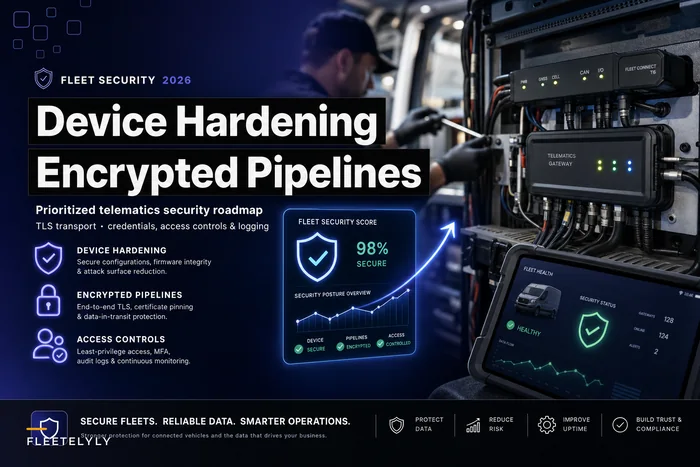
Every new integration and every version change is a new door into your data. Telematics feeds carry location, driver behavior, and vehicle diagnostics — that's sensitive, and the broader hardening picture is worth reviewing in the telematics cybersecurity checklist. For governance specifically, the review should happen before any new consumer or version goes live, not after.
A practical pre-launch security checklist for any integration change:
-
[ ] Authentication method confirmed (API keys rotated, OAuth scopes minimized — no "full access" tokens for a feed that only reads fault codes)
-
[ ] Transport encryption verified (TLS, no plaintext endpoints, certificate expiry tracked)
-
[ ] Data minimization checked (are we pulling driver PII we don't actually need for work orders?)
-
[ ] Access scope documented (which system reads this, which writes, who approved)
-
[ ] Rate limits and abuse protections in place
-
[ ] Secrets stored in a vault, not in config files or shared docs
-
[ ] Logging captures who accessed the pipeline without logging the sensitive payload itself
-
[ ] Vendor's own breach-notification SLA on file
-
[ ] Rollback plan exists if the new version behaves badly
One mistake worth flagging: teams run security review for the first integration with a vendor, then skip it for every version update after that. But a version bump can change what data is exposed or how auth works. Treat each major version as a fresh review — a lighter one, but a review. This is how credentials silently expand in scope over time without anyone signing off on it.
Consumer onboarding playbooks: letting new systems plug in safely
As your fleet operation matures, you'll keep adding "consumers" of the telematics data — a new analytics dashboard, a warranty system, a maintenance platform you're migrating to. Each one needs to read the same data without breaking the pipeline or interpreting it wrong.
A consumer onboarding playbook is the repeatable process for letting a new system join. Here's the sequence that works:
-
Contract handoff — Give the new consumer the documented data contract first. Not access, the contract. They need to know what fields exist and what they mean before they touch anything.
-
Sandbox access — Provision read access to a staging feed with realistic synthetic data. Never let a new consumer's first read be against production.
-
ID reconciliation — This is where most onboardings quietly fail. Confirm the new system's idea of a "vehicle" matches your master vehicle record. Mismatched IDs create duplicate or orphaned records that take weeks to untangle.
-
Contract test submission — The new consumer writes its own contract tests asserting what it expects. You review them. If their expectations don't match the real contract, you catch it now.
-
Shadow run — Let the consumer read production data for a week without acting on it. Compare what it produces against the existing system.
-
Cutover with rollback — Go live, keep the old path warm for a defined window, and keep the deprecation calendar updated.
The hidden cost of skipping this: a fleet that onboarded a new maintenance platform without ID reconciliation ended up with two vehicle records for around 60 trucks — one from the old numbering scheme, one from the telematics GUID. PM history split across both. It took most of a quarter of manual cleanup to merge them. A one-day reconciliation step at onboarding would have prevented all of it.
Running through these steps adds maybe a day or two of overhead per integration. That feels slow when you're trying to move fast, but it's a lot faster than spending three months detangling duplicate vehicle records.
A real scenario: pulling drift under control
A mid-sized urban delivery fleet — roughly 220 vehicles, two depots, two telematics vendors from an incomplete migration — kept getting burned by integration surprises. Their symptoms were familiar: work orders that didn't generate, PMs that slipped, and a maintenance team that had quietly stopped trusting the automated tickets and started manually checking telematics dashboards "just in case."
What they actually had was zero governance. No version pinning, no deprecation calendar, no contract tests. Vendors changed things and the pipeline absorbed the damage silently.
Here's the workflow that caught drift and kept the pipeline healthy:
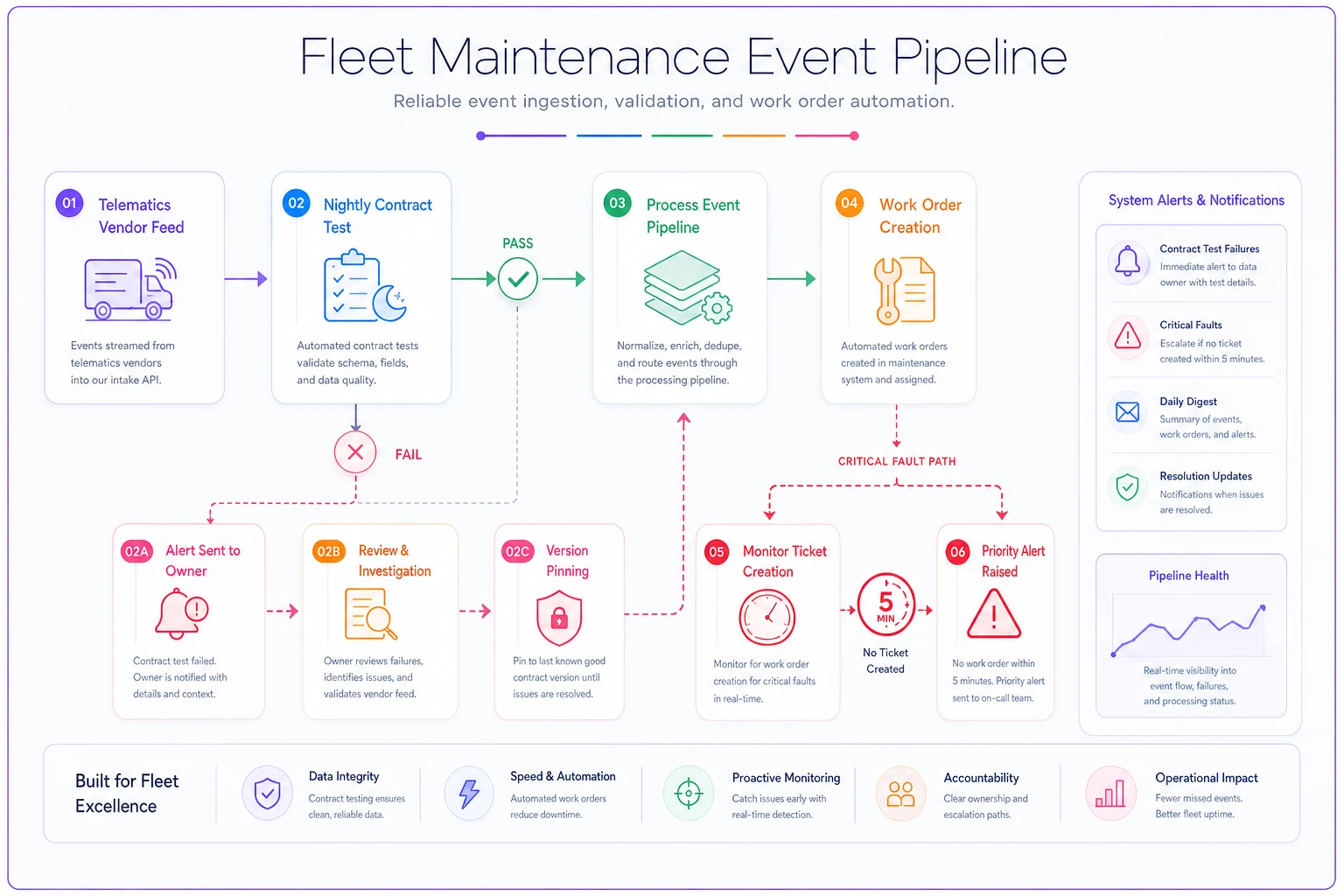
They didn't buy new technology. They put governance in place over about a quarter:
-
Pinned every integration to a major version
-
Built the deprecation calendar and assigned owners
-
Wrote contract tests for the three most critical feeds and ran them nightly
-
Added the critical-fault-must-create-ticket output rule
The change wasn't dramatic from the outside. Silent drops fell to near zero because contract tests caught drift within a day. The two mystery PM slips per month they'd been living with stopped. And maybe most importantly, the maintenance team went back to trusting the automated work orders — which freed up a few hours a week they'd been spending double-checking dashboards. No heroics, just someone finally owning the lifecycle.
Where the right tooling fits — and where it doesn't
You can run all of this with spreadsheets, scheduled scripts, and discipline. Plenty of fleets do, at least at first. The governance matters more than the tooling.
That said, as integrations multiply, a maintenance platform that treats the telematics→work-order flow as a managed, versioned pipeline — with built-in contract validation, change alerts, and audit logging — removes the "someone has to remember to check" dependency that eventually fails. AI-assisted monitoring helps most on the drift-detection side: automatically flagging when an incoming payload deviates from its contract, or when a critical fault doesn't produce a work order within the expected window, so a human gets an alert instead of discovering it through a grinding brake. The point isn't automation for its own sake — it's closing the silent-failure gaps that human monitoring misses when you're running hundreds of vehicles across multiple integrations.
Don't buy tooling to avoid building the policy, though. Tools enforce governance; they don't invent it. A platform pointed at a pipeline with no defined contracts just automates the chaos faster.
Bringing it together
Integration governance for fleet maintenance isn't a technical nicety — it's the difference between a telematics pipeline you trust and one you've quietly stopped relying on. The four pillars reinforce each other: versioning gives you predictable change, deprecation windows give you time to react, contract tests catch drift before it hits the floor, and onboarding playbooks keep new systems from poisoning the data.
The fleets that get this right aren't the ones with the fanciest tech. They're the ones where someone owns the deprecation calendar, the contract tests run on a schedule, and every new integration passes through the same gate. Start with your two or three most critical feeds, write the contracts, run the tests nightly, and build out from there. The drift is already happening — governance just means you find out about it on your terms instead of your driver's.
Start with your two or three most critical feeds, write the contracts, run the tests nightly, and build out from there. The drift is already happening — governance just means you find out about it on your terms instead of your driver's.
Ready to maximize fleet uptime and reduce maintenance costs?
Join 2,000+ fleet managers using Fleetelyly to streamline maintenance workflows and improve vehicle reliability.