

The worst part failures aren't the dramatic ones. They're the quiet ones — a $14 sensor goes end-of-life with no announcement, and six months later your parts desk finds out when the supplier portal returns "no longer available" and the truck is already in the bay.
For mixed fleets running equipment from four or five manufacturers across model years spanning a decade, the bill of materials is a minefield. You're not tracking one platform. You're tracking hundreds of subcomponents, most of which nobody thinks about until they can't be sourced. That's the real shape of the parts obsolescence problem: it hides inside BOMs you assume are stable and surfaces at the exact moment you have the least room to react.
This post walks through a discovery audit you can actually run, the cross-reference rules that separate a safe substitution from a warranty-voiding gamble, how to qualify remanufactured sources, and how to decide between stocking ahead versus redesigning the assembly. There's a supplier qualification checklist and a couple of sample mitigation timelines at the end.
Start with a discovery audit, not a parts list
Most fleets already have a parts list. What they don't have is a discovery audit — a deliberate pass through the BOM to flag risk before it becomes a stockout.
The difference matters. A parts list tells you what you buy. A discovery audit tells you what's about to become unbuyable.
-
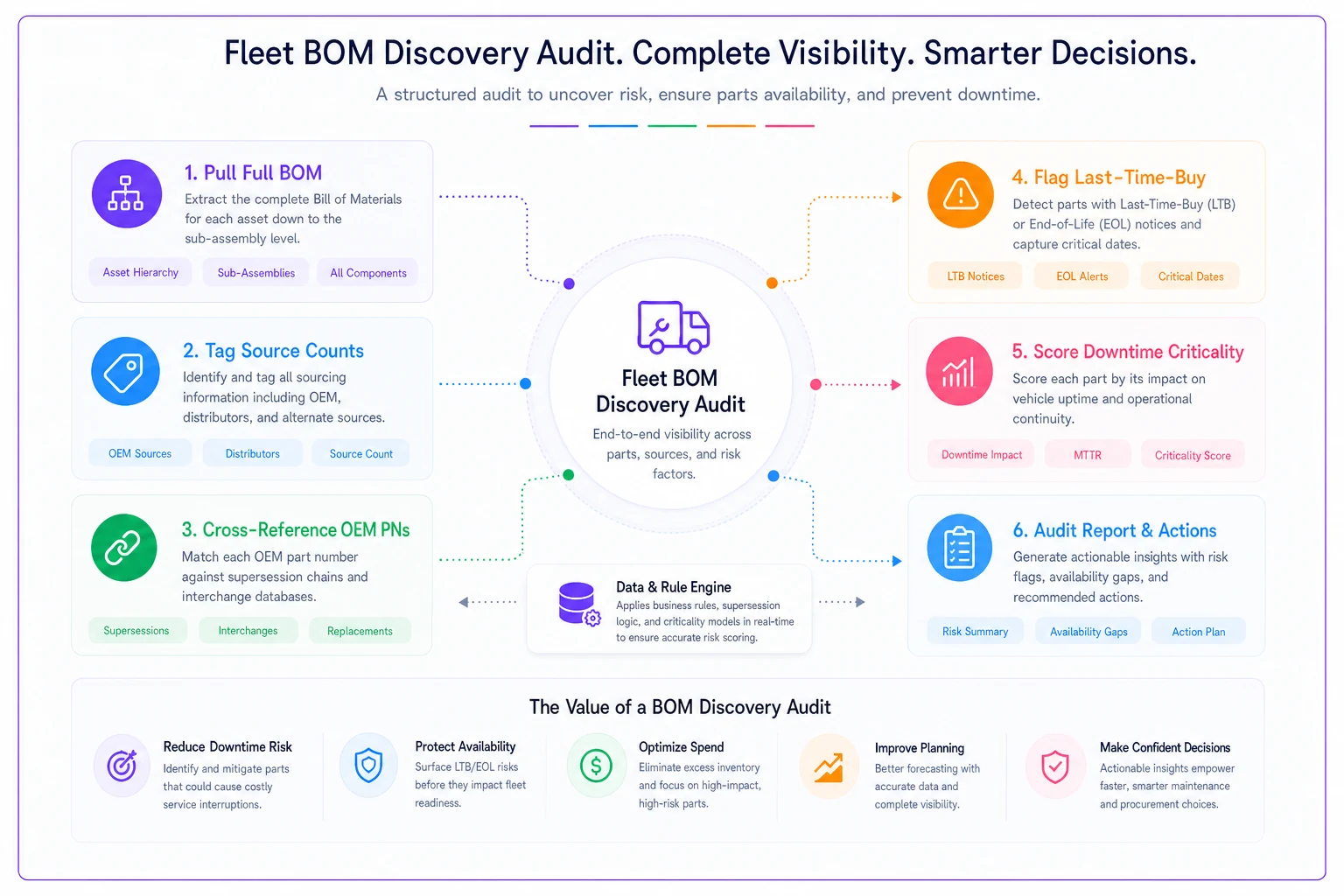
Pull the full BOM per platform, down to sub-assembly level. Not just the top-level SKU you order, but the components inside it. A remanufactured alternator you buy as one line item may contain a voltage regulator that's independently going obsolete.
-
Tag each line with a source count. How many distinct suppliers can actually deliver this today? One source is a red flag. Zero is a fire.
-
Cross-reference OEM part numbers against supersession chains. OEMs quietly replace part numbers all the time. The old number shows "discontinued," but there's a live successor — you just have to find it.
-
Flag last-time-buy (LTB) notices. Component makers issue these when they're winding down production. If your supplier received an LTB notice and didn't pass it along, you're already behind.
-
Score criticality against downtime impact. A part that's obsolete but sits on a non-critical accessory is a very different problem than an obsolete brake system component on your highest-mileage units.
The mistake that comes up constantly: teams audit the parts they order frequently and ignore the slow movers. Slow movers are exactly where obsolescence bites, because nobody notices the supply drying up until the one time a year you actually need it.
Prioritize slow-moving SKUs with a single source on your first audit pass to get the biggest risk reduction for the least effort.
This visual maps the audit steps so everyone on the parts team can follow the same process.
The obsolescence signals worth watching
Obsolescence rarely announces itself. It leaks through smaller signals first, and catching them early gives you months of lead time instead of days.
Prevent costly breakdowns with proactive maintenance.
Fleetelyly helps you schedule, track, and manage every vehicle service efficiently.
- Automated maintenance reminders
- Real-time service tracking
- Parts inventory integration
No credit card required
-
Price creep with no volume change. When a component's unit price jumps 20–30% over two quarters and nothing else changed, it's often a sign the supplier is managing down a dying line.
-
Lengthening quoted lead times. A part that used to ship in a week now quotes six. That's not always demand — sometimes it's the last production run being rationed.
-
"Equivalent" substitutes appearing unprompted. When a distributor starts offering a cross-reference part you didn't ask for, the original is usually on its way out.
-
Minimum order quantity increases. Suppliers raise MOQs to clear final inventory. A jump from 5 units to 50 is a soft last-time-buy signal.
-
Datasheet or revision changes on electronic components. For anything with a chip in it — telematics modules, controllers, sensors — a revision bump can mean the old rev is gone.
Worth noting: the parts most exposed to obsolescence tend to be electronic and electromechanical, not mechanical castings. A wheel hub design lives for decades. A body control module might have a five-year production window. If your mixed fleet skews toward newer, electronics-heavy vehicles, your obsolescence exposure is higher than an older diesel fleet, even if the trucks themselves are younger.
Cross-reference rules: when a substitute is safe
Finding a cross-reference part is easy. Trusting it is where teams get burned. A cross-reference that "fits" mechanically can still fail on tolerance, firmware compatibility, or warranty terms.
Form, fit, function must all pass — not two of three. A part can bolt in perfectly and still be wrong. If the electrical spec, thermal rating, or duty cycle differs, "fits" means nothing.
Confirm the interchange direction. Cross-reference tables aren't always bidirectional. Part A may supersede Part B, but Part B may not be a valid replacement for Part A because of a mid-cycle upgrade. Always check which direction the supersession runs.
Verify against the OEM revision, not just the base number. Two parts with the same base number and different suffixes can behave differently. This trips up teams constantly on control modules and sensors.
Get the substitution in writing from a qualified source. A distributor's verbal "yeah that'll work" is not a cross-reference. If it voids OEM warranty or fails, you need a paper trail. The same documentation discipline that makes your fleet RCA process with evidence templates effective applies directly to substitution records.
| Check | Pass condition | Red flag |
|---|---|---|
| Mechanical fit | Same mounting, clearance, connector | "Close enough with a bracket" |
| Electrical spec | Voltage, current, signal type match | Different pinout or logic level |
| Firmware/software | Compatible or flashable to spec | Requires OEM tool you don't have |
| Warranty impact | Documented as OEM-approved | Voids powertrain or component coverage |
| Source reliability | Named, qualified supplier | Anonymous marketplace listing |
If a candidate fails on warranty impact or source reliability, it's not a substitute — it's a liability you're choosing to accept.
Qualifying remanufactured sources
Remanufactured parts are often the right answer for obsolescence, especially on mechanical and electromechanical components. But "reman" covers a huge quality range, from genuine OEM remanufacturing programs down to someone cleaning a used core and reselling it.
The real question isn't "is it remanufactured?" It's "what actually happened to this part before it got to me?"
-
Core testing process. Do they test cores before rebuilding, or rebuild everything and hope? A supplier that rejects marginal cores is worth more than one with a lower price.
-
Wear-item replacement policy. In a genuine reman, bearings, seals, and consumables get replaced regardless of condition. Ask which parts they replace every time versus "as needed."
-
Warranty terms and duration. A reman part with a 90-day warranty tells you the supplier isn't confident in what they're sending. Twelve to twenty-four months signals a real process behind it.
-
Failure rate data. Ask for their return/failure rate on the specific SKU. A supplier who tracks this and shares it is operating a real quality system. One who can't produce it isn't.
-
Traceability. Can they tell you the core's origin and rebuild date? That's the difference between a remanufacturer and a refurbisher.
Reman works well for starters, alternators, calipers, steering gears, and hydraulic components. It gets riskier for anything with embedded software or safety-critical electronics, where the rebuild process can't restore the underlying component lifecycle. Match the sourcing strategy to the part type, not to the price.
Stocking ahead vs redesign: the real decision
Once you've identified an obsolete or soon-to-be-obsolete component, you have two structural options: buy ahead (last-time-buy stocking) or redesign the assembly to accept a currently-produced alternative. Most teams reflexively stock. Sometimes that's right. Often it isn't.
Stocking ahead makes sense when:
-
The remaining fleet life is short enough that a one-time buy covers it
-
The part is cheap, small, and shelf-stable
-
Consumption is predictable and you can forecast the buy accurately
-
Redesign would require re-engineering or re-certification you can't justify
Redesign makes sense when:
-
The fleet will run five or more years and no realistic last-time-buy quantity covers that window
-
The part is expensive to hold or degrades in storage (rubber, electronics, batteries)
-
A currently-produced alternative exists and integration cost is modest
-
You're standardizing across platforms and can eliminate a one-off component entirely
The trap is the middle case: a moderately expensive part on a fleet with three to four years left. Stocking ties up capital and storage; redesign costs engineering time. The right call depends on how confident you are in the consumption forecast. If your usage history is thin, over-buying wastes money and under-buying leaves you exposed. Reorder discipline matters here — the same logic behind a spare-parts reorder policy for variable lead times applies to sizing a last-time-buy, since an LTB is essentially a final safety-stock calculation with no reorder point.
A common miscalculation: teams size the last-time-buy on average annual usage and forget the tail. If a part has a failure rate that climbs as units age, the last three years of fleet life may consume more than the first five. Model the aging curve, not the flat average, or you'll run out right when the fleet is oldest and most vulnerable.
Supplier qualification checklist
Before committing to any source — OEM alternate, reman supplier, or cross-reference distributor — run them through this. It's short on purpose. A checklist nobody uses is worthless.
-
[ ] Can they name the actual manufacturer of the part (not just the distributor)?
-
[ ] Do they provide written cross-reference or supersession documentation?
-
[ ] What is the current quoted lead time, and how has it moved over the last two quarters?
-
[ ] Is there a last-time-buy notice on this component, and if so, when?
-
[ ] What warranty terms apply, and do they cover consequential downtime?
-
[ ] Can they provide failure/return rate data for this SKU?
-
[ ] What is the minimum order quantity, and has it changed recently?
-
[ ] Is there a second qualified source, or does this create single-source risk?
-
[ ] For reman
what's the core testing and wear-item replacement policy?
-
[ ] For electronics
what revision level ships, and is it firmware-compatible?
If a supplier stumbles on more than two of these, treat them as a stopgap, not a qualified source.
Sample mitigation timelines
Timelines depend entirely on how early you catch the problem. These two scenarios show the difference between an early catch and a late one.
Scenario A — early detection (LTB notice received, 12+ months runway):
-
Weeks 1–2 Confirm affected platforms and total remaining consumption. Pull aging-adjusted usage forecast.
-
Weeks 3–4 Evaluate stock-vs-redesign. Get cross-reference candidates qualified.
-
Weeks 5–8 If redesign, begin integration testing on 2–3 units. If stocking, place last-time-buy at forecast plus tail buffer.
-
Weeks 9–12 Validate substitute in field on pilot units. Document approval and update BOM records.
-
Ongoing Monitor pilot units for early failures before rolling the substitute fleet-wide.
Scenario B — late detection (already stocked out, truck down):
-
Days 1–2 Emergency cross-reference search. Accept a qualified reman or verified alternate to return the unit to service.
-
Days 3–5 Backfill the immediate gap; identify how many other units are exposed to the same part.
-
Week 2 Run the discovery audit that should have happened earlier — find the next few parts heading the same direction.
-
Weeks 3–6 Formalize the substitute, qualify a second source, and set up monitoring so this specific SKU never surprises you again.
The gap between these two scenarios is entirely about detection lead time. Everything downstream — cost, downtime, quality risk — gets worse when you're reacting instead of planning.
A real scenario
A regional service fleet running around 140 mixed light and medium-duty vehicles hit a wall on a body control module used across roughly 30 of their older units. The module went end-of-life; the distributor had stopped stocking it months earlier and nobody flagged it. When two units came in needing the module in the same week, there were none available.
The scramble cost them. Two trucks sat for about eleven days waiting on a reman source they hadn't qualified in advance, and the expedited reman units ran roughly 40% over what a planned buy would have cost. All-in impact, counting downtime and premium sourcing, landed somewhere around $9k–$12k for what should have been a routine replacement.
Afterward they ran a discovery audit across the older platforms and found four more components on the same trajectory — two with active last-time-buy notices they'd never seen. They placed planned last-time buys on the two cheap, shelf-stable parts and started a redesign path for a sensor that wasn't worth stocking. No repeat stockouts on those platforms since. The audit took about two days of work. The failure that triggered it cost more than five times that.
Where this usually breaks down
The pattern behind almost every BOM failure is the same: the information existed somewhere, but not where the person making the decision could see it. The LTB notice sat in an email. The supersession chain lived in a distributor's system. The aging failure curve was buried in work-order history nobody analyzed. Obsolescence isn't really a parts problem — it's a visibility problem that shows up as a parts problem.
Fleets that stay ahead of this treat their BOM as a living record, not a static list. They keep source counts, lead-time trends, and last-time-buy flags attached to each critical component, and they review them on a schedule instead of waiting for a stockout to force the conversation. Centralizing that data — pulling supplier lead times, usage history, and supersession notes into one place your parts team actually looks at — is what turns a two-day emergency into a two-week planned transition. Whether you do that in a maintenance platform or a well-maintained spreadsheet matters less than doing it consistently.
Run the discovery audit before you need it. Qualify your reman and alternate sources while the trucks are still running. And model your last-time buys against the fleet's aging curve, not a flat average. The parts that take trucks off the road are almost never the ones you're watching — they're the quiet ones you stopped thinking about.
Ready to maximize fleet uptime and reduce maintenance costs?
Join 2,000+ fleet managers using Fleetelyly to streamline maintenance workflows and improve vehicle reliability.