



Most electrification projects don't stall because the trucks are wrong. They stall because the depot wasn't ready to run them. The vehicles show up, the chargers are half-commissioned, the utility interconnect is still in queue, and nobody built a duty-cycle plan that accounts for how long a Class 6 box truck actually needs to sit on a charger overnight. Suddenly the shop that used to turn diesel PMs in a predictable rhythm is juggling energy constraints it never had to think about.
Nobody tells you upfront: a depot electrification project is not a procurement project. It's an operations redesign that touches facilities, power, scheduling, technician skills, and your cost model all at once. Miss one leg and the whole thing wobbles. This is why a fleet electrification depot roadmap has to be built as a system, not a checklist of unrelated tasks handed to different departments.
Below is how the pieces connect, where they break as you scale from a pilot to a real fleet, and the phased gates that keep you from over-committing capital before the operation proves it can absorb it.
Why depot readiness is a coordination problem, not a construction problem
The instinct is to treat electrification like a building upgrade: pour pads, run conduit, mount chargers, done. That framing is exactly what gets fleets into trouble. Charging isn't a fixed asset you install and forget — it's a shared, constrained resource that has to be scheduled against vehicle duty cycles, technician availability, and utility rate windows.
Here's the pattern that shows up again and again. A fleet runs a 5-vehicle pilot. Five vehicles, five chargers, zero contention. Everything charges overnight, everyone's happy, the pilot report says "success." Then they scale to 40 vehicles on 25 chargers because the capital committee balked at a 1:1 ratio, and now the depot has a queuing problem it never modeled. Vehicles that were supposed to leave at 6 a.m. are sitting at 40% because three of them shared a charger overnight and the last one only got two hours.
The pilot didn't fail. The pilot lied — because contention doesn't exist at small scale. Almost every depot readiness failure is invisible until you cross the point where the resource becomes shared. Power, chargers, and technician bandwidth all behave fine in isolation and badly under contention.
So the roadmap has to be designed around the crossover points, not the pilot. Every section below is really about the same question: what breaks when this stops being one-to-one?
The site audit: what you're actually measuring
A proper site audit is not a walk-through with an electrician. It's a data-collection exercise that produces the constraints your entire schedule will live inside. Skip the rigor here and every downstream decision inherits bad assumptions.
Prevent costly breakdowns with proactive maintenance.
Fleetelyly helps you schedule, track, and manage every vehicle service efficiently.
- Automated maintenance reminders
- Real-time service tracking
- Parts inventory integration
No credit card required
What a real depot audit has to capture:
-
Existing electrical capacity at the service entrance — not nameplate, actual available headroom after current loads (HVAC, compressors, shop equipment, lighting).
-
Utility interconnect lead time and cost for the service upgrade you'll likely need. This is often the single longest pole in the tent — 12 to 24 months in some territories.
-
Physical charger placement mapped against how vehicles actually flow through the yard, not how the CAD drawing wishes they did. Cable reach, drive lanes, turning radius for larger vehicles.
-
Demand profile by hour — when vehicles return, when they leave, how long they dwell. This is your charging window, and it's usually narrower than people assume.
-
Rate structure and demand charges from your utility. Demand charges can quietly dominate your operating cost if every vehicle plugs in at the same moment.
-
Redundancy and failure modes — what happens when one charger goes down? When the transformer trips? What's your fallback for vehicles that must roll?
Measure available headroom after representative peak loads, not just service nameplate, so your model matches real operations.
The most common mistake: teams size the electrical service for the vehicle count but never model the simultaneity. Forty vehicles don't need forty vehicles' worth of instantaneous power if you stagger charging. But if you don't manage the stagger, you'll pay demand charges as though they all pulled at once — and you'll trip capacity you thought you had.
A typical example: a depot with roughly 1.2 MW of available service tries to charge 30 medium-duty vehicles. Uncontrolled, the return-to-depot spike hits the service ceiling by 7 p.m. and the last chargers throttle. Managed charging spreads that same load across an eight-hour window and never touches the ceiling. Same hardware, completely different outcome. The audit is where you decide which of those two depots you're building.
Charging provisioning and the ops playbook
Once the site is understood, provisioning becomes a policy question, not just a hardware order. How many chargers, at what power level, in what ratio to vehicles, managed how? These are operational decisions with real cost and uptime consequences.
The charger-to-vehicle ratio is where budgets and reality collide. Here's a rough way to think about it:
| Ratio | When it fits | Risk |
|---|---|---|
| 1:1 (charger per vehicle) | Short dwell windows, high-utilization duty cycles, mission-critical routes | Highest capex, often idle chargers midday |
| 1.5–2:1 (vehicles per charger) | Predictable overnight dwell, staggered departures | Requires disciplined scheduling; contention risk |
| 3:1+ | Long dwell, flexible departures, opportunity charging | Fragile — one schedule slip cascades |
Most fleets land around 1.5:1 to 2:1 and manage the gap with software-controlled sequencing. The ops playbook is what makes that ratio survivable. It should define:
-
Charging priority rules — which vehicles charge first based on next departure and current state of charge.
-
Load management policy — how total draw is capped to stay under demand-charge thresholds and service limits.
-
Rate-window targeting — pushing as much energy as possible into off-peak hours.
-
Exception handling — the procedure when a vehicle returns late, a charger faults, or a route needs an unplanned midday top-up.
-
Daily readiness check — a morning verification that every vehicle assigned to a route has the range it needs before dispatch.
That last point sounds obvious and is the one most often missing. Diesel fleets never had to verify fuel state programmatically because a five-minute fill fixed any shortfall. Electric fleets can't fast-fix a depleted battery at 5:45 a.m. The readiness check has to move upstream into the overnight window, which means somebody — or some system — has to be watching charge state through the night and flagging vehicles that won't make target.
This is where centralizing the data matters. When charger telemetry, vehicle state of charge, and the next day's route assignments live in three different systems, nobody can answer "will everything be ready by 6?" until it's too late to fix. The fleets that run this well pull those signals into one operational view, and increasingly use automated logic to sequence charging and raise exceptions overnight instead of relying on a human to babysit a dashboard until 2 a.m. That's not about replacing anyone — it's about catching the one vehicle out of forty that's going to be short before the driver is standing next to it.
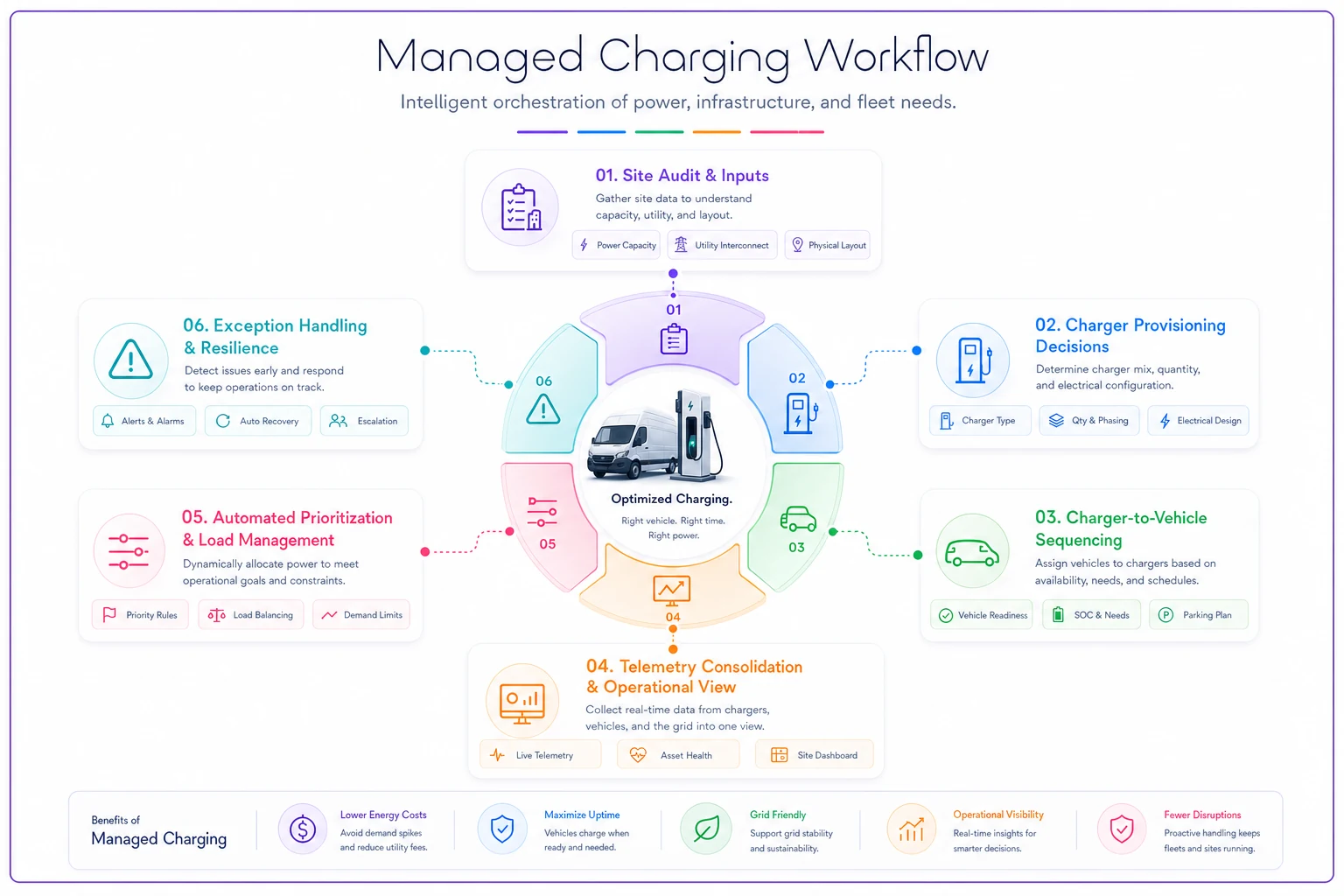
A simple diagram of the managed-charging workflow helps align teams and clarify handoffs.
Scheduling impacts: where electrification collides with the shop
This part gets underestimated every time. Charging doesn't just constrain dispatch — it reshapes the maintenance shop's rhythm too.
On a diesel fleet, a tech can pull almost any vehicle into a bay whenever there's an opening. On an electric fleet, that vehicle might be mid-charge, or scheduled to charge in a specific window to hit its rate target and departure time. Pull it into the bay at the wrong moment and you've knocked it off its charging plan — and now it might not make its morning route. Two teams that used to operate independently, maintenance and charging ops, are now sharing the same asset on the same timeline.
The coordination failure looks like this: the shop schedules a PM for 10 p.m. because that's when a tech is free. But that vehicle was slated to start charging at 11 p.m. to catch off-peak rates and be full by 5 a.m. The PM runs long, the vehicle misses its window, charges on peak rates instead, and shows up at 60% for a route that needs 85%. Nobody did anything wrong individually. The systems just weren't talking.
The fix is to treat charging windows as hard constraints in the maintenance schedule, the same way you'd treat a route SLA. If you already convert uptime targets into structured PM plans — the logic in converting SLA uptime targets into PM schedules carries directly over — you extend that model to include charging state as another dimension the PM has to work around. The vehicle isn't just "available" or "in service" anymore. It's "available, charging, must-be-ready-by-X." Three states where you used to have two.
This is also where bay throughput planning has to account for a slower, less flexible pull system. You lose the ability to grab any vehicle on a whim, which means you plan the shop schedule further ahead and build the charging plan and the maintenance plan together, not in sequence.
Technician retraining: the skill gap nobody budgets for
High-voltage systems are a different discipline. Not harder, necessarily, but genuinely different — and the safety stakes are real. A tech who's spent fifteen years on diesel powertrains has deep intuition that partially transfers and partially becomes a liability if they assume EV systems behave like what they know.
The retraining plan has to cover more than "how the drivetrain works." It has to cover:
-
High-voltage safety and lockout/tagout specific to EV systems — the non-negotiable baseline before anyone touches a pack.
-
Charging infrastructure troubleshooting — because now your techs are also maintaining chargers, not just vehicles. A faulted charger is a fleet-availability problem, and waiting on a vendor callout for every fault will crush your uptime.
-
Diagnostics on EV-specific fault codes and battery health assessment.
-
Thermal management systems, which behave nothing like a diesel cooling loop.
The staffing pattern that works is phased cross-training rather than a big-bang certification push. You certify a small core team on high-voltage work first, run the pilot through them, then expand as vehicle count grows. This mirrors the competency-matrix approach used for any mixed-fleet skills rollout — you're mapping who can do what, identifying gaps, and closing them ahead of the vehicle deliveries rather than after.
The mistake here is timing. Fleets order vehicles, schedule delivery, and only then start thinking about certification — which typically has its own lead time and limited class availability. You want your core team certified before the first vehicle rolls in, not scrambling for a training slot while a $200k truck sits uncommissioned in the yard.
Phased TCO gates: don't buy the fleet before the depot proves it
This is the discipline that separates electrification projects that work from the ones that become expensive lessons. Total cost of ownership for an electric fleet is not a spreadsheet you fill in once at approval and revisit never. It's a series of assumptions that each need to be validated at a real checkpoint before you release the next tranche of capital.
The phased-gate mindset here is the same one behind a phased roadmap for fleet maintenance modernization with quarterly gates — you commit incrementally, and each gate has to prove out before the next unlocks.
-
Gate 1 — Site & pilot validation. Site audit complete, utility interconnect timeline confirmed, 3–5 vehicles running. Validate real energy consumption per mile against the assumption you underwrote. If your kWh/mile is 20% worse than modeled — often true in cold climates or hilly routes — you catch it here, on five vehicles, not forty.
-
Gate 2 — Contention & scheduling proof. Scale to the point where chargers become shared. Prove the managed-charging plan holds and vehicles hit morning readiness targets consistently. This is where the pilot's optimistic numbers meet reality.
-
Gate 3 — Operating cost validation. Enough runtime to see real demand charges, real charger uptime, real maintenance labor hours. Recompute TCO with actuals. Only now do you know your true cost per mile.
-
Gate 4 — Full-scale commit. With validated energy, contention, and operating costs, release capital for the balance of the fleet and remaining infrastructure.
Each gate has a stop condition. If the numbers at Gate 3 blow past your model — demand charges twice what you assumed, charger uptime below 90%, technician hours per vehicle higher than planned — you pause and fix the operation before you scale the problem. Scaling a broken depot doesn't average out the problems. It multiplies them.
The most common TCO surprise: demand charges. Fleets model the energy cost per kWh carefully and then get blindsided by the demand component, which can add a substantial premium if charging isn't load-managed. That's a Gate 2/Gate 3 catch — and it's why the charging ops playbook and the TCO model aren't separate documents. The playbook is what controls the biggest cost variable in the model.
A real scenario
A regional last-mile delivery operation running about 45 medium-duty vehicles decided to electrify a first tranche of 12. Their initial plan was 12 chargers, 1:1, plug in at end of shift, done. The site audit flagged that their available service couldn't support 12 simultaneous 60 kW pulls without an upgrade the utility quoted at north of 18 months out.
Rather than wait, they re-provisioned: 8 chargers, managed sequencing, vehicles staggered across the overnight window. The catch at their equivalent of Gate 2 was scheduling — two vehicles kept missing morning readiness because the shop was pulling them for PMs during their charging windows. Once they merged the charging plan and the maintenance schedule into a single overnight view and let the system sequence charging around the PM slots, morning readiness went from missing roughly one vehicle every few days to consistently full departures.
The bigger payoff was on the cost side. Their first month of uncontrolled charging — before the sequencing was tuned — racked up demand charges that would have blown the TCO model by a wide margin at full scale. Catching that at 12 vehicles instead of 45 saved them from underwriting the whole fleet on a broken assumption. Cost per mile settled roughly 15–20% above their original optimistic model but well within the range they could plan around, because they found the real number at a gate, not after a full-fleet commit.
When this phased approach makes sense — and when it doesn't
When it fits: Almost any fleet moving beyond a token pilot into real operational scale. If you're crossing the point where chargers become shared, where techs need new certifications, and where demand charges start to matter, the gated roadmap protects you from committing capital ahead of proof.
When it's overkill: A tiny operation electrifying two or three vehicles with abundant overnight dwell and generous existing electrical capacity. If there's no contention and no service upgrade needed, you don't need four gates — you need a site check and a training plan. Don't manufacture process where there's no constraint to manage.
Who should not rush this: Fleets with mission-critical routes and no diesel fallback should be the most conservative about scaling, not the least. The temptation is to go big to prove commitment. But a depot that can't guarantee morning readiness on a critical route hasn't earned the right to scale yet. Prove readiness under contention first.
Bringing it together
The reason electrification projects fail isn't the technology — it's that the depot gets treated as five separate projects handed to five separate teams. Facilities orders chargers. Someone else negotiates the interconnect. The shop finds out about charging windows the hard way. Finance builds a TCO model on pilot numbers that never accounted for contention. Each team does its job, and the system still fails because nobody owned the seams between them.
A real depot roadmap is the plan for those seams. The site audit defines the constraints. The charging playbook manages the shared resource inside those constraints. The maintenance schedule respects charging windows as hard limits. The retraining plan gets your people ready before the vehicles arrive. And the phased TCO gates make sure you never scale a depot that hasn't proven it can run.
Get those five talking to each other, gate the capital against real numbers, and electrification stops being a gamble and starts being an operation you can actually manage.
Ready to maximize fleet uptime and reduce maintenance costs?
Join 2,000+ fleet managers using Fleetelyly to streamline maintenance workflows and improve vehicle reliability.