

Most fleets don't fail compliance audits because they're unsafe. They fail because they can't prove they're safe. The maintenance was done, the driver was retrained, the defective part was pulled — but three months later, nobody can find the photo, the work order timestamp doesn't match the incident report, and the insurer is asking for documentation that lives in someone's inbox.
That gap between "we did the right thing" and "we can demonstrate we did the right thing" is where a fleet safety compliance framework either holds up or quietly falls apart. And it almost always falls apart at the seams — the handoffs between an incident, the maintenance response, the recall or warranty flow, and the insurer notification.
This is a systems problem, not a paperwork problem. So instead of walking through regulations, let's map the whole incident lifecycle end-to-end and look at exactly where evidence leaks out.
Why compliance breaks at the handoffs, not the tasks
The individual tasks in a compliance program are usually fine. Somebody inspects the vehicle. Somebody writes the incident report. Somebody orders the replacement part. The failures show up in the spaces between those tasks.
The pattern across mixed fleets is pretty consistent: the incident lives in one system (or a phone call), the maintenance response lives in the shop's work-order system, the warranty claim lives in a supplier portal, and the insurer conversation lives in email. Four systems, four timestamps, four people, and no single thread connecting them. When an auditor or claims adjuster asks "show me the full timeline for this incident," someone spends two days reconstructing it from memory.
At small scale — say a 20-vehicle fleet — you get away with it. One dispatcher remembers everything. The shop foreman knows which truck had the brake issue. Institutional memory covers the gaps.
That memory stops scaling somewhere around 60–80 vehicles or the moment you add a second location. Suddenly the person who "just knew" is on vacation, the second shop uses slightly different terminology, and the incident from March is impossible to reconstruct in September. The framework didn't get worse. The fleet just outgrew the informal glue holding it together.
The incident lifecycle, mapped to evidence
The cleanest way to think about this is to treat every incident as a chain of states, and to define what evidence gets captured at each state transition — not after, at the transition.
Prevent costly breakdowns with proactive maintenance.
Fleetelyly helps you schedule, track, and manage every vehicle service efficiently.
- Automated maintenance reminders
- Real-time service tracking
- Parts inventory integration
No credit card required
-
Detection — a driver report, telematics event, roadside inspection, or a defect caught during PM.
-
Triage — is this immediate (grounds the vehicle), scheduled, or monitor-only?
-
Containment — vehicle taken out of service, part quarantined, driver reassigned.
-
Root cause — why did this actually happen, and is it isolated or systemic?
-
Corrective action — repair, part replacement, process change, driver retraining.
-
External flows — recall check, warranty claim, insurer notification if a claim is involved.
-
Closure and review — verification the fix held, evidence archived, pattern logged.
The mistake most teams make is capturing evidence at closure — writing up a tidy report after everything is done. But the auditor and the insurer both want to see the sequence, with timestamps that prove containment happened before the vehicle went back on the road, not after.
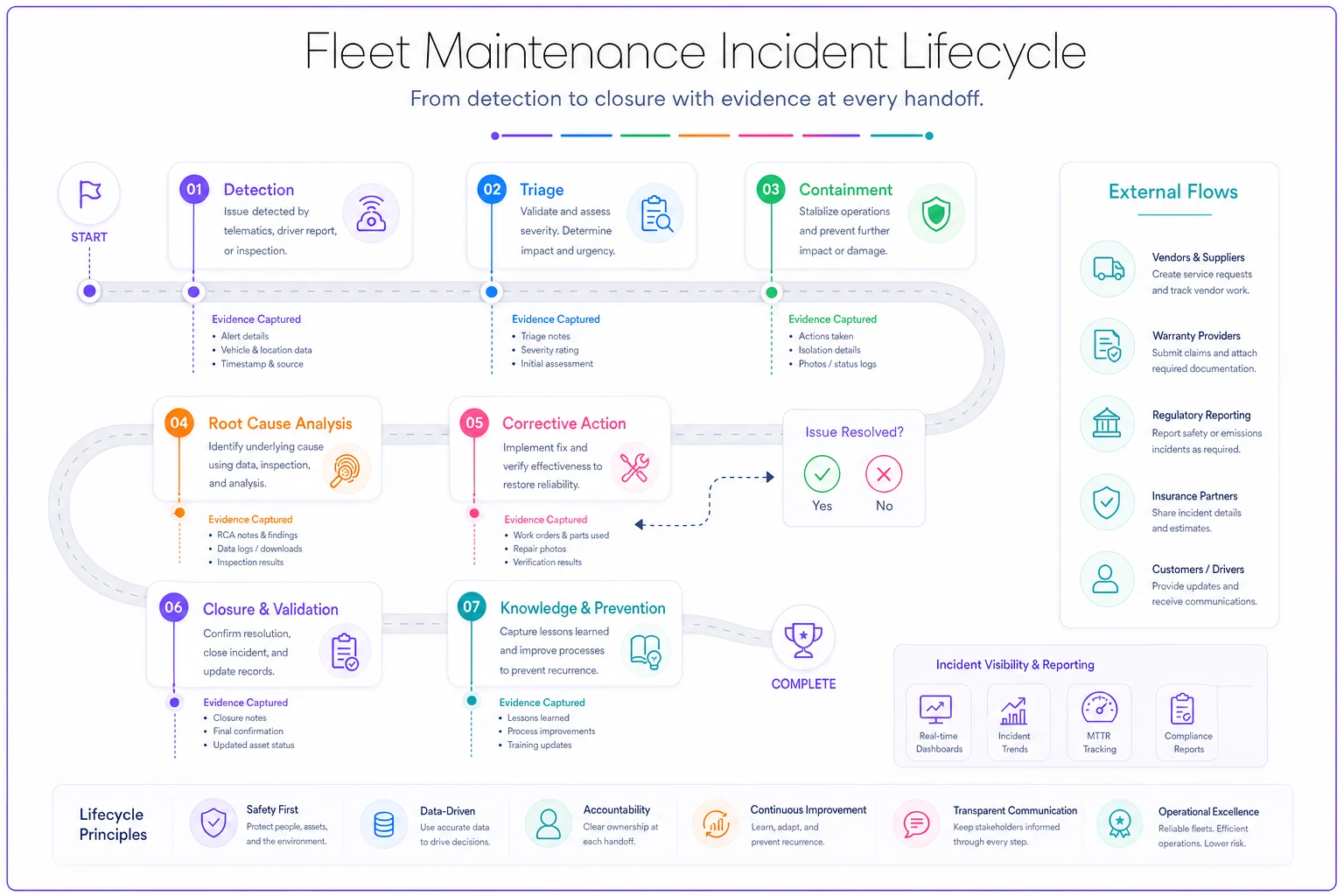
This illustrates where evidence should be captured during each handoff so timelines stay intact.
A useful rule: evidence should be a byproduct of doing the work, not a separate task you do later. If capturing it is a second step, it won't happen consistently once things get busy.
What evidence to capture at each stage
"Document everything" is useless advice. You need to know the specific artifact that proves each state transition happened.
| Lifecycle stage | Evidence artifact | Common failure |
|---|---|---|
| Detection | Timestamped source record (driver DVIR, telematics event ID, inspection form) | Verbal report with no time or reporter logged |
| Triage | Decision record: severity + who decided + criteria used | No paper trail on why it was called non-urgent |
| Containment | Out-of-service tag, quarantine log, photo of tag on vehicle | Vehicle "grounded" but still shows active in dispatch |
| Root cause | RCA findings tied to the incident ID | RCA done informally, never linked to the incident |
| Corrective action | Work order + parts used + tech sign-off | Work order exists but not linked to the incident |
| Recall/warranty | VIN-level recall check result, claim number, submission date | Recall check skipped; warranty window missed |
| Insurer handoff | Notification timestamp, adjuster contact, evidence package sent | Insurer looped in late, weakening the claim |
| Closure | Verification of fix + reviewer sign-off | Closed without confirming the repair held |
The single highest-leverage column is the middle one. If every incident carries a stable incident ID and every downstream artifact references that ID, your audit problem is basically solved. The reconstruction nightmare only exists because the work order, the warranty claim, and the insurer email have no shared key.
Make the incident ID mandatory on all downstream forms so nothing can be filed without it.
For the root-cause stage specifically, it's worth being disciplined about linking the analysis back to the incident record rather than letting it float as a separate document. If you've already built a structured fleet RCA process with evidence templates and escalation triggers, the compliance framework should reuse that output directly — don't make techs document the same root cause twice in two different formats.
The recall and warranty flow — where money and compliance overlap
Recall and warranty handling is where compliance and cost recovery collide, and both tend to get dropped.
A recall check is a compliance obligation — you're not supposed to keep running a vehicle with an open safety recall on a covered component. But it's also a financial one, because a repair you paid for out of pocket might have been covered under warranty or a recall campaign if someone had checked first.
In real operations, the shop just fixes the problem to get the truck back on the road. Nobody runs the VIN against open recalls, nobody checks whether the failed component is still in its warranty window. The fix is fast, the truck's back, everyone moves on — and the fleet eats a repair cost that a supplier should have covered, while also leaving an open recall unaddressed.
A typical example: a mid-size regional fleet running about 140 trucks was replacing a specific failed sensor at roughly $400–$600 a pop, several times a quarter. When they finally cross-referenced the VINs, a chunk of those failures fell under an active manufacturer campaign. They'd been paying out of pocket for something covered — probably $8k–$12k over the course of a year, plus the compliance exposure of running vehicles with an open recall on the books.
The fix isn't complicated, but it has to be a mandatory gate in the flow:
-
Before any repair is authorized on a covered system, the VIN gets checked against open recalls and the part's warranty status.
-
The result of that check — even if it's "no recall, out of warranty" — gets logged against the incident ID.
-
If it is covered, the warranty claim number becomes part of the evidence chain.
That "even if it's negative, log it" habit matters more than it sounds. A logged "we checked, nothing applied" is itself audit evidence. A missing check is indistinguishable from negligence when someone reviews it later.
This also feeds directly into cost recovery. The same discipline that keeps you compliant is what lets you claw back warranty dollars — which ties into how you structure rolling forecasts, reserve triggers and repair-vs-replace rules. Recovered warranty costs shouldn't quietly disappear into the general maintenance budget.
The insurer handoff — timing is the whole game
The insurer handoff has one dominant failure mode: it happens too late.
Adjusters build their assessment on the evidence available when they get involved. If you notify them promptly with a clean evidence package — timestamped photos, the incident timeline, the containment record — you're negotiating from documented fact. If you loop them in three weeks later after the vehicle's been repaired and the scene evidence is gone, you're negotiating from memory, and memory always loses.
The pattern that hurts fleets: the incident feels minor at first, so nobody notifies the insurer. Then it turns out the other party is filing a claim, or an injury surfaces later, and now you're assembling evidence for something that happened weeks ago with none of the contemporaneous documentation an adjuster wants.
A better approach is to make notification part of triage, not part of closure. During triage, one of the decisions is explicitly: does this cross the insurer-notification threshold? If it might, you notify early and provide the evidence package built from the artifacts you're already capturing. You're not doing extra work — you're routing what you already have to one more destination.
-
The incident ID and full timeline with timestamps
-
Photos from the scene and of the damage
-
The driver's statement and any witness information
-
The containment record (proving the vehicle was pulled if it should have been)
-
Any telematics data from the event window
-
The corrective action record once the repair is complete
If all of that already references a single incident ID, assembling the package is a filter operation, not a scavenger hunt.
The quarterly risk review — turning incidents into prevention
Everything above is reactive — handling individual incidents well. The quarterly risk review is where you turn that pile of incidents into something that actually reduces future risk. Without it, you handle a hundred incidents correctly and never notice that thirty of them share the same root cause.
The review isn't a meeting where everyone reads reports out loud. It's a pattern-hunting session. You're looking at the quarter's incidents to answer a few specific questions:
-
Which failure modes are recurring, not isolated?
-
Which vehicles, routes, or vehicle types are overrepresented?
-
Where did the process itself break — evidence gaps, missed recall checks, late insurer notifications?
-
Which corrective actions did not hold?
-
Are we handling more incidents, or the same number better?
A quarterly cadence works because monthly is too noisy to see patterns and annual is too slow to react. For fast-growing fleets or ones coming off a rough safety quarter, a lighter monthly version can make sense until things stabilize.
The output should be concrete: a short list of systemic corrective actions with owners and dates, and updates to the process itself. If recall checks got skipped four times in a quarter, the fix is a workflow change, not a reminder email everyone forgets in two weeks.
When a heavier framework makes sense — and when it doesn't
When this level of structure is worth it:
-
You're past roughly 50–60 vehicles, or you run more than one location.
-
You operate in a regulated context (DOT-regulated commercial fleets, transporting hazardous materials, passenger transport).
-
You've had a claim go badly because of missing documentation.
-
Your insurance premiums are climbing and you have no evidence to argue your safety record is improving.
When it's premature:
-
A 15-vehicle single-location fleet where one person genuinely has full visibility. Build the habits — incident IDs, evidence at each stage — but don't drown a small operation in review cadences it doesn't need yet.
Who should not do this: anyone treating it as a documentation exercise divorced from operations. If the compliance system is a separate binder that lives apart from how work actually gets done, it will always be out of date and will fail you exactly when you need it. The whole point is that evidence falls out of normal work, not that someone maintains a parallel paper universe.
A short real scenario
A regional delivery fleet running about 110 vehicles across two depots was pushing incidents through informal channels — radio calls, texts, and one shared spreadsheet that was perpetually behind. When a minor collision turned into a contested liability claim, they spent close to two weeks reconstructing the timeline and still couldn't produce timestamped proof of when the vehicle had last been inspected.
They rebuilt around one principle: every incident gets an ID at detection, and every downstream artifact — work order, recall check, insurer notice — references it. Nothing fancy in the tooling, just discipline about the shared key and capturing evidence at each transition rather than at the end.
By the next audit cycle, pulling a full incident timeline went from a multi-day reconstruction to a same-day export. On the next liability claim, they handed the adjuster a complete, timestamped package within 48 hours. The claim settled faster and, by their estimate, meaningfully lower than the previous one. No dramatic revenue story — just the difference between having your evidence and hunting for it.
Where software quietly earns its place
You can run this entire framework on spreadsheets and discipline, and plenty of smaller fleets do. The thing that breaks first as you scale isn't the templates — it's keeping the incident ID consistent across the four or five systems where the work actually happens. That's the manual, error-prone glue.
This is the narrow spot where AI-assisted operational platforms genuinely help: automatically stamping each incident with an ID, linking the work order and warranty check and insurer package back to it, flagging when a recall check was skipped or an insurer-notification threshold was crossed without action, and surfacing recurring patterns for your quarterly review so you're not manually sifting through months of records. The value isn't the software doing compliance for you — it's removing the coordination overhead that causes evidence to leak between handoffs.
The framework comes first. Tooling just keeps it from decaying as the fleet grows and the informal memory that used to hold everything together stops being enough.
The takeaway
A fleet safety compliance framework isn't a binder or a policy document. It's the connective tissue that turns messy real-world incidents into evidence that holds up — to an auditor, an adjuster, or a regulator. The fleets that do this well aren't the ones with the most paperwork. They're the ones where every incident carries a thread from detection through closure, where evidence gets captured as a byproduct of the work, and where a quarterly review turns individual incidents into fewer incidents next quarter.
Start with the incident ID and evidence-at-each-transition habit. Everything else — recall gates, insurer timing, the review cadence — hangs off that foundation. Get it right at 50 vehicles and it'll still be holding when you're at 500.
A fleet safety compliance framework isn't a binder or a policy document. It's the connective tissue that turns messy real-world incidents into evidence that holds up — to an auditor, an adjuster, or a regulator. The fleets that do this well aren't the ones with the most paperwork. They're the ones where every incident carries a thread from detection through closure, where evidence gets captured as a byproduct of the work, and where a quarterly review turns individual incidents into fewer incidents next quarter.
Start with the incident ID and evidence-at-each-transition habit. Everything else — recall gates, insurer timing, the review cadence — hangs off that foundation. Get it right at 50 vehicles and it'll still be holding when you're at 500.
Ready to maximize fleet uptime and reduce maintenance costs?
Join 2,000+ fleet managers using Fleetelyly to streamline maintenance workflows and improve vehicle reliability.