


Most denied warranty claims don't fall apart because the failure wasn't covered. They fall apart because nobody can prove what failed, when it failed, or which unit it came off of. The part gets swapped, the truck goes back into service, and three weeks later the OEM asks for a photo of the fracture surface and a fluid sample that no longer exists.
By then you're arguing from memory. And memory loses.
If you've already built out your warranty recovery process and evidence packages, this is the layer underneath it — the shop-floor SOP that decides whether those packages ever contain anything usable. A failure evidence capture SOP for fleet operations isn't a form. It's a set of hard rules about what gets photographed, labeled, exported, and time-stamped before the old part leaves the bay.
Below is where this actually breaks, and how to build capture rules that survive an OEM adjuster's review.
The moment evidence disappears
Here's the sequence that kills claims, and it plays out the same way across shops:
A tech pulls a failed water pump on a Class 8 truck. The truck is needed back by 2 PM. He grabs one blurry photo on his personal phone, tosses the pump in the core bin, and closes the work order. The fluid that came out — coolant with a suspicious brown tint — goes down the floor drain. Nobody logged the coolant contamination that would have proven the pump failure was secondary to a head gasket issue the OEM should cover.
Two weeks later, the warranty coordinator opens the claim and finds:
-
One photo, wrong angle, no scale reference
-
No serial number capture from the failed part
-
No fluid sample
-
A work order that says "replaced water pump — leaking"
That claim is dead. Not because the failure wasn't warrantable, but because there's nothing to submit.
The pattern here isn't laziness. It's that nobody defined the capture requirements at the moment of removal, and the moment of removal is the only time the evidence exists. Once the part is in the core bin and the fluid is gone, you can't reconstruct it.
Why metadata is the part everyone forgets
Photos without metadata are surprisingly weak evidence. An adjuster looking at a cracked bracket wants to know: when was this taken, was it before or after removal, what unit did it come from, and can they trust the timestamp wasn't backdated.
Prevent costly breakdowns with proactive maintenance.
Fleetelyly helps you schedule, track, and manage every vehicle service efficiently.
- Automated maintenance reminders
- Real-time service tracking
- Parts inventory integration
No credit card required
A photo texted from a personal phone strips most of this. The EXIF data may be there, but it's inconsistent, the timezone may be wrong, and there's no link to the work order. What you actually need attached to every piece of evidence:
| Metadata field | Why the OEM cares | Common failure |
|---|---|---|
| Unit / VIN | Ties evidence to the covered asset | Photo has no unit reference at all |
| Work order number | Links evidence to the documented repair | Photo lives on a phone, never linked |
| Component serial/part number | Proves the failed part is the claimed part | Serial never photographed before scrapping |
| Capture timestamp (server-side) | Establishes failure timeline | Phone timestamp, wrong timezone, disputed |
| Technician ID | Chain of custody | Anonymous, no accountability |
| Mileage / hours at failure | Confirms in-warranty window | Recorded later from memory, inaccurate |
The thing most shops miss: the timestamp needs to come from something the tech can't casually edit. A phone clock is disputable. A capture logged through your maintenance system, stamped server-side the moment it's uploaded, is far harder for an adjuster to wave off. Same photo, completely different evidentiary weight.
Use your maintenance system's native photo capture so images are auto-tagged with server-side timestamps and work order links.
A phone clock is disputable. A capture logged through your maintenance system, stamped server-side the moment it's uploaded, is far harder for an adjuster to wave off. Same photo, completely different evidentiary weight.
Photo angles and resolution — be specific or techs will guess
"Take photos of the failure" is a useless instruction. Techs interpret it as one photo, whatever angle is convenient. Then the claim needs a shot of the fracture surface and you don't have it.
Every failure type needs a defined shot list. For a cracked component, that means:
-
Wide context shot — the part still mounted on the unit, showing location and surroundings
-
The failure itself — close, in focus, with the crack or wear clearly visible
-
A scale reference — a ruler or coin next to the damage so size is provable
-
The serial/part number plate — legible, readable text, not a glare-washed blur
-
The fracture or wear surface after removal — often the single most important image for a metallurgical failure
Resolution matters more than people think. A photo that looks fine on a phone screen turns to mush when the adjuster zooms into the crack. Set a minimum — most modern phone cameras clear it easily, but the SOP should require the original file, not a compressed version pasted into a text thread. Compression from messaging apps has killed more usable evidence than bad camera hardware ever did.
One pattern worth flagging: shots of the serial plate get skipped constantly because the tech "already knows what part it is." But the OEM doesn't know. If you can't produce the serial number of the exact part that failed, you often can't prove it was theirs versus a previously replaced aftermarket part. That single missing photo voids more claims than any other gap.
Diagnostic exports — capture the logs before you clear the codes
For anything with a control module — engines, transmissions, aftertreatment, ABS — the diagnostic log is often the strongest evidence you have. Freeze-frame data, fault code history, and parameter snapshots at the moment of failure tell a story a photo can't.
The problem: techs clear codes as part of the repair, and the pre-repair diagnostic state vanishes. Once you've cleared the DTCs and completed the fix, that snapshot is gone unless someone exported it first.
Your SOP needs a hard rule: export the full diagnostic report before clearing any codes or starting the repair. Not a screenshot of the scan tool screen — the actual exported report file. Save it, attach it to the work order, then proceed.
This connects directly to how you triage in the first place. If you've built out decision trees that map fault codes to work orders, the diagnostic export is the artifact that proves the fault existed when the truck came in — which is exactly what a warranty adjuster wants to see. The triage tells you what to do; the export proves you were right to do it.
A quick note on aftertreatment and emissions components specifically: these have some of the most valuable — and most frequently denied — warranty claims. The OEM will scrutinize the fault history hard. If your regen counts, DPF differential pressure, and fault progression aren't exported before the repair, you're submitting a claim with no supporting data on a component the manufacturer really doesn't want to pay for.
Fluid samples — the evidence that's gone in five seconds
Fluid samples are the most perishable evidence in the shop and the most routinely destroyed. Contaminated coolant, metal-laden oil, milky transmission fluid — these prove root cause in ways nothing else can. And they go down the drain in seconds.
The SOP rule is simple but has to be enforced: for any failure where fluid condition could be relevant, pull and label a sample before draining anything.
Labeling is where this falls apart. A sample bottle with "coolant" scrawled on masking tape is nearly worthless a month later. A proper sample label needs:
-
Unit / VIN
-
Work order number
-
Fluid type and system it came from
-
Date and time pulled
-
Technician who pulled it
-
A note on visible condition (color, contamination, smell)
The pattern worth flagging: sample bottles get pulled but never linked back to the work order in the system. So three weeks later you have a shelf of unlabeled bottles and no idea which claim each belongs to. The label and the work order have to reference each other, or the sample might as well not exist.
Store samples somewhere with a retention window that matches your claim timelines — if OEM claims can take six to eight weeks to process, keep samples at least that long before disposal.
Linking evidence to work orders — where automation actually earns its keep
This is the part that quietly determines whether any of the above works: getting all this evidence attached to the right work order without relying on a tech to manually match files later.
In real operations, the failure looks like this. The tech captures decent photos, exports the diagnostic report, pulls a fluid sample — genuinely does the work right. But the photos sit in a phone gallery, the export sits in a scan-tool app, and the sample sits on a shelf. Nothing is connected. When the warranty coordinator goes looking, they're doing digital archaeology across three systems and a physical shelf.
Everyone captured evidence; nobody linked it. That's the mundane operational failure that undoes good technique.
Where AI-assisted maintenance platforms help here is unglamorous but real:
-
Auto-tagging uploads to the open work order. When a tech captures a photo through the work order in the system, it's already linked to the unit, the WO, and the timestamp — no manual matching later.
-
Flagging missing evidence before a work order can close. If the SOP requires four photos and a serial shot for a "component replacement" job and only two photos are attached, the system holds the closure and prompts for the rest. This is the single biggest fix, because it moves enforcement to the moment of capture instead of the moment of claim.
-
Server-side timestamps on every upload, so the failure timeline isn't dependent on a phone clock. - Pulling diagnostic exports into the record automatically where the scan tool integrates, so the pre-repair snapshot is captured without a tech remembering to save a file.
Visualizing the capture-and-link workflow can make the enforcement step clearer.
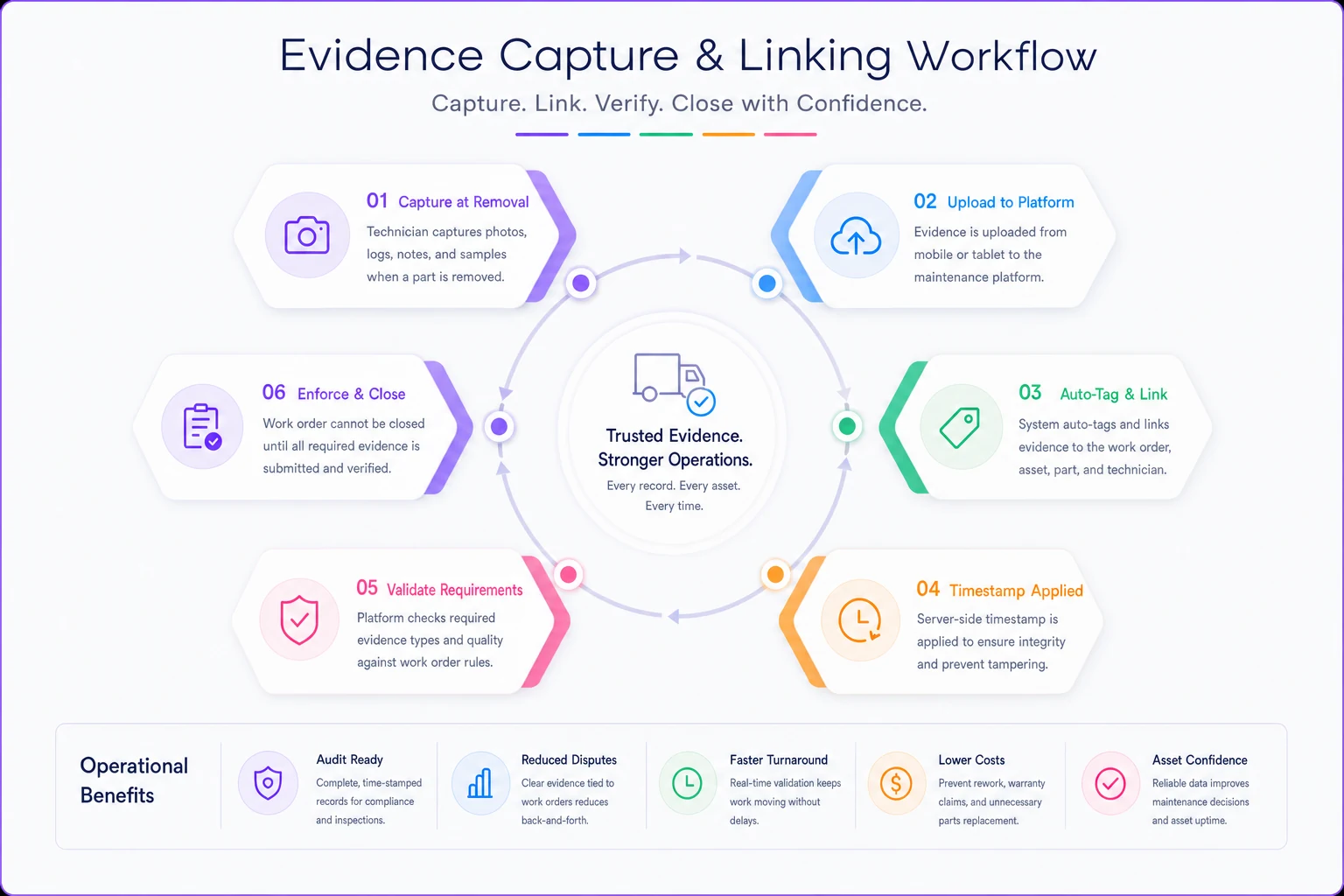
The point isn't the technology for its own sake. It's that evidence capture fails at the linking and enforcement step far more than the capture step, and that's exactly the part humans are bad at remembering under time pressure and a machine is good at enforcing.
When strict evidence SOPs make sense — and when they don't
Not every repair needs the full protocol. If you demand a five-photo shot list and a fluid sample for every wiper blade and light bulb, techs will start ignoring the SOP entirely — and then it fails when you actually need it.
Apply the full capture SOP when:
-
The failed component is under OEM or supplier warranty
-
The repair cost is meaningful enough that a denied claim actually hurts
-
The failure could be part of a recurring pattern you're tracking
-
There's any chance of a secondary or root-cause dispute (fluid contamination, related component failure)
Keep it light when:
-
The part is out of warranty and there's no recovery to pursue
-
It's routine consumable replacement with no claim potential
-
The cost is trivial enough that documentation time exceeds any possible recovery
The teams that get this right tier their SOP by claim value. High-value warrantable failures get the full treatment; routine work gets a lightweight version. Trying to enforce maximum rigor everywhere is how you get zero rigor anywhere.
A short real scenario
A regional fleet running around 90 mixed-duty trucks was recovering far less in warranty than they should have. Their coordinator estimated they were successfully submitting maybe half the claims they were eligible for, and losing a good chunk of those to insufficient documentation.
The core issue wasn't skill — the techs were competent. It was that capture was ad hoc. Photos on personal phones, codes cleared before export, coolant down the drain.
They rolled out a tiered evidence SOP: full protocol for warrantable failures above a set cost threshold, enforced at work-order closure through their maintenance system. Required photos, serial plate shot, diagnostic export before code-clear, and a labeled fluid sample where relevant — all auto-linked to the work order.
Over the following few quarters, their claim approval rate on submitted warranty items climbed noticeably, and — maybe more importantly — the coordinator stopped spending hours chasing evidence that didn't exist. The recovered dollars weren't dramatic month to month, but across a year it added up to real money that had previously just been leaking out through denied and un-submitted claims.
What made it stick wasn't the SOP document. It was that the system wouldn't let a qualifying work order close without the evidence attached. The rule enforced itself.
The takeaway for your shop
Evidence capture is won or lost in the ninety seconds between removing the failed part and putting it in the core bin. That's the entire window. Everything your warranty coordinator does downstream depends on what happened — or didn't — in that moment.
Build the SOP so the requirements are specific (exact shot lists, mandatory serial photos, export-before-clear), the metadata is trustworthy (server-side timestamps, work-order linking), and the enforcement lives at the point of capture rather than the point of claim. Get those three things right and the perishable evidence — the fluid, the fault snapshot, the fracture surface — actually survives long enough to get you paid.
Evidence capture is won or lost in the ninety seconds between removing the failed part and putting it in the core bin. That's the entire window. Everything your warranty coordinator does downstream depends on what happened — or didn't — in that moment.
Build the SOP so the requirements are specific (exact shot lists, mandatory serial photos, export-before-clear), the metadata is trustworthy (server-side timestamps, work-order linking), and the enforcement lives at the point of capture rather than the point of claim. Get those three things right and the perishable evidence — the fluid, the fault snapshot, the fracture surface — actually survives long enough to get you paid.
Ready to maximize fleet uptime and reduce maintenance costs?
Join 2,000+ fleet managers using Fleetelyly to streamline maintenance workflows and improve vehicle reliability.